Newsroom
US and UK Launch Joint Alliance Against Crypto Scam Centers
4 September, 2026 / News / AI / Tags: scam, crime, fraud, workers, pirro
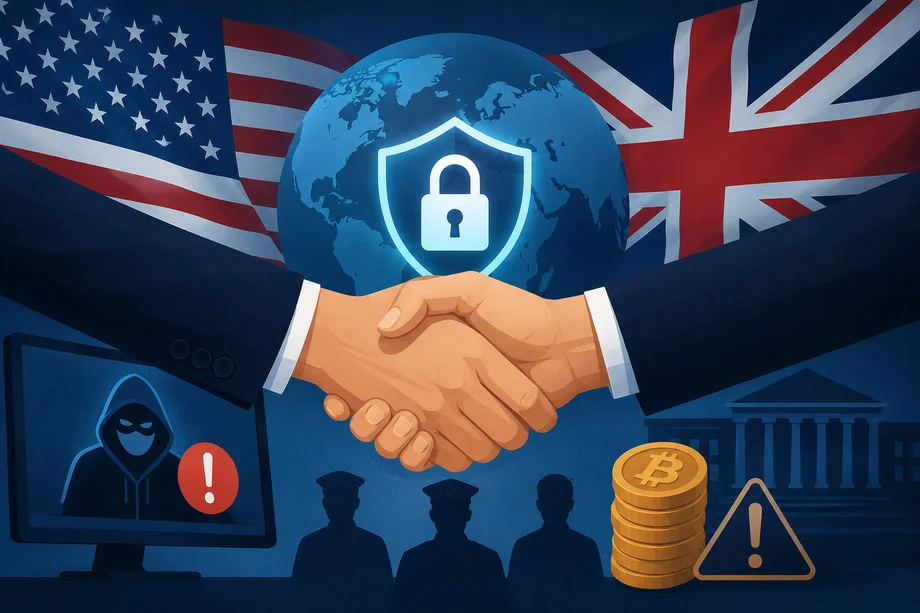
American and British authorities signed a memorandum of understanding to coordinate investigations into scam centers driving cryptocurrency and cyber-enabled investment fraud, with a planned disruption operation in London next month
The United States and the United Kingdom have established a formal law-enforcement partnership to dismantle organized scam centers responsible for large-scale cryptocurrency investment fraud and related cyber-enabled schemes. On Thursday, the U.S. Department of Justice announced that the U.S. Attorney’s Office for the District of Columbia, the Crown Prosecution Service for England and Wales, and the UK’s National Crime Agency had signed a memorandum of understanding. Officials described the pact as a first-of-its-kind international cooperation agreement focused on disabling these operations.
Under the agreement, the agencies will pursue parallel investigations into shared targets, exchange intelligence on organized crime networks, and coordinate decisions on which jurisdiction should lead prosecutions in overlapping cases. Authorities reported that several common cases have already been identified. The partners plan an in-person disruption operation with private-sector participants in London in early October, hosted by the National Crime Agency.
Rising Scale of Reported Losses
The announcement arrives amid a sharp increase in reported victim losses. Data from the FBI’s Internet Crime Complaint Center, cited by the Department of Justice, show losses tied to crypto investment fraud rose 89 percent to $8.65 billion in 2025 from $4.57 billion in 2023. Cyber-enabled fraud accounted for the large majority of total losses reported to the center. Officials noted that these figures, based primarily on victim reports, likely understate the full extent of harm because many cases go unreported. U.S. authorities have estimated annual costs from such schemes at roughly $10 billion.
Expansion of the Scam Center Strike Force
The new U.S.-UK arrangement expands the reach of the Scam Center Strike Force, launched in November 2025 by U.S. Attorney Jeanine Ferris Pirro. That initiative targets Chinese organized crime networks operating scam compounds mainly in Southeast Asia. These operations commonly involve cryptocurrency investment fraud and are frequently linked to human trafficking and money laundering.
Participating U.S. agencies include the FBI, U.S. Secret Service, Internal Revenue Service Criminal Investigation, Homeland Security Investigations, and components of the Justice Department. The force also works with the Treasury and State departments as well as private-sector partners to disrupt infrastructure and pursue recovery of victim funds. U.S. Attorney Pirro signed the memorandum alongside Crown Prosecutor Stephen Parkinson and National Crime Agency Director General Graeme Biggar at the residence of the UK ambassador to the United States.
Earlier cooperation under the Strike Force included a May enforcement effort that brought in the National Crime Agency along with agencies from Australia, Canada, New Zealand, and Thailand, plus private companies. That action disrupted more than 1.4 million social media and email accounts, led private firms to freeze more than $3.8 million in cryptocurrency linked to laundering of funds stolen from Americans, and resulted in seven arrests in Thailand along with disruption of servers and network connections.
Prior Cross-Border Enforcement Actions
International operations have already produced significant results against similar networks. On April 29, a Dubai police-led effort conducted with the FBI and China’s Ministry of Public Security led to 276 arrests and the closure of at least nine crypto scam centers. Six individuals faced charges related to schemes that used fake cryptocurrency investment platforms to solicit deposits.
In related U.S. cases, federal prosecutors charged two Chinese nationals accused of managing a cryptocurrency investment fraud compound in Burma and attempting to establish another in Cambodia. Authorities restrained more than $700 million in cryptocurrency linked to suspected scam-related money laundering, seized 503 fake investment websites, and took down a Telegram channel with more than 6,000 followers used to recruit workers. Investigators said some job postings specifically sought people who could speak with American accents and work during U.S. daytime hours. Workers were allegedly lured with high-pay promises and then held against their will to operate the frauds. Fraudulent platforms typically displayed fabricated account balances and returns to extract additional funds. The Strike Force has seized more than $800 million since its launch, and in July the Department of Justice sought forfeiture of $25 million recovered in five investigations involving victims in the United States and Canada.
Regional Legislative Responses
Governments in regions hosting scam compounds have advanced their own measures. On May 15, Myanmar’s military government released draft legislation proposing sentences of 10 years to life imprisonment for digital currency fraud and related activities, including recruitment and financial facilitation. The draft allowed for the death penalty in cases involving coercion, violence, or death of forced workers at scam centers. Parliament approved the bill on July 28, though presidential assent and a commencement date had not been confirmed at the time of reporting.
An INTERPOL operation spanning November 2025 through June 2026 produced 58 arrests across 22 countries, including the United States and the United Kingdom, further illustrating the multi-jurisdictional nature of these networks.
Next Steps in London
The planned early-October gathering in London is expected to bring together investigators and private-sector partners to advance disruption of identified targets. Officials have framed the memorandum as a practical framework for faster information sharing and aligned prosecutions, reducing the ability of criminal groups to shift operations across borders after initial enforcement pressure.
Disclaimer
This article was generated by AI using information from multiple industry sources. It has not been reviewed or verified by a human editor and may contain inaccuracies, omissions, or misinformation. Readers are encouraged to independently verify any information before making decisions based on its content.Tired of the noise?
Let the bots trade for you.
Trade 24/7, without emotion, with data-driven strategies.
Associated articles

U.S. Authorities Seek Forfeiture of $25 Million in Crypto from Romance and Investment Scams

US Authorities Seize Over $25 Million in Crypto From Five Fraud Probes

Vietnamese National Charged in $16 Million Cryptocurrency Pig Butchering Fraud

Global Crackdown Nets 5,811 Arrests in Major Fraud and Crypto Laundering Bust

Hong Kong Records 25 Crypto Romance Scams With Nearly $9 Million in Losses
Latest articles

SpaceX and Tesla Set Up Committees to Explore Merger That Would Combine Holdings of Over 30,000 Bitcoins

UK Banks Face Thousands of Complaints Over Crypto Transfer Restrictions

Ripple Backs SEC Proposed Crypto Asset Rules After $150 Million Legal Battle

Blockchain.com Introduces Options Trading on Seven Major Crypto Assets