Newsroom
Samsung Wallet to Bring USDC Cross-Border Transfers to 82 Million Galaxy Devices
8 October, 2026 / News / AI / Tags: samsung, galaxy, usdc, wallet, ramps
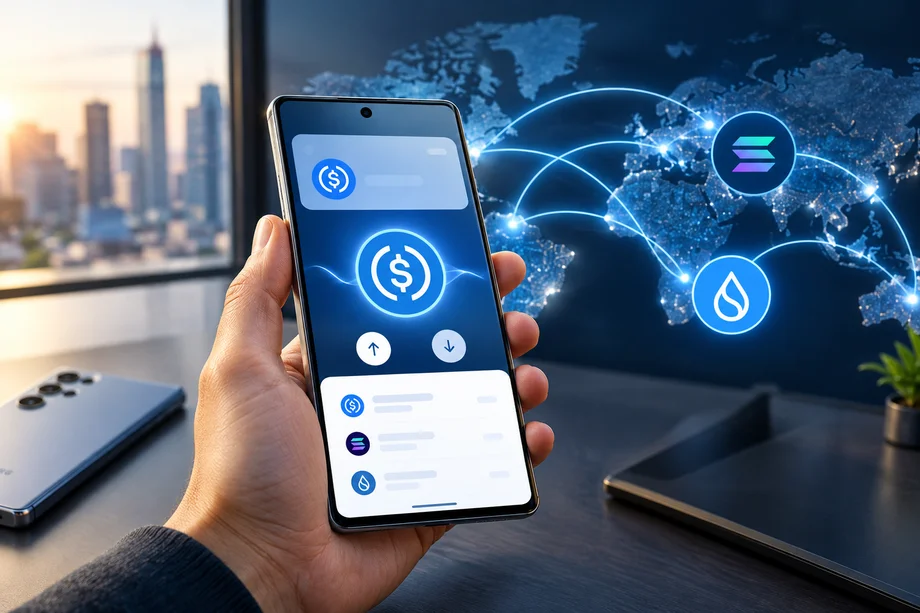
Samsung Electronics will launch USDC stablecoin transfers directly in Samsung Wallet for eligible U.S. Galaxy users starting late October, enabling seamless international money movement without separate apps or crypto complexity
Samsung Wallet Expands Into Stablecoin Transfers
Samsung Electronics is set to introduce cross-border USDC transfers in its Samsung Wallet and Samsung Pay apps for eligible Galaxy device users in the United States. The rollout begins the last week of October 2026 and covers roughly 82 million compatible devices. Users will be able to send funds to compatible external crypto wallets or eligible bank accounts overseas without leaving the familiar wallet interface they already use for cards, IDs, and boarding passes.
The service features built-in fiat on-ramps and off-ramps, so users convert between local currency and USDC at either end. Blockchain networks handle the underlying transactions in the background, delivering near-instant settlements for wallet-to-wallet sends. Samsung has not charged transfer fees for these transactions, though recipient wallets or exchanges may apply their own costs, and processing times will depend on network conditions.
This marks a significant step for mainstream adoption of stablecoins, allowing Galaxy owners to move money abroad without downloading additional apps or managing private keys. The feature also includes support for more than 60 countries, with bank recipients receiving funds directly in local currency.
Technical Infrastructure and Partnerships
Solana and Sui networks provide the blockchain infrastructure for the transfers. Gas fees on Sui are eliminated entirely, ensuring zero-cost processing for users. Coinbase Prime will act as the official sub-custodian for USDC, with Bastion offering the licensed stablecoin custody framework. USDC held in Samsung Wallet will be safeguarded through Coinbase Prime Vault under Bastion’s oversight.
These arrangements follow the establishment of a U.S. regulatory framework for stablecoins, allowing Samsung to roll out the service without creating its own token.
Access and Usability for Galaxy Users
Only eligible Galaxy owners aged 18 or older with Android 13 or higher on registered devices can access the service. Biometric authentication is required for transactions. No prior crypto account or separate wallet is needed, as the on-ramps and off-ramps are integrated directly into the existing Samsung Wallet experience.
Samsung executives emphasize that the goal is to make international transfers feel as straightforward as everyday wallet use. Woncheol Chai, executive vice president and head of Samsung’s Digital Wallet Team, stated that Galaxy users should be able to access USDC transfers “without having to navigate the complexity of traditional crypto tools.”
Prior Partnership Context and Future Plans
The announcement builds on Samsung’s earlier collaboration with Coinbase, which had already brought crypto trading and staking services to more than 75 million U.S. Galaxy users. At the July 2026 Galaxy Unpacked event in London, Samsung showcased a sample wallet screen displaying a USDC balance, though details on the chain and issuer were not confirmed at the time.
Additional features, including stablecoin payments at participating online merchants and physical stores, are under consideration but have no launch timeline. International expansion beyond the U.S. will follow local regulatory requirements in each market. Samsung has not announced plans to issue its own stablecoin through the wallet.
| Key Metric | Value |
|---|---|
| Launch Start | Last week of October 2026 |
| Eligible Devices | 82 million U.S. Galaxy devices |
| Supported Networks | Solana and Sui |
| Custody Partner | Bastion with Coinbase Prime Vault |
| Wallet Recipients | More than 60 countries |
Industry Reception
Solana Foundation President Lily Liu described the partnership as an inflection point for stablecoins, noting that they are transitioning from specialized crypto products to everyday tools for moving money. Coinbase’s head of infrastructure products, Alec Lovett, highlighted the significant distribution milestone Samsung provides for USDC.
Remittances continue to carry high fees in traditional systems, with the latest World Bank data showing an average cost of 6.36% for a $200 cross-border transfer. Samsung has not disclosed specific fees for the new feature, but the integrated approach aims to address this gap for users already familiar with the Galaxy ecosystem. The company plans to extend the service to additional markets as regulations permit.


Disclaimer
This article was generated by AI using information from multiple industry sources. It has not been reviewed or verified by a human editor and may contain inaccuracies, omissions, or misinformation. Readers are encouraged to independently verify any information before making decisions based on its content.Tired of the noise?
Let the bots trade for you.
Trade 24/7, without emotion, with data-driven strategies.
Associated articles

Samsung Wallet to Add Stablecoin Support in Major Digital Payments Expansion
Toss Bank Partners with Solana for Stablecoin Remittance Pilot
OKX Rolls Out Stablecoin Savings and Payments App Aimed at Emerging Markets
World Rolls Out Self-Custodial World Money Super App Across 150+ Countries
Changer+ Debuts Self-Custodial Wallet Focused on Stablecoin Simplicity
Latest articles
Ripple Prime Enters Leveraged ETF Financing, Targeting $3T Annual Clearing Volume

Standard Chartered Expands Digital Asset Custody to Singapore

Sui Achieves 40.6 Million TPS Record in AI Agent Stress Test

30-Year Treasury Yield Surges Past 5.7% Amid Bond Selloff and $39 Billion Auction