Newsroom
Putin Signs Russia’s First Comprehensive Crypto Law, Opens Regulated Trading
7 August, 2026 / News / AI / Tags: russia, qualified, law, rubles, rules
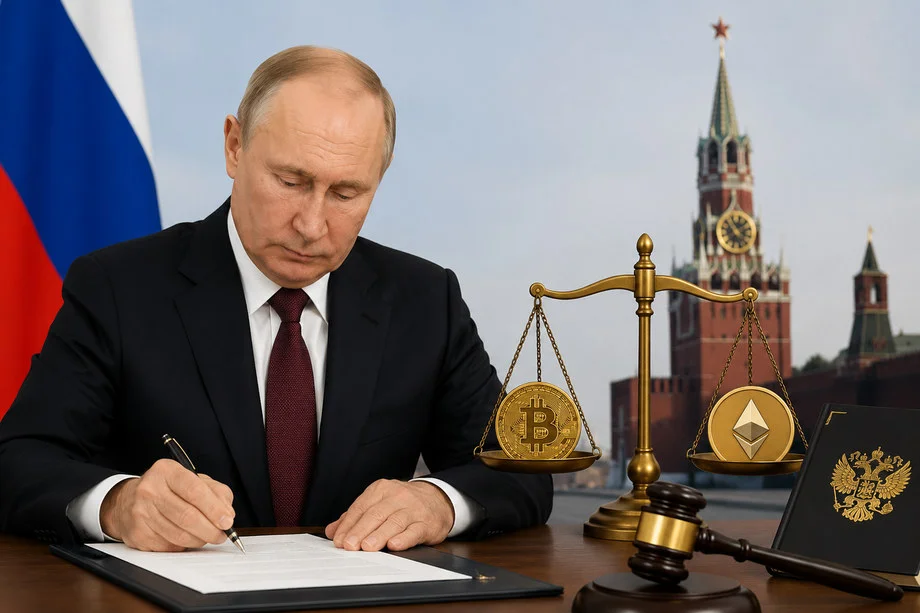
President Vladimir Putin has enacted legislation creating a formal framework for cryptocurrency exchanges and investors while keeping domestic payments banned. Main rules take effect September 1, 2026
Russian President Vladimir Putin has signed into law the country’s first comprehensive legislation governing digital currencies and digital rights. The measure, known as bill No. 1194918-8 and titled “On Digital Currencies and Digital Rights,” establishes licensing requirements, investor access rules, and oversight mechanisms for cryptocurrency activity after years of limited formal regulation.
The State Duma, Russia’s lower house of parliament, approved the bill in late July. Official records confirm the presidential signing, which shifts the country from a largely restrictive stance toward a structured, supervised market for licensed participants.
Licensing Requirements for Market Participants
The law requires cryptocurrency exchanges, brokers, custodians, and related service providers to operate under state supervision. Only firms placed on a special government registry will be authorized to run exchanges. Operators must hold at least 15 million rubles in capital, equivalent to roughly 187,000 dollars, and join a financial market self-regulatory organization.
Existing platforms receive a transition period, with full compliance required by July 1, 2027. Firms whose monthly trading volume exceeds 3.5 million rubles fall under the complete set of rules. Banks, including branches of foreign lenders, must refuse transfers they suspect are directed to unregistered providers.
The Bank of Russia will oversee the regulated market. Its responsibilities include issuing detailed rules and determining which digital assets licensed intermediaries may offer.
Retail and Qualified Investor Rules
Retail investors gain limited access to approved, highly liquid cryptocurrencies through licensed intermediaries. Purchases are capped at 300,000 rubles, approximately 3,700 dollars, per intermediary each year. Both retail and qualified investors must complete a knowledge assessment before trading.
Qualified investors face no annual purchase limit and may acquire any cryptocurrency permitted under the framework. The law also provides court protection for holders of crypto assets regardless of whether ownership was previously declared to authorities.
Domestic Payments Remain Prohibited
Despite the new trading framework, cryptocurrency cannot serve as legal tender or payment for goods and services inside Russia. The law maintains the existing ban and prohibits advertising that promotes crypto as a means of payment. This distinction separates regulated investment activity from any attempt to create a parallel currency.
Most provisions of the legislation become effective on September 1, 2026. That date coincides with the Central Bank of Russia’s timeline for financial institutions to support the digital ruble, reinforcing the national currency’s central role in the domestic monetary system.
Cross-Border Settlements Permitted
The law creates exceptions for international activity. Settlements under foreign trade contracts between Russian residents and non-residents are allowed. Transactions involving mined cryptocurrencies and payments within authorized digital asset platforms are also permitted.
These provisions offer regulated pathways for cross-border commerce at a time when traditional payment channels face external restrictions. Counterparties outside Russia remain subject to their own jurisdictions’ sanctions, anti-money-laundering rules, and other requirements.
Mining of cryptocurrency had already been legalized under earlier legislation signed in 2024. The new law fills the previous gap by addressing trading, custody, and related services.
Implementation Timeline and Oversight
Core rules begin on September 1, 2026. Additional requirements covering non-resident digital depositories take effect on July 1, 2027. Market participants must adapt operations to meet licensing, capital, and self-regulatory standards or face restrictions.
The Bank of Russia will define the list of cryptocurrencies eligible for retail trading based on liquidity criteria. Until that list is published, the precise scope of assets available to ordinary investors remains undetermined.
The legislation grants crypto holders formal legal recognition and access to supervised venues while concentrating supervisory authority with the central bank. It expands regulated investment channels and cross-border settlement options without altering the prohibition on domestic use as money.
Disclaimer
This article was generated by AI using information from multiple industry sources. It has not been reviewed or verified by a human editor and may contain inaccuracies, omissions, or misinformation. Readers are encouraged to independently verify any information before making decisions based on its content.Tired of the noise?
Let the bots trade for you.
Trade 24/7, without emotion, with data-driven strategies.
Associated articles

Russia’s New Crypto Framework Takes Effect, Opening Regulated Trading in Bitcoin, Ethereum and USDT

Russia Enacts Comprehensive Framework for Regulated Cryptocurrency Market
Russia Advances Landmark Crypto Regulation Bill Toward Final Approval

Russia's Central Bank Approves Bitcoin, Ethereum and USDT for Exchange Trading Under New Rules
Russia Registers First Crypto Exchanges and Custodians Under New Digital Asset Rules
Latest articles

SpaceX and Tesla Set Up Committees to Explore Merger That Would Combine Holdings of Over 30,000 Bitcoins
UK Banks Face Thousands of Complaints Over Crypto Transfer Restrictions

Ripple Backs SEC Proposed Crypto Asset Rules After $150 Million Legal Battle

Blockchain.com Introduces Options Trading on Seven Major Crypto Assets