Newsroom
OpenAI Launches ChatGPT Wallet Enabling AI Agents to Complete Purchases
13 November, 2026 / News / AI / Tags: openai, agents, chatgpt, card, agent
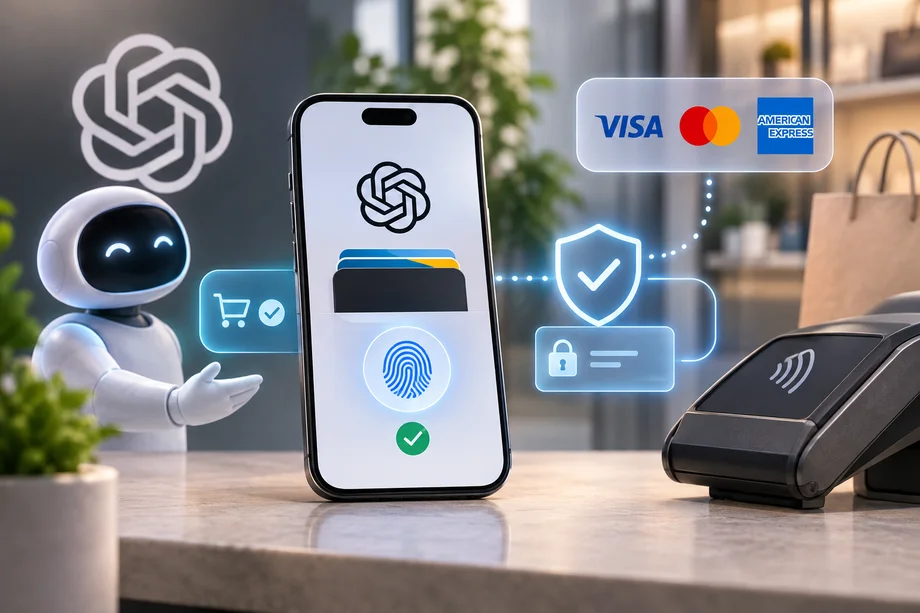
OpenAI partners with Visa, Mastercard and American Express on a U.S.-only feature that lets AI agents handle shopping while users approve every transaction via biometrics
OpenAI has introduced ChatGPT Wallet, a payment tool that allows its AI agents to complete online purchases for users without exposing actual card details. The feature launched on November 13, 2026, in partnership with American Express, Mastercard and Visa, and is initially restricted to eligible ChatGPT Pro subscribers in the United States.
Limited Rollout and Eligibility
Access is limited at launch to U.S. residents aged 18 and older who hold ChatGPT Pro subscriptions and use qualifying U.S.-issued cards from American Express, Mastercard or Visa. Users add their card information once. The system then operates through OpenAI’s personal AI agents, known as dots, which can research products, compare options and prepare orders.
At the start, the wallet functions only within certain agent conversations. OpenAI stated that ChatGPT serves 1.2 billion weekly users, many of whom already use the service to research and compare products before buying.
How Transactions Work
Before any purchase proceeds, the user reviews the selected items, the total cost including taxes and shipping, and the chosen payment card. Approval requires a biometric security check such as Face ID or a fingerprint scan. Once approved, the payment network generates a transaction-specific payment token. This token includes a temporary card number, security code and expiration date that stands in for the real credentials.
Neither the AI agent nor the merchant receives the user’s actual card details. Users retain their existing card rewards and eligible dispute protections. Merchants continue to set prices, handle delivery, manage returns and provide customer service. For recurring subscriptions, merchants may retain the tokenized credential to collect future payments under the terms the user previously accepted.
Security Measures and Merchant Controls
OpenAI requires verification for every transaction at launch and maintains a clear record of what the user authorized. The company is collaborating with fraud-prevention firms including Forter, Riskified, Sardine and Signifyd, as well as payment processors such as Adyen, Checkout.com and Stripe. It has also published guidance for businesses on allowing agent access, uploading product information and establishing profiles inside ChatGPT.
Some major merchants have chosen to block AI agents. Amazon prevents agents from completing purchases on its platform, and United Airlines has stated it will block agents from accessing its systems to book tickets. Other companies take varied approaches: Walmart permits shopping through dedicated agent profiles with spending limits, while certain financial firms restrict agents from moving customer funds.
No Transaction Fees at Launch and Future Plans
OpenAI will not take a share of transaction fees during the initial rollout. The company said its current priority is establishing safe merchant relationships and gathering real-world usage data. Over time, OpenAI expects to enable fuller delegation, allowing users to set spending limits, product categories or time periods in advance so that agents can complete approved purchases without individual confirmation for each one.
The wallet does not create separate balances or accounts. Charges are applied directly to the user’s existing payment cards. OpenAI has indicated that users must still verify details carefully because artificial intelligence systems can make errors.
The launch forms part of a broader industry move toward agent-driven commerce. Payment networks and technology firms continue developing tools that let software agents initiate and complete transactions under controlled conditions while preserving consumer oversight and existing card protections.
Disclaimer
This article was generated by AI using information from multiple industry sources. It has not been reviewed or verified by a human editor and may contain inaccuracies, omissions, or misinformation. Readers are encouraged to independently verify any information before making decisions based on its content.Tired of the noise?
Let the bots trade for you.
Trade 24/7, without emotion, with data-driven strategies.
Associated articles

MoonPay Launches PayBox Vault for Crypto Transactions in ChatGPT and Claude

Visa Teams With Mesh to Enable Crypto and Stablecoin Spending at 175 Million Merchants

Four Firms Test AI Agents for Secure Crypto Payments Aimed at Japanese Tourists in South Korea

Mastercard Unveils Agent Connect to Power AI-Driven Shopping for Merchants

ForumPay Launches Card and Bank Transfer Options for Merchants
Latest articles

Upbit Suspends OSMO Deposits and Withdrawals After Osmosis Network Halts Block Production

DOJ and CFTC Sue Arkansas to Halt Enforcement Against Kalshi Prediction Markets

Two 2010 Bitcoin Mining Wallets Move 100 BTC Worth $6.9 Million After 16 Years

Nvidia Board Contacts Arm CEO Rene Haas in Search for Permanent Leader