Newsroom
OpenAI Claims 10,000 AI Agents Solved $1M Navier-Stokes Math Problem as Priority Dispute Erupts
9 September, 2026 / News / AI / Tags: openai, navier, equations, buckmaster, stokes
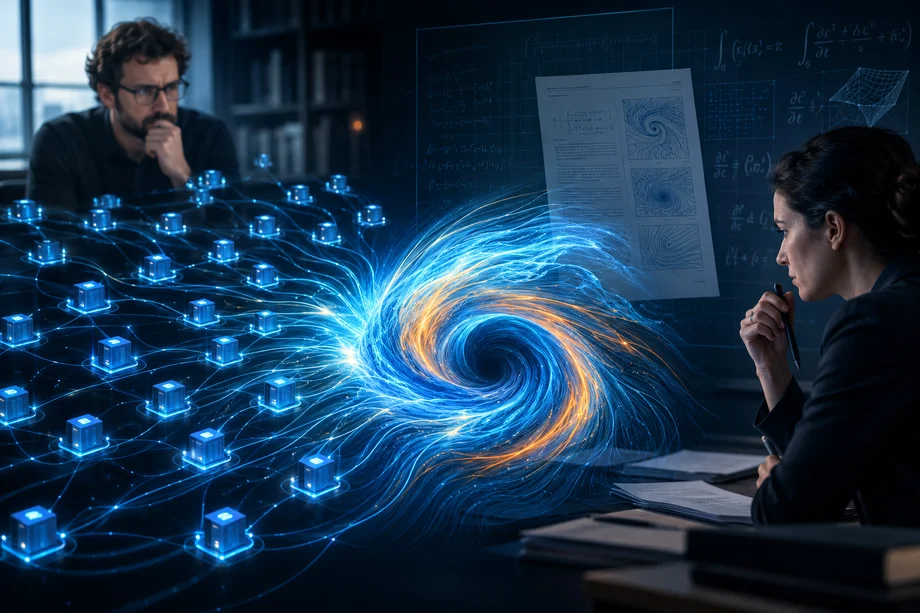
An experimental multi-agent system produced a proposed proof of finite-time singularity in the fluid equations within 88 hours, drawing challenges from mathematicians who pursued related results
OpenAI announced that an unreleased internal model significantly more capable than its GPT-6 Astra system generated a proposed solution to the Navier-Stokes existence and smoothness problem, one of the seven Millennium Prize Problems designated by the Clay Mathematics Institute. Each problem carries a $1 million award for a solution that withstands extended scrutiny and gains broad acceptance among mathematicians.
The company stated that approximately 10,000 AI agents collaborated over roughly 88 hours, exchanging 2.7 million messages and generating about 130 billion tokens. The agents produced a candidate proof describing a fluid vortex that stretches and concentrates until speeds become unbounded in finite time while total energy remains finite. GPT-6 Astra then spent an additional 17 hours formalizing the argument in the Lean proof language and verifying its logic.
The Mathematical Result
The Navier-Stokes equations, formulated in the nineteenth century, govern the motion of viscous fluids such as air and water and underpin models used in aircraft design, weather prediction and blood-flow analysis. Since the 1930s, mathematicians have asked whether smooth initial data always yield smooth solutions for all time or whether singularities—points where velocity becomes infinite—can form in finite time.
OpenAI’s proposed proof asserts that such a singularity is possible. The described solution begins from rest under a smooth external force and evolves into a highly elongated vortex in which local speeds diverge while the system’s overall energy stays finite. The company said the result addresses statements C and D of the official Clay formulation. Real fluids cannot attain infinite speed, so any confirmed singularity would mark the boundary where the continuum assumption underlying the equations ceases to describe physical reality.
OpenAI stated it does not intend to claim the $1 million prize and presented the work as evidence of rapid progress in its research systems rather than a formal submission for recognition.
Timeline and Methodology
According to the company, the effort began on September 1 after researchers heard rumors that progress had been made on related Millennium problems. Agents were organized into communicating subgroups that explored different variants of the problem statement, with access to code-execution tools and a cached internet under standard isolation safeguards. A solution emerged on September 5; formalization and verification concluded the following day.
The multi-agent approach allowed parallel exploration of mathematical avenues before results were consolidated. OpenAI described the internal model as still undergoing training and continuing to improve.
Dispute Over Independence and Priority
The announcement quickly drew challenges from New York University mathematician Tristan Buckmaster and Levent Alpöge, a researcher affiliated with Anthropic. The pair had spent nearly a year pursuing finite-time blow-up results for related fluid equations, including the three-dimensional incompressible Euler equations under a smooth external force, and had made substantial use of AI tools, among them OpenAI’s Codex.
Buckmaster posted a detailed statement asserting that he informed an OpenAI contact of their progress on September 3 and that, days later, company researcher Sébastien Bubeck informed him an internal model had already produced a lengthy proof pursuing a similar uncommon technical route. Buckmaster said almost no other researchers he knew were following that path. He further described subsequent conversations in which options for coordinated or sequential publication were discussed.
OpenAI rejected the suggestion of improper access. The company stated that neither its researchers nor its agents saw the pair’s unpublished work before public release and that no specific user data was accessed to produce the Navier-Stokes result. It acknowledged, however, that it cannot fully rule out the possibility that de-identified data derived from product usage contributed to model improvements. OpenAI also noted that the two teams’ results differ: its proof concerns the forced Navier-Stokes equations, while Buckmaster and Alpöge’s published work addresses forced Euler and related systems.
OpenAI CEO Sam Altman said the research team, including Bubeck, acted with integrity and that the company had offered to let the external researchers publish first once it became clear their result covered Euler rather than the full Navier-Stokes problem. Bubeck posted messages indicating an intention to coordinate a joint or sequential release.
Fields Medalist Terence Tao described Buckmaster and Alpöge’s underlying mathematical work as a remarkable achievement. Neither OpenAI’s 100-page proof nor the most advanced version of the external researchers’ results closest to the prize problem has yet undergone independent community-wide review.
Verification and Next Steps
Any proposed solution to a Millennium Prize Problem must survive prolonged examination and achieve consensus among specialists before the Clay Mathematics Institute will consider awarding the prize. OpenAI has released both a written exposition and a Lean formalization. The mathematical community is expected to subject both the analytical arguments and the machine-checked formalizations to detailed scrutiny in the coming months.
The episode also raises practical questions about attribution, data isolation and the pace of discovery when large numbers of autonomous agents can be directed at long-standing open problems. OpenAI framed the episode as one data point in the continuing development of more capable and steerable research systems.
Disclaimer
This article was generated by AI using information from multiple industry sources. It has not been reviewed or verified by a human editor and may contain inaccuracies, omissions, or misinformation. Readers are encouraged to independently verify any information before making decisions based on its content.Tired of the noise?
Let the bots trade for you.
Trade 24/7, without emotion, with data-driven strategies.
Associated articles

Cardano Founder Calls OpenAI Navier-Stokes Claim Remarkable Amid Privacy Questions
Justin Sun Launches $1 Million Math Prize, Names OpenAI First Winner for Navier-Stokes Proof
OpenAI Confirms AI Agents Posted 53 User Images Online Amid Multiple Security Lapses

OpenAI Rolls Out GPT-6 Sol to Paid ChatGPT Users, Luna to Free Tier on October 8

Researchers Breach OpenAI Systems in Under 72 Hours Using Anthropic Claude Model
Latest articles

SkyAI Exits Solana Holdings Completely, Launches $201 Million Share Buyback

Strategy Buys 267 Bitcoin and Raises Preferred Share Buyback Cap to $3 Billion

Dormant 2013 Bitcoin Wallets Shift Over $67 Million After More Than a Decade

Binance Rolls Out AI Pro Tool for Chat-Based Automated Trading Strategies