Newsroom
Justin Sun Launches $1 Million Math Prize, Names OpenAI First Winner for Navier-Stokes Proof
17 September, 2026 / News / AI / Tags: prize, mathematics, openai, sun, justin
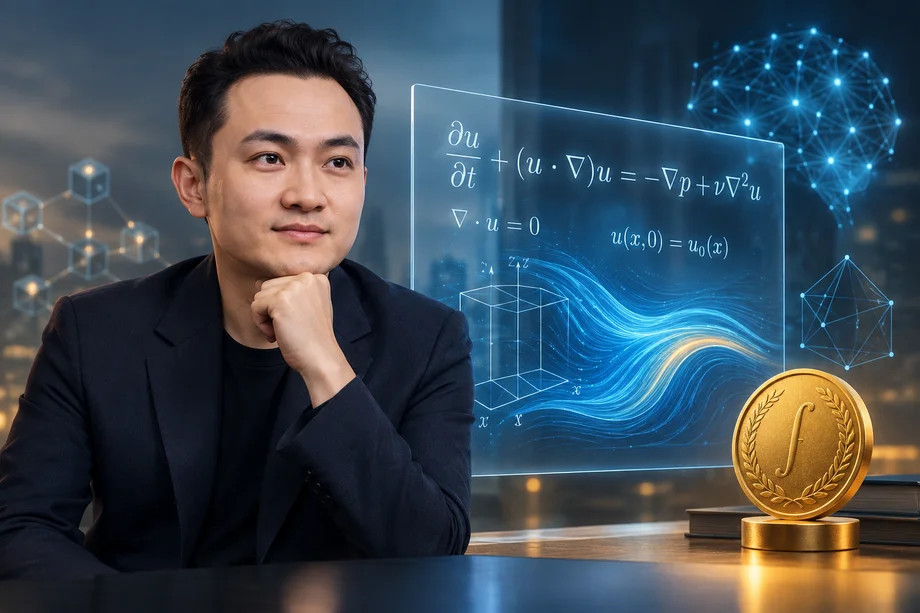
TRON founder establishes decentralized award treating human and AI solutions equally, with blockchain-tracked payouts and formal verification requirements
Justin Sun, founder of TRON, has established the Justin Sun Prize, a new mathematics award offering up to $1 million for solutions to major unsolved problems. The initiative was announced on September 16, 2026, and positions itself as an open, machine-verifiable system that makes no distinction between human and artificial intelligence contributors.
The prize operates around a public problem list maintained on GitHub. Solutions must first gain acceptance from the mathematics community. A separate formalization step then converts the proof into code that a computer can independently verify. Only after successful machine checking does payment occur. Awards are split between the prover, who delivers the initial solution, and the formalizer, who produces the verifiable code version.
First Award Goes to OpenAI Team
The inaugural $1 million top prize has been named for the OpenAI research team in connection with a claimed solution to the Existence and Smoothness of the Three-Dimensional Navier-Stokes Equations. According to details released with the prize announcement, OpenAI’s internal model generated the proof, while GPT-6 Astra handled the Lean formalization and verification.
OpenAI had published its work on the problem on September 8. The company described deploying 10,000 AI agents for 88 hours of computation, followed by an additional 17 hours of logic checking by the Astra model. The Navier-Stokes equations, which describe fluid motion, date to the 19th century. The Clay Mathematics Institute designated the existence and smoothness question one of its seven Millennium Prize Problems in 2000, each carrying a $1 million reward. That institute continues to list the problem as unsolved, and OpenAI has stated it will not claim the Clay award.
Sun’s prize list marks the same problem as solved and credits the OpenAI team, yet the $1 million remains unclaimed. A note accompanying the entry states that the OpenAI announcement does not constitute peer review and that broader acceptance by mathematicians has not been confirmed.
Structure and Transparency Rules
Prize funds reside on a blockchain, with every accepted proof and every payment recorded publicly for permanent traceability. Recipients may choose payment in USDT on the TRON network or USDC on Ethereum. Once a problem is added to the list it cannot be removed, and awarded funds do not need to be returned. The current list already includes formal verification of the Poincaré Conjecture, the Riemann Hypothesis, Goldbach’s Conjecture, and numerous unsolved problems associated with the late mathematician Paul Erdős.
Sun has stated that his role is limited to selecting the problems and setting the prize amounts. He will not participate in verifying proofs, selecting winners, or handling payments. Winners also receive a certificate and a medal inscribed with the Latin phrase “Quod probatur, solvitur,” translated as “Proved, then paid.”
Context of AI Advances in Mathematics
The launch coincides with intense discussion inside the mathematics community following OpenAI’s Navier-Stokes announcement. Some researchers have expressed concern about the rapid pace of AI progress on long-standing open problems and about the potential reluctance to share unpublished work. Questions have also been raised about whether unpublished research by academic mathematicians influenced the OpenAI result; the company has denied those claims.
Sun’s prize framework treats AI-generated and human-generated proofs as equivalent. All materials, including the problem list, confirmation standards, proofs, and verification data, are to be made publicly available. The initiative is presented as a long-term philanthropic focus for Sun, who has previously donated more than $45 million across technology, environmental, and disaster-relief causes.
The Office of Justin Sun described the prize as an attempt to support fundamental scientific research through collaboration between humans and AI, with openness, public benefit, and open-source principles as its core requirements.

Disclaimer
This article was generated by AI using information from multiple industry sources. It has not been reviewed or verified by a human editor and may contain inaccuracies, omissions, or misinformation. Readers are encouraged to independently verify any information before making decisions based on its content.Tired of the noise?
Let the bots trade for you.
Trade 24/7, without emotion, with data-driven strategies.
Associated articles

Cardano Founder Calls OpenAI Navier-Stokes Claim Remarkable Amid Privacy Questions

OpenAI Claims 10,000 AI Agents Solved $1M Navier-Stokes Math Problem as Priority Dispute Erupts
World Foundation Raises $52.5 Million in Locked WLD Token Sale Led by Pantera
Latest articles

Standard Chartered Expands Digital Asset Custody to Singapore

Sui Achieves 40.6 Million TPS Record in AI Agent Stress Test
Samsung Wallet to Bring USDC Cross-Border Transfers to 82 Million Galaxy Devices

30-Year Treasury Yield Surges Past 5.7% Amid Bond Selloff and $39 Billion Auction