Newsroom
DTCC Launches Tokenization Service Linking $114 Trillion Custody to Blockchain Networks
28 October, 2026 / News / AI / Tags: dtc, dtcc, securities, tokenization, service
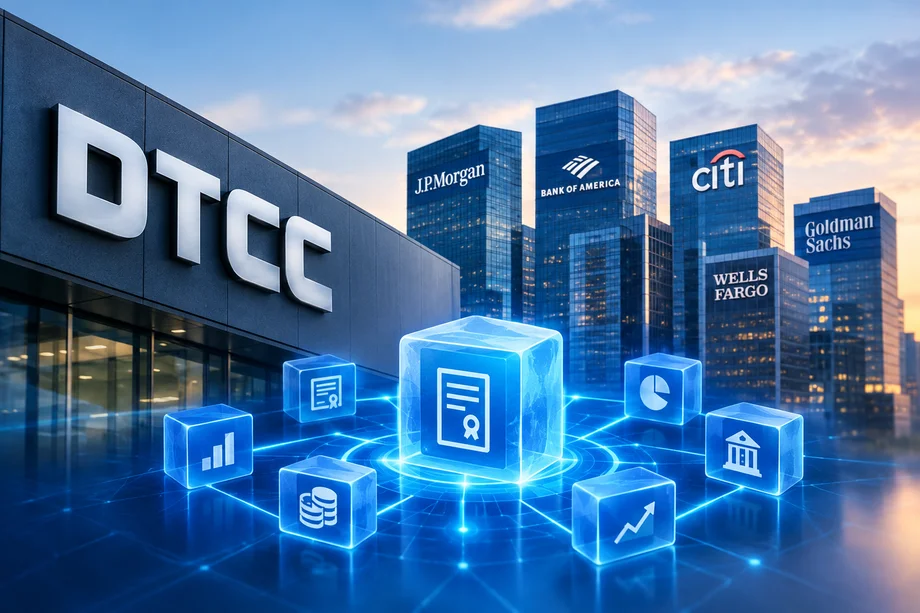
Major banks and firms gain ability to create digital representations of DTC-held securities while retaining traditional rights and protections
The Depository Trust & Clearing Corporation has moved its long-planned tokenization initiative into full production. On October 28, 2026, its subsidiary, the Depository Trust Company, activated the DTCC Tokenization Service. The platform lets eligible institutions convert conventional securities entitlements held in DTC custody into blockchain-based digital twins that can be transferred to registered wallets and later converted back to traditional form.
DTC currently holds more than $114 trillion in assets under custody. The new service does not shift that entire pool onto distributed ledgers. Instead, it creates regulated digital representations of selected holdings so institutions can use them in blockchain workflows without abandoning the ownership rights, investor protections, and economic entitlements attached to the underlying securities.
Twenty Institutions Sign On at Launch
Twenty DTC participants have already signed agreements to access the service. The group includes major global banks and market intermediaries such as J.P. Morgan, Morgan Stanley, Bank of America, Barclays, Citi, Fidelity Investments, UBS, State Street, BNP Paribas, and Citadel Securities. Other early adopters include Alpaca, Apex Clearing, Brown Brothers Harriman, Clear Street, DriveWealth, Edward Jones, Interchange Clearing, Marex, Mirae Asset Securities, and Velocity Capital.
Additional firms are expected to join on a rolling basis. The service was developed with input from more than 150 companies through DTCC’s Digital Assets Solutions Industry Working Group. Technology and market partners supporting the rollout include Fireblocks, BitGo, Ondo, Broadridge, Tradeweb, Blockdaemon, and others.
Regulatory Framework and Eligible Assets
The service operates under a no-action letter issued by the U.S. Securities and Exchange Commission staff in December 2025. That letter permits DTC to offer tokenization of specified securities for three years under defined conditions. Covered assets include eligible constituents of the Russell 1000 index, exchange-traded funds that track major indexes, and U.S. Treasury securities.
At launch the platform supports 34 securities drawn from those categories. The broader pool of assets eligible for tokenization under the SEC framework is estimated at approximately $30 trillion. Tokens are backed one-to-one by securities that remain in DTC custody and share the same CUSIP identifiers as their traditional counterparts.
Participants can convert securities between traditional and tokenized form and deliver the tokens to digital wallets registered with DTC. Transfers between registered wallets can occur around the clock. Conversion requests are processed within defined business-day windows, with the goal of completing most operations in minutes.
Network Support and Future Expansion
At launch the service connects to the Canton Network and DTCC’s private Besu blockchain. Additional network integrations are scheduled for 2027. Stellar is expected to be among the first public blockchains added, following earlier discussions between DTCC and the Stellar Development Foundation.
The multi-network design is intended to give institutions choice while avoiding fragmentation. Tokenized positions remain linked to the official books and records maintained by DTC, preserving the legal and operational framework of the traditional market.
Path from Pilot to Production
The October launch follows limited-production transactions completed in July 2026. More than 30 firms participated in those tests, using tokenized securities for collateral pledges, securities lending, U.S. Treasury repurchase agreements, equity transfers, and central-counterparty margin movements. The exercises ran on both Canton and the private Besu network.
DTCC has positioned the service as a practical bridge rather than a replacement for existing post-trade infrastructure. Potential applications include faster mobilization of collateral, improved capital efficiency, and the ability to move assets outside conventional settlement windows while remaining inside a regulated custody environment.
Brian Steele, President of Clearing & Securities Services at DTCC, stated that the industry is ready to move beyond experimentation toward practical adoption. The breadth of engagement across traditional finance and digital-asset markets, he said, demonstrates that readiness.
Further participants will be onboarded progressively, and the roster of supported securities is expected to expand over time within the boundaries set by the SEC authorization. The service keeps the underlying securities inside DTC’s established custody system, ensuring that tokenized activity remains anchored to the core of U.S. market infrastructure.
Disclaimer
This article was generated by AI using information from multiple industry sources. It has not been reviewed or verified by a human editor and may contain inaccuracies, omissions, or misinformation. Readers are encouraged to independently verify any information before making decisions based on its content.Tired of the noise?
Let the bots trade for you.
Trade 24/7, without emotion, with data-driven strategies.
Associated articles
DTCC Prepares October Launch of Tokenization Service Covering $30 Trillion in Assets

HashKey Becomes First Asian Digital Asset Firm in DTCC Tokenization Working Group

Morgan Stanley Delays Tokenized Stock Trading to First Quarter of 2027
DTCC Launches Live Tokenized Trading of Major Stocks and Treasuries

DTCC Stellar Partnership Ignites XLM Surge and Multi-Chain Tokenization Debate
Latest articles

Predict.fun Confirms $400,000 USDT Unauthorized Transfers and Full Refunds

Binance Schedules Removal of 10 Margin and 12 Spot Trading Pairs for October 30

Fed Holds Rates Steady at 3.75%-4% Amid Persistent Inflation

Crypto.com and OG.com Introduce Regulated US Crypto Perpetuals With 5x Leverage