Newsroom
Microsoft Withdraws From Nscale’s Essex AI Data Center Over Grid Delays Into 2030s
19 October, 2026 / News / AI / Tags: nscale, loughton, microsoft, essex, grid
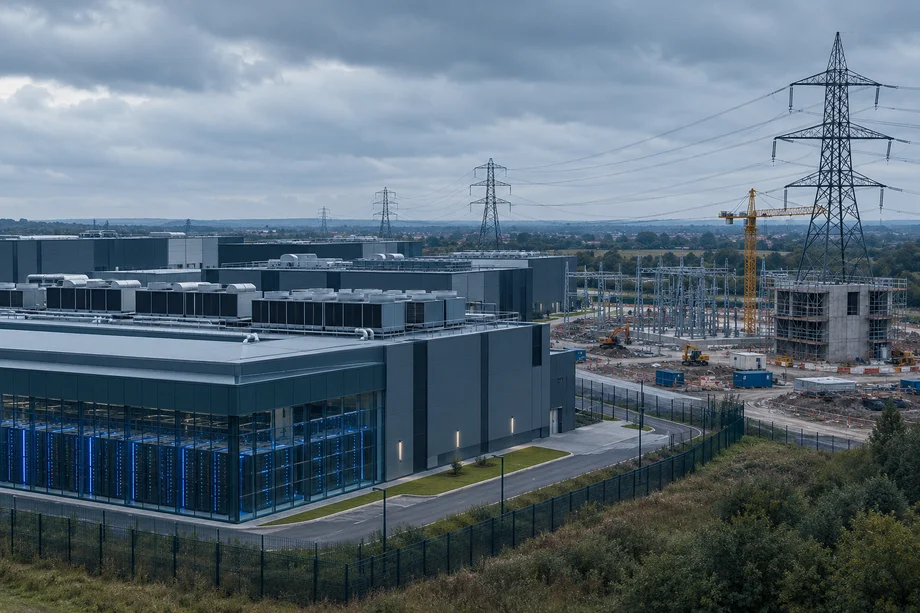
The tech giant abandons a planned UK facility meant to deliver 50 megawatts of Azure capacity with more than 23,000 Nvidia chips by early 2027, citing power connection timelines that stretch years beyond the original schedule
Microsoft has exited a major planned artificial intelligence data center project in Loughton, Essex, with Nvidia-backed Nscale after the local electricity grid operator indicated that sufficient power capacity may not become available until the early-to-mid 2030s. The facility had been scheduled to begin serving Microsoft’s Azure cloud platform in early 2027.
The Loughton campus was designed for an initial 50 megawatts of computing capacity, expandable to 90 megawatts, and was set to house 23,040 Nvidia GB300 processors. The companies announced the project in September 2025 as part of broader UK efforts to expand domestic AI infrastructure. The site had been positioned as Britain’s largest sovereign AI data center under the government’s 2025 artificial intelligence strategy.
Power Constraints Force Project Cancellation
UK Power Networks informed Nscale that the required electricity supply for the cleared Loughton site could remain unavailable for roughly another decade. That timeline left a multi-year gap between the planned chip deliveries in the first quarter of 2027 and any realistic grid connection. Microsoft confirmed the withdrawal, stating that the decision applied only to this specific location and did not affect its wider relationship with Nscale.
Nscale said it remains committed to the Essex site and is examining alternative power options, including on-site generation and faster connection pathways. An Nscale spokesperson stated that the grid issue has no impact on the company’s other contracts with Microsoft. Those agreements cover additional infrastructure projects in Europe and the United States, including a separate facility in Norway.
Without a confirmed power solution or a replacement anchor customer, the prepared Loughton site risks remaining idle for an extended period.
Nscale’s Roots in Bitcoin Mining and AI Transition
Nscale emerged from Arkon Energy, a firm that developed bitcoin mining facilities. Founder Josh Payne applied experience in securing land and electricity for mining operations to a business model focused on supplying computing capacity to AI customers. The shift mirrors a broader industry trend in which public bitcoin miners have moved into high-performance computing.
By March 2026, listed miners had announced more than $70 billion in AI and high-performance computing contracts. Many reduced their bitcoin holdings by more than 15,000 BTC from peak levels, partly through sales that funded construction. Building AI-ready facilities carries substantially higher costs than mining sites. Estimates place construction expenses for AI infrastructure at $8 million to $15 million per megawatt, compared with roughly $700,000 to $1 million per megawatt for bitcoin mining operations. AI customers also require continuous server availability.
Across the sector, contracted AI capacity has far outpaced operational revenue. One analysis tracked more than 4 gigawatts under contract among monitored miners, yet only about 550 megawatts were generating customer payments. Contract backlogs exceeded $100 billion while annualized AI revenue remained slightly above $1 billion.
IPO Ambitions and Broader Grid Challenges
The withdrawal arrives as Nscale prepares a U.S. stock market listing on the New York Stock Exchange under the proposed ticker NSCL. The company reported $140.6 million in revenue for the first half of 2026 alongside a net loss of approximately $1.02 billion. Its filings disclosed more than $103 billion in active and contracted total contract value as of August, figures that represent multiyear commitments rather than current revenue.
Reports have placed a potential IPO valuation in the range of $30 billion to $35 billion, though final pricing has not been set and some discussions have pointed to lower figures. Delivering on the large contract pipeline depends on completed facilities, installed hardware, and reliable electricity, all of which face execution risks illustrated by the Essex delay.
The episode occurs against a backdrop of significant pressure on the UK electricity network. Energy regulator Ofgem has reported that data center projects account for roughly 73 gigawatts of demand in the national connection queue, with some estimates placing the figure higher. The queue expanded sharply between late 2024 and mid-2025. Ofgem is examining stricter rules to address speculative applications that may never reach construction and that currently delay ready-to-proceed projects.
Microsoft’s decision on the Loughton site leaves Nscale without its announced customer for that campus while the company continues other collaborations and explores power alternatives. The situation illustrates the practical constraints that can arise even after major commercial commitments are secured in the rapidly expanding AI infrastructure sector.

Disclaimer
This article was generated by AI using information from multiple industry sources. It has not been reviewed or verified by a human editor and may contain inaccuracies, omissions, or misinformation. Readers are encouraged to independently verify any information before making decisions based on its content.Tired of the noise?
Let the bots trade for you.
Trade 24/7, without emotion, with data-driven strategies.
Associated articles

Hyperscale Data Halts Michigan Bitcoin Mining for AI Data Center Shift
Anthropic Secures $35 Billion Compute Pact with Nvidia-Backed Lambda at Texas Campus

Riot Platforms Shares Rise After Securing $9.1 Billion AI Compute Agreement
Galaxy Converts Helios Bitcoin Facility Into AI Data Center With 133 MW Delivery

Bitcoin Miners Turn to AI as Capital Flows Shift Away From Crypto
Latest articles

SkyAI Exits Solana Holdings Completely, Launches $201 Million Share Buyback

Strategy Buys 267 Bitcoin and Raises Preferred Share Buyback Cap to $3 Billion

Dormant 2013 Bitcoin Wallets Shift Over $67 Million After More Than a Decade

Binance Rolls Out AI Pro Tool for Chat-Based Automated Trading Strategies