Newsroom
ECB Official Positions Digital Euro as Tool for European Payments Sovereignty
25 October, 2026 / News / AI / Tags: cipollone, piero, ecb, euro, essential

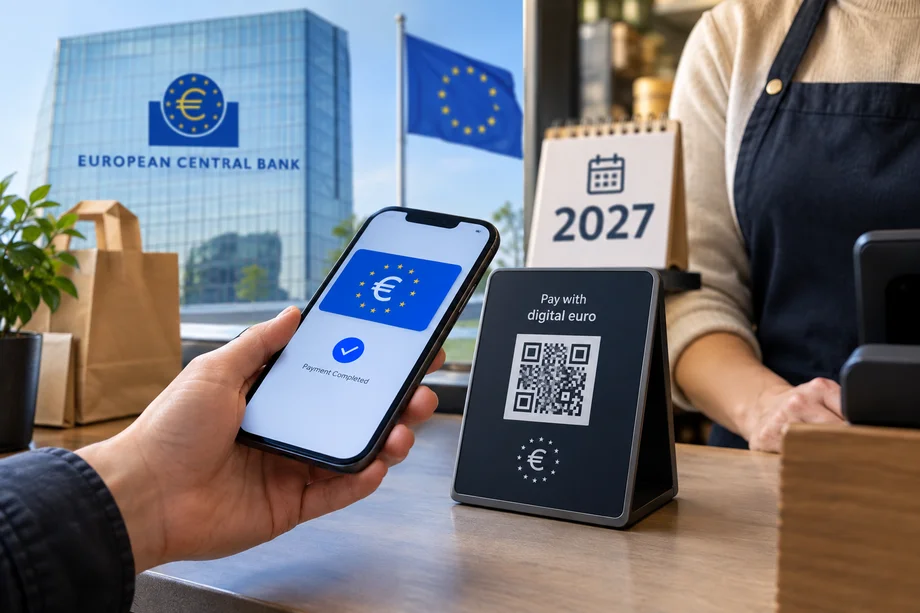
Piero Cipollone links the planned 2027 pilot to reducing reliance on non-European payment providers, with possible issuance from 2029 pending EU legislation
European Central Bank Executive Board member Piero Cipollone has described the digital euro project as a means to strengthen the euro area’s control over critical payments infrastructure. In an interview published by the central bank, he argued that dependence on external providers creates operational risks similar to those previously encountered in energy and defense.
Cipollone stated that Europe has learned it cannot rely solely on third parties for essential services. “In recent years Europe has learned that, for some essential services, we cannot rely only on third parties. We saw this with energy and we’re seeing it today with defense. And the same is true for payments,” he said.
He added that the smooth operation of payment systems forms part of the ECB’s responsibilities. Critical dependence on outside actors makes consistent performance more difficult to guarantee. Sovereignty in this context does not require excluding third-party providers. “It means having the power to choose and knowing that, for an essential service like payments, Europe can also rely on its own strength,” Cipollone explained.
Pilot Plans and Market Involvement
The ECB plans a pilot phase for 2027 that will involve real transactions carried out by staff from the ECB and national central banks. Thirty-six market operators are participating in preparations, including seven from Italy. The central bank is also inviting e-commerce and mobile-commerce operators to join the testing process.
The digital euro is conceived as electronic central bank money available for both online and offline use across the euro area, operating alongside physical banknotes and coins. It has not yet been issued. Current payment systems remain fragmented across euro-area countries, and a common public instrument could address that fragmentation.
Earlier Concerns Over Card Payments
In an April public lecture in Latvia, Cipollone noted that two-thirds of euro-area card transactions are governed by non-European companies. He presented this reliance as a strategic vulnerability that a European-controlled digital euro could help reduce by providing infrastructure under regional oversight.
The pilot is intended to move beyond simulation and test practical integration points for merchants and everyday payment flows. Results from the operational phase are expected to inform further decisions once legal conditions are met.
Legislative Path and Timeline
The ECB Governing Council cannot decide on issuing a digital euro until legislative negotiations in Brussels are completed. Cipollone expressed hope that the required regulation will be adopted by the end of 2026. Approval would enable the Governing Council to take a formal decision on issuance, with the first possible rollout as early as 2029.
Technical progress through the pilot therefore remains conditional on the outcome of the political and legal process. Market participants are tracking both the operational testing and the pace of regulatory talks in Brussels as the key factors determining the project’s next steps.
Disclaimer
This article was generated by AI using information from multiple industry sources. It has not been reviewed or verified by a human editor and may contain inaccuracies, omissions, or misinformation. Readers are encouraged to independently verify any information before making decisions based on its content.Tired of the noise?
Let the bots trade for you.
Trade 24/7, without emotion, with data-driven strategies.
Associated articles
ECB Invites Online Merchants for Digital Euro Pilot Starting 2027

ECB Survey Shows Crypto Payments Near Absent Among Euro Area Merchants

ECB Activates Pontes Platform for Tokenized Asset Settlement in Central Bank Money

Stripe Stablecoin Executive Connor Fitzgerald Departs as Bridge Expands to Over 100 Markets

Hyundai Card Completes First Stablecoin Cross-Border Payment Trial
Latest articles

Keystone Confirms Website Breach Exposing Customer Shipping Details

Hamilton ETFs Declare Monthly Distributions for Four Canadian Financial Funds

Tether Gains Backing from 15 Mining Firms for Open Automation Platform

Kraken Ends Trading on 13 Tokens, Sets January 2027 Withdrawal Deadline