Newsroom
DTCC Prepares October Launch of Tokenization Service Covering $30 Trillion in Assets
18 October, 2026 / News / AI / Tags: dtcc, securities, canton, stellar, tokenization
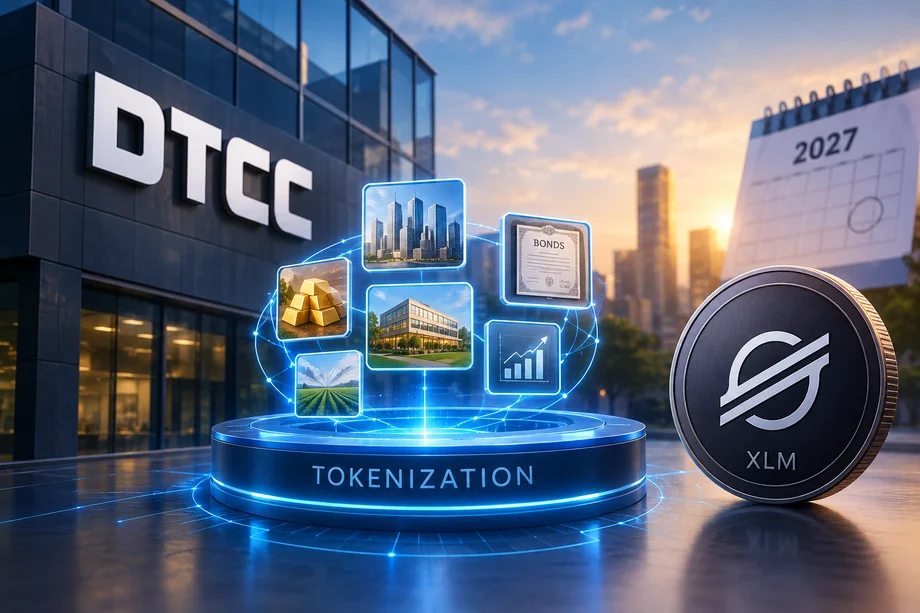
The Depository Trust & Clearing Corporation will open commercial access to its Tokenization Service later this month, starting with 25 securities on private and select networks while public chains including Stellar wait until 2027
The Depository Trust & Clearing Corporation is set to begin commercial operations of its Tokenization Service at the end of October, giving major financial institutions the ability to create digital representations of traditional securities. The service covers a pool of roughly $30 trillion in assets held at the Depository Trust Company, equivalent to about one quarter of the securities under DTC custody.
According to details released by DTCC on October 16, the initial rollout will support just 25 highly liquid instruments. These include selected U.S. Treasury securities, a limited group of exchange-traded funds, and large-capitalization stocks drawn from the Russell 1000 index. The full commercial launch follows a production exercise conducted on July 15 that involved more than 30 Wall Street firms processing real trades across multiple use cases.
Initial Networks and Operational Limits
At launch the service will operate exclusively on two networks. One is the Canton Network, which uses the CIP-56 token standard. The other is a private environment operated by DTCC on Hyperledger Besu that supports the ERC-20 standard. Institutional participants will be able to convert book-entry securities into tokens through a user interface or API. Conversion requests are restricted to East Coast business hours, running from 2:00 a.m. to 6:00 p.m. ET, and are expected to complete in 15 minutes or less.
Once issued, the tokens maintain a one-to-one linkage with the underlying securities. Each token retains its original CUSIP identifier and the same legal rights and investor protections as the conventional holding. DTCC continues to serve as the official record keeper, ensuring continuity with existing settlement and custody frameworks. Transfers between registered institutional wallets can occur around the clock on the same network.
Fireblocks is providing custody and connectivity infrastructure for several participants, including Citadel Securities. Citadel took part in the July production event, tokenizing U.S. Treasuries on the Canton Network and using them for collateral and inter-institutional transfers.
Public Blockchain Integration Deferred
Public blockchains remain outside the initial phase. Stellar is scheduled for integration no earlier than 2027, alongside Circle’s Arc network. DTCC has indicated that Stellar will employ its SEP-41 standard for asset transfers when connectivity becomes available. The original timeline for public-network access has not been accelerated.
DTCC has stated that the first wave of tokenized liquidity will circulate only among authorized banks and their clients on the approved private and permissioned networks. Broader expansion of eligible securities, support for corporate actions, and on-chain settlement of collateral using digital cash are planned for later phases once additional networks are added.
| Network | Type | Token Standard | Timing |
|---|---|---|---|
| Canton Network | Public (privacy-focused) | CIP-56 | October 2026 launch |
| Hyperledger Besu (DTCC private) | Private | ERC-20 | October 2026 launch |
| Stellar | Public | SEP-41 | 2027 |
| Circle Arc | Public | ERC-20 | 2027 |
Background and Regulatory Foundation
The commercial service builds on a December 2025 no-action letter from the U.S. Securities and Exchange Commission that authorized DTC to operate a controlled tokenization environment for assets it already custodies. The July production exercise tested collateral pledges, securities lending, Treasury repurchase agreements, equity delivery-versus-payment, and central-counterparty margin workflows on both Canton and the private Besu network.
DTCC processes more than $2 quadrillion in securities transactions annually and serves as the primary clearing and settlement utility for U.S. equities and fixed-income markets. The tokenization initiative is designed to preserve existing legal and operational safeguards while enabling faster, around-the-clock movement of securities among institutional participants.
Active trading of the newly tokenized instruments is expected to begin once the service goes live later this month. Participants in the working group, including major market makers and custodians, have been preparing systems in advance of the October 28 target date.
Disclaimer
This article was generated by AI using information from multiple industry sources. It has not been reviewed or verified by a human editor and may contain inaccuracies, omissions, or misinformation. Readers are encouraged to independently verify any information before making decisions based on its content.Tired of the noise?
Let the bots trade for you.
Trade 24/7, without emotion, with data-driven strategies.
Associated articles
DTCC Launches Live Tokenized Trading of Major Stocks and Treasuries

HashKey Becomes First Asian Digital Asset Firm in DTCC Tokenization Working Group

BlackRock BUIDL Reclaims Lead in Tokenized US Treasuries at $2.8 Billion

DTCC Stellar Partnership Ignites XLM Surge and Multi-Chain Tokenization Debate
Circle Activates Arc Mainnet With USDC Gas and Major Financial Validators
Latest articles

Thai Police Arrest Chinese Man in $75M Crypto Laundering Probe
Cysic Suspends Cross-Chain Bridge After Unauthorized 10 Million CYS Mint

Cardano Founder Builds New Programming Language with Groth16 Proofs

Yuga Labs Debuts Mudwater Trading Cards on Solana With ApeCoin Rewards