Newsroom
Character.ai Files for Chapter 11 Bankruptcy as Disney Bids $20 Million for Selected Assets
13 October, 2026 / News / AI / Tags: disney, character, court, bankruptcy, nonexclusive
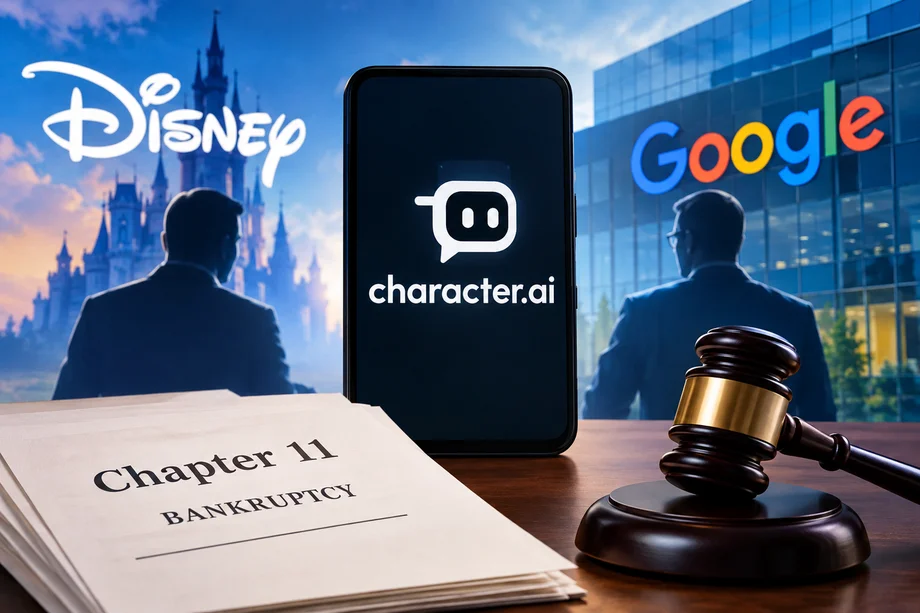
Character.ai filed for Chapter 11 bankruptcy protection in Delaware on Oct. 12, seeking a buyer through a court-supervised process while Disney has submitted an initial $20 million offer for portions of its intellectual property
Filing and Bankruptcy Process
Character.ai, the consumer-facing platform for AI-powered chatbot conversations, entered Chapter 11 proceedings in the United States District Court for the District of Delaware. The move came as the company weighed its options following five years of operation since its founding in late 2021 by former Google engineers Noam Shazeer and Daniel De Freitas.
The filing places Character Technologies, the entity that owns the platform, under court supervision. Assets and liabilities are estimated between $50 million and $100 million, according to the court documents. Paid user subscriptions remain active, with billing and data-privacy practices continuing unchanged during the process.
The service is expected to operate with minimal disruption. Users can still create and interact with AI characters, export their data or delete accounts through the website and mobile apps. The platform reached more than 20 million monthly active users by October 2024 and had accumulated billions of messages exchanged with its bots.
Disney’s $20 Million Bid and Transition Support
Disney Worldwide Services, a Walt Disney Company affiliate, has agreed to serve as the initial stalking-horse bidder by offering $20 million for selected intellectual property, including a permanent, nonexclusive license to the technology. Other interested parties may submit higher bids under court-approved auction rules, with the sale process expected to conclude between late November and early December 2026.
Disney is providing transition services, including support from former Character.ai employees it has hired. Among them is Karandeep Anand, who joined the company as chief technology officer on Oct. 2 after serving as Character.ai’s former CEO. Some technical staff previously transferred to Google alongside the founders, who returned to the tech giant in 2024 after a $2.7 billion nonexclusive licensing deal for its large-language-model technology.
The deal does not include the entire platform. If no buyer emerges to continue operations, Character.ai will wind down, ending the service as planned.
Legal Challenges and Safety Measures
The bankruptcy filing follows several lawsuits alleging that the platform contributed to self-harm or harmed minors. Kentucky filed suit in January, claiming Character.ai preyed on children. Texas launched an investigation into compliance with child-privacy laws, and additional cases involved claims that chatbots encouraged harmful behavior, including in connection with a 14-year-old Florida boy who died by suicide.
In response, the company restricted open-ended conversations for users under 18 starting in November 2025 and reached agreements in principle with Google in 2026 to settle related matters. It also began removing certain features for minors and implemented broader safety enhancements. The platform had expanded into areas such as AI video generation and interactive storytelling to drive engagement.
Business Trajectory and Challenges
Character.ai grew rapidly after launching its apps in May 2023, which saw 1.7 million installs in the first week alone. Funding exceeded $193 million across rounds led by investors including Lightspeed, Greycroft and a16z, with a unicorn valuation achieved in September 2022 following a $150 million raise.
General counsel Dominic Perella served as interim CEO during a strategic shift away from foundation-model training toward growth-focused features. The company faced pressure from escalating AI development costs, which limited cash flow, combined with regulatory and legal risks that reduced its ability to sustain operations in its current form.
Despite these hurdles, the platform maintained strong user retention, with active users spending more than two hours per day on average at peak times. The court-supervised sale is positioned as the route that best preserves stakeholder value while allowing the service to continue for the duration of the proceedings.
Disclaimer
This article was generated by AI using information from multiple industry sources. It has not been reviewed or verified by a human editor and may contain inaccuracies, omissions, or misinformation. Readers are encouraged to independently verify any information before making decisions based on its content.Tired of the noise?
Let the bots trade for you.
Trade 24/7, without emotion, with data-driven strategies.
Associated articles

Poolin, Once Bitcoin's Top Mining Pool, Files for Chapter 11 Bankruptcy
Storj Labs Files Chapter 11 to Clear Legacy Debts as Token Drops Sharply
Australia Sues Telegram Over Alleged Failure to Remove Pro-Terror Content

Movement Labs Files for Chapter 11 Bankruptcy Amid Lingering MOVE Token Fallout

Dutch Prosecutors Sell €2.2 Million in Crypto from Failed Knaken Platform
Latest articles

Bumble Agrees to $1.3 Billion Take-Private Deal with Ithaca Holdings

Interactive Brokers Launches Ethereum Staking to Boost Client Rewards on Holdings

Sberbank Receives Approval to Trade Bitcoin and Ether

S&P Dow Jones Executes First On-Chain OTC Swap Referencing Tokenized Index on Canton