Newsroom
Chainalysis Challenges ICE Sole-Source Award of $95 Million Blockchain Contract to Rival TRM Labs
31 August, 2026 / News / AI / Tags: chainalysis, trm, sextortion, court, award
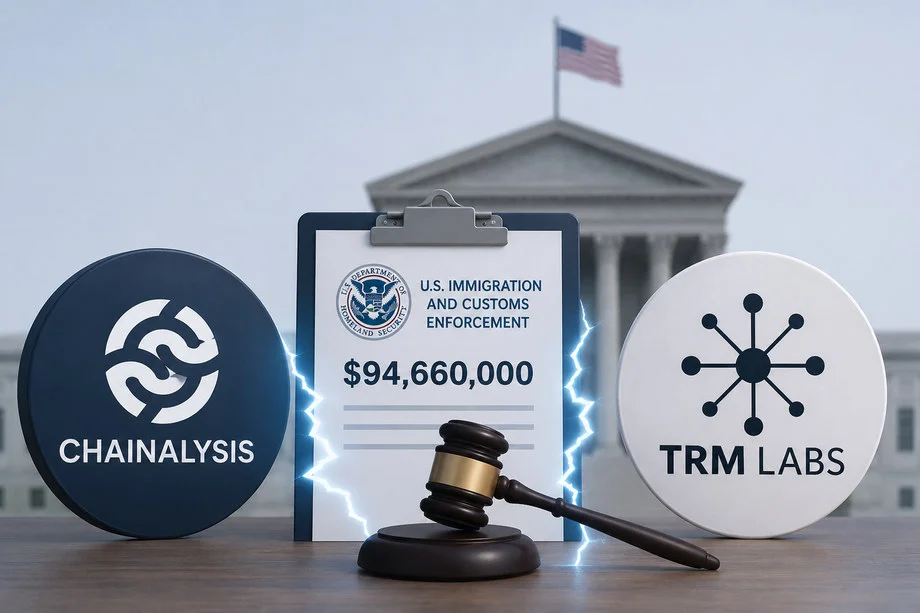
Blockchain analytics firm Chainalysis Government Solutions has filed a federal court protest seeking to block a nearly $95 million Immigration and Customs Enforcement contract awarded without competition to competitor TRM Labs
Chainalysis Government Solutions, the federal contracting arm of blockchain analytics provider Chainalysis, has asked the U.S. Court of Federal Claims to annul a sole-source contract valued at $94,655,840 that Immigration and Customs Enforcement awarded to TRM Labs. The company contends that the agency structured the procurement around capabilities unique to TRM and evaluated competitors against undisclosed standards, effectively shutting out fair competition for what it describes as the largest blockchain analytics contract ever issued by the U.S. government.
The one-year agreement, running from July 1, 2026, through June 30, 2027, covers forensic software and support services for Homeland Security Task Force investigations. Work focuses on disrupting scams, cybercrime, and sextortion cases. Federal records show the full amount obligated but no funds disbursed to date. The place of performance is listed as Fairfax, Virginia.
Procurement Timeline and Limited Response Window
ICE issued a Request for Information on May 28, 2026, seeking vendor input on 18 questions. Responses were due by June 2. The questions covered capabilities such as a proprietary scam-victim database containing more than one million records, an artificial-intelligence platform supporting agentic data retrieval and entity resolution, automated notifications to virtual asset service providers about suspicious transfers, and operational partnerships with stablecoin issuers to coordinate freezes of illicit assets.
On June 8, ICE published a Notice of Intent to award the work on a sole-source basis to TRM Labs. Interested vendors received a separate Statement of Need and were given three days—until June 11—to submit a one-page capability statement challenging the intent. Chainalysis Government Solutions submitted the only such statement. ICE later stated that a six-day market-research period drew responses from eight firms, none of which matched TRM’s specialized capabilities.
Chainalysis alleges that several technical requirements featured in the May Request for Information did not reappear in the June Statement of Need, which instead centered on scam disruption, cybercrime disruption, and sextortion disruption. The term “sextortion” itself was absent from the earlier Request for Information yet became a prominent requirement. The company further asserts that ICE assessed its submission against thresholds for automated real-time disruption, integration of on-chain and off-chain intelligence, and large-scale victim notification that had never been identified as decisive selection criteria.
Agency Justification and Competing Claims
ICE justified the sole-source award by citing features it described as unique to TRM, including a large proprietary scam-victim database, an AI-native investigative platform, automated freeze capabilities delivered through the Beacon Network, formal relationships with stablecoin issuers, and security-cleared personnel. Chainalysis counters that several of these attributes were not part of the final Statement of Need and that others are not exclusive to TRM. The company notes that ICE’s own market research acknowledged both vendors’ AI-enabled platforms and cleared staff, as well as Chainalysis’s established law-enforcement experience.
The Beacon Network operates in partnership with Tether and TRON through the T3 Financial Crime Unit. That collaboration has frozen more than $450 million in USDT linked to criminal activity since 2024. Chainalysis maintains that this real-world footprint was improperly embedded into the requirements in a manner that favored TRM.
Court Proceedings and Next Steps
Chainalysis filed the sealed protest on July 27, 2026. TRM Labs intervened the following day to defend the award. A redacted version of the complaint became public on August 28. Judge Stephen Schwartz has scheduled oral arguments for September 2 on an accelerated track. The government has asked for a ruling by September 10.
Prior to the court filing, Chainalysis had lodged an initial protest with the Government Accountability Office on July 12 before withdrawing it and shifting the dispute to the Court of Federal Claims. The company argues that the agency’s actions were arbitrary and that the magnitude of the contract warranted the competitive process preferred under federal acquisition rules. The court has not yet ruled on the merits of the allegations.

Disclaimer
This article was generated by AI using information from multiple industry sources. It has not been reviewed or verified by a human editor and may contain inaccuracies, omissions, or misinformation. Readers are encouraged to independently verify any information before making decisions based on its content.Tired of the noise?
Let the bots trade for you.
Trade 24/7, without emotion, with data-driven strategies.
Associated articles

Chainalysis Sues US Over $94.6M Sole-Source ICE Contract Awarded to TRM Labs

TRM Labs Doubles Valuation to $2 Billion After Series C Expansion

Kenya's Regulator Turns to Blockchain Tool to Tackle Crypto Crime

CoinEx Faces Scrutiny Over $3.84 Billion in Iran-Linked Crypto Flows

US and UK Launch Joint Alliance Against Crypto Scam Centers
Latest articles

SkyAI Exits Solana Holdings Completely, Launches $201 Million Share Buyback

Strategy Buys 267 Bitcoin and Raises Preferred Share Buyback Cap to $3 Billion

Dormant 2013 Bitcoin Wallets Shift Over $67 Million After More Than a Decade

Binance Rolls Out AI Pro Tool for Chat-Based Automated Trading Strategies