Newsroom
Cardano Foundation Calls on EU to Apply Existing Rules to DeFi and Staking
22 October, 2026 / News / AI / Tags: foundation, cardano, european, mica, staking

The group submitted a detailed response opposing expansion of MiCA to cover decentralized activities and non-custodial participation, favoring risk-based oversight instead
The Cardano Foundation has urged European Union authorities to regulate decentralized finance and staking activities under existing financial laws rather than creating new technology-specific rules. In a 19-page submission to the European Commission dated September 30 and made public in late October, the foundation argued that regulation should focus on the economic substance of activities, the functions performed, and the risks involved.
The organization, which supports the development of the Cardano blockchain, stressed the need to distinguish between users’ direct, non-custodial participation in decentralized networks and financial services offered by intermediaries that involve custody or control of client assets.
Distinction Between Non-Custodial and Intermediary Staking
A central point in the foundation’s position concerns Cardano’s staking model. Token holders can delegate ADA to help secure the network without transferring custody of their assets or locking the tokens. The foundation maintains that this form of participation differs fundamentally from staking services run by intermediaries who take control of user assets and make decisions on their behalf.
Applying identical regulatory requirements to both approaches would be disproportionate, according to the submission. Such a move could undermine the security, resilience, and decentralization of proof-of-stake networks without delivering corresponding benefits to investors or the broader financial system. Benjamin Buergi, the foundation’s senior legal counsel, prepared the response warning against the creation of separate regimes for decentralized technologies that would impose unnecessary burdens.
The foundation also cautioned against overly broad classification of non-fungible tokens, hybrid tokens, and prediction markets under existing frameworks.
Context of MiCA Review and ESMA Recommendations
The submission arrives as the European Commission reviews the Markets in Crypto-Assets Regulation, known as MiCA. Parts of the framework took effect in mid-2024, with full application beginning at the end of that year. The Commission is scheduled to report on MiCA’s implementation by June 30, 2027, and the review could lead to legislative proposals.
In September, the European Securities and Markets Authority recommended additional safeguards for staking, lending, and borrowing activities. It also proposed a new regulated service category for companies that facilitate access to DeFi protocols. The Cardano Foundation’s filing directly addresses these ideas, arguing that more regulation does not automatically produce better outcomes.
The foundation called for clearer boundaries between MiCA requirements and broader financial legislation. Overlapping rules and inconsistent interpretations across EU member states risk creating uncertainty for crypto businesses operating in the region. It further supported targeted clarifications on issues such as cross-border token ownership, treatment of multi-function tokens, stablecoins issued across jurisdictions, and genuinely unique non-fungible tokens.
Other EU bodies have examined related areas. The European Banking Authority has previously encouraged consideration of rules for crypto-asset lending, including cases where providers give customers access to DeFi lending protocols, though those recommendations have not yet resulted in new requirements.
Wider Regulatory Engagement
Beyond the European consultation, the Cardano Foundation has sought greater clarity in other jurisdictions. On October 20, it joined five other blockchain industry groups in an open letter to the US Securities and Exchange Commission. The organizations asked the agency to formally categorize digital commodities as non-securities within its proposed rules for crypto assets. That appeal comes amid ongoing discussions among US regulators about the proper classification of digital assets.
The foundation’s European response emphasizes that regulatory obligations should depend on the presence of an identifiable operator and the degree of control that operator exercises over customer assets or transactions. Supplying general-purpose software, it argued, should not automatically classify a developer as a regulated service provider.
Markets showed limited immediate reaction to the publication of the submission, consistent with the nature of formal consultation responses. The Commission’s eventual conclusions on the MiCA review will determine the scope of rules governing decentralized activities and network participation across the European Union for years ahead.

Disclaimer
This article was generated by AI using information from multiple industry sources. It has not been reviewed or verified by a human editor and may contain inaccuracies, omissions, or misinformation. Readers are encouraged to independently verify any information before making decisions based on its content.Tired of the noise?
Let the bots trade for you.
Trade 24/7, without emotion, with data-driven strategies.
Associated articles

Circle and Hyperliquid Urge EU Adjustments to MiCA Stablecoin and Derivatives Rules

EU Prepares MiCA Changes to Handle Non-EU Stablecoin Issuers

France Proposes Crypto Platform Liability for DeFi Security Failures Under MiCA Review
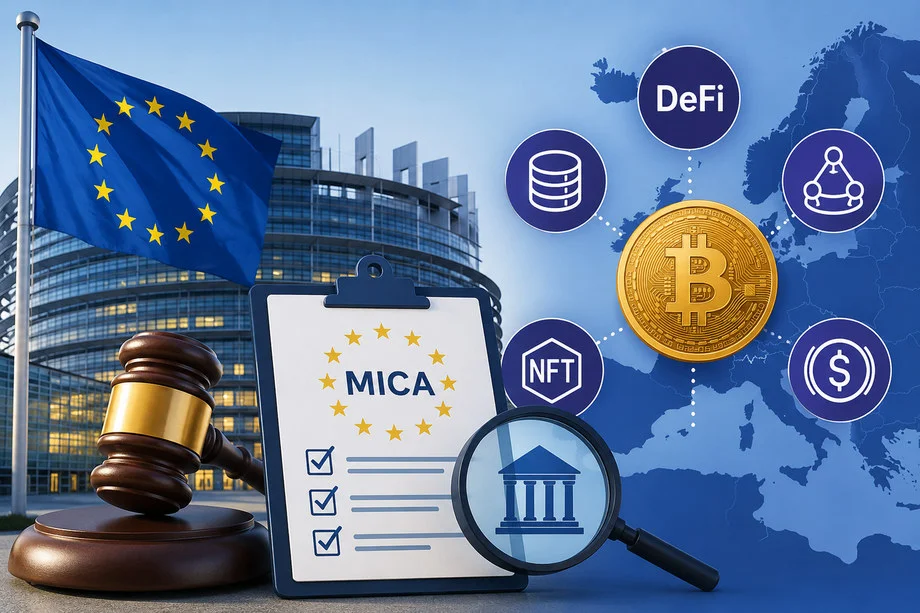
EU Lawmakers Call for Review of DeFi, Staking, NFT Rules Under MiCA

EU Prepares MiCA Review in 2027 to Address Non-EU Stablecoin Issuers
Latest articles

Bybit Eyes U.S. Broker Deals and European App Launch Amid Regulatory Wait

Collector Crypt Logs Over 100,000 Pack Openings and $22 Million Revenue After Pump.fun Integration
MEXC Ends Services for Users in Russia and Belarus Amid Compliance Push

Critical PHP Flaws Enable Remote Server Takeovers, Prompting Emergency Patches and Site Shutdowns