Newsroom
Brazilian Banks Broaden Crypto Access as Market Hits $98.7 Billion
7 September, 2026 / News / AI / Tags: banks, brazil, bank, brazilian, safra
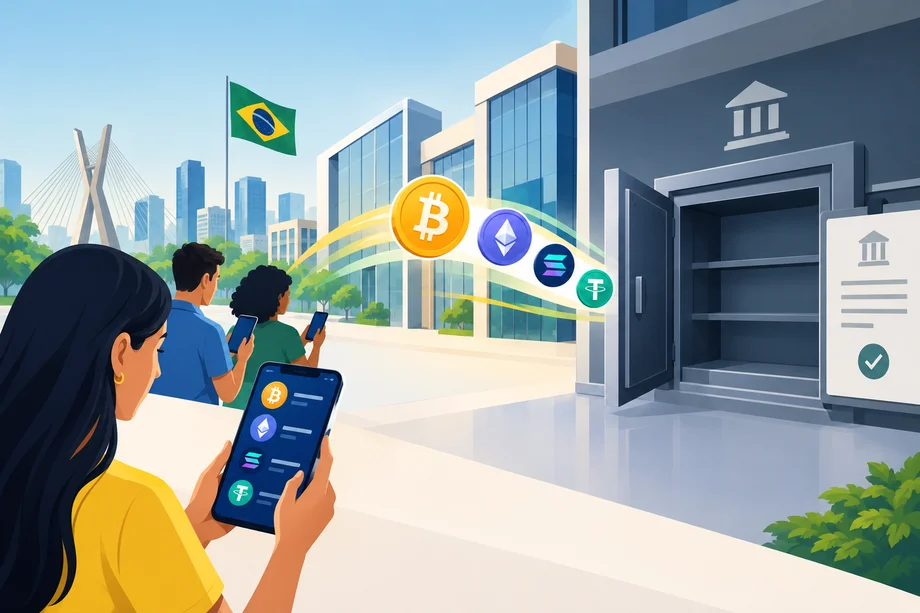
Major lenders offer up to 28 digital assets to clients while reporting zero proprietary holdings, following a sharp rise in national transaction volumes and clearer regulatory rules
Brazil’s leading banks have significantly expanded the range of cryptocurrencies available to retail customers, even as official filings confirm they hold none of the assets on their own balance sheets. The move coincides with a record year for crypto activity in the country and the rollout of detailed operating rules by the Central Bank.
Record Transaction Volumes Drive Demand
Data from Brazil’s federal tax authority show that crypto transactions totaled R$505.5 billion, or approximately $98.7 billion, in 2025. That figure represents a 22 percent increase from 2024 and a 433 percent rise from the level recorded in 2020. Companies accounted for nearly all of the activity, generating R$497 billion, or about $97 billion, equal to 98.3 percent of the total. Individual investors made up the remainder.
Stablecoins form a substantial share of the market, providing users with dollar-linked tokens that facilitate payments and serve as an alternative to traditional foreign-exchange channels. The International Monetary Fund has previously noted that stablecoin purchases in Brazil respond more sharply to global shocks than conventional portfolio flows or foreign direct investment.
Banks Expand Client Offerings Without Taking Balance-Sheet Risk
Itaú, the country’s largest bank by assets under management, now provides access to 15 crypto assets through its investment platform. The selection includes Bitcoin, Ethereum and the dollar-backed stablecoin USDC. Nubank has gone further, listing 28 digital assets for more than 7 million users of its crypto service. Banco do Brasil, the most profitable state-controlled bank, began offering direct purchases of Bitcoin and Ethereum in January and has since processed more than R$11 million, or roughly $2.1 million, in customer transactions.
Other major institutions, including Bradesco and Santander, have also enlarged their digital-asset menus since 2025. Under the model adopted by these banks, customers buy or hold the assets while the institutions supply custody or order-processing services. Proprietary holdings would require the banks to deploy their own capital and accept the associated price, liquidity and credit risks. Central Bank filings from March 2026 show that Brazilian banks reported no virtual assets on their balance sheets.
Regulatory Framework Provides Clarity
Brazil’s Legal Framework for Virtual Assets, approved in 2022, placed the sector under Central Bank oversight. In November 2025 the regulator issued Resolutions 519, 520 and 521, which require virtual-asset service providers to obtain authorization, maintain minimum capital and keep client assets separate from their own funds. Approximately 120 crypto firms operating in the country face a licensing deadline of October 30, 2026.
Additional capital and risk rules approved in July will begin taking effect in January 2027. Providers will eventually fall into the Central Bank’s S4 regulatory segment by mid-2028, while smaller S5 institutions will no longer be permitted to offer virtual-asset services. Resolution 521 also classifies transactions involving foreign-currency-denominated tokens, including dollar stablecoins, as foreign-exchange operations subject to corresponding reporting requirements.
Licensed banks already operate under full Central Bank supervision, giving them an established compliance structure as pure-play crypto firms prepare their authorization applications. The rules do not compel banks to acquire digital assets for their own portfolios before offering custody or execution services to clients.
Stablecoin Initiatives and Broader Market Context
Banco Safra, which primarily serves high-net-worth clients, entered the stablecoin market directly in September 2025 by issuing Safra Dólar. The bank maintains in-house custody of the dollar-pegged token and markets it as a means for clients to gain dollar exposure without opening an overseas account. Itaú has previously examined the possibility of issuing a token linked to the Brazilian real, though any such project remains subject to further Central Bank guidance.
The combination of rising transaction volumes, client demand and a clearer regulatory perimeter has encouraged traditional banks to treat crypto as another product line available through familiar banking interfaces, while carefully limiting their own financial exposure.
Disclaimer
This article was generated by AI using information from multiple industry sources. It has not been reviewed or verified by a human editor and may contain inaccuracies, omissions, or misinformation. Readers are encouraged to independently verify any information before making decisions based on its content.Tired of the noise?
Let the bots trade for you.
Trade 24/7, without emotion, with data-driven strategies.
Associated articles
IMF Calls for Stronger Controls on Brazil’s Surging Stablecoin Activity

US Slaps 25% Tariffs on Brazil Targeting Pix Payment System
Absa Launches First Bank-Backed Digital Asset Custody Service in Africa

Brazil Central Bank Mandates 24-Hour Hold on Large Crypto Transfers Starting 2027

Russia’s Central Bank Issues Draft Rules for Organized Crypto Trading Ahead of September Framework
Latest articles

SkyAI Exits Solana Holdings Completely, Launches $201 Million Share Buyback
Strategy Buys 267 Bitcoin and Raises Preferred Share Buyback Cap to $3 Billion

Dormant 2013 Bitcoin Wallets Shift Over $67 Million After More Than a Decade

Binance Rolls Out AI Pro Tool for Chat-Based Automated Trading Strategies