Newsroom
Boris Johnson Reaffirms Bitcoin Doubts While Urging UK Lead on Blockchain and Tokenization
17 November, 2026 / News / AI / Tags: johnson, london, boris, kempsell, tokenization
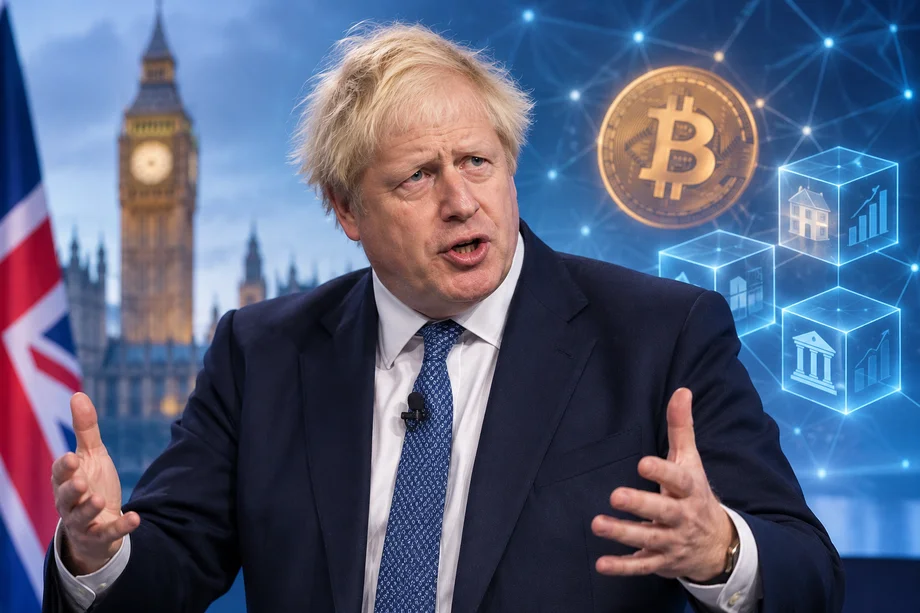
Former UK prime minister questions Bitcoin accountability at Solana Breakpoint in London but insists the country must drive blockchain innovation and asset tokenization amid advancing regulation
Former UK Prime Minister Boris Johnson restated his long-held skepticism toward Bitcoin on Monday while speaking at Solana’s Breakpoint conference in London. He maintained that the cryptocurrency lacks clear accountability and resembles a giant Ponzi scheme, a view he first outlined in a March opinion column. At the same time, he drew a firm distinction between Bitcoin and the underlying blockchain technology, arguing that London and the UK must take a leading position in blockchain development and the tokenization of assets.
Johnson told the audience of developers and industry participants that he remains unsure who is ultimately responsible for Bitcoin. “As far as I can see, nobody knows who’s in charge, apart from Yakimoto Nakasori, and I don’t know where to find him,” he said, deliberately mispronouncing the name of Bitcoin’s pseudonymous creator, Satoshi Nakamoto. He added that if billions of dollars were stolen from a cryptocurrency, he would not know whom to approach or how to recover the funds.
The former prime minister acknowledged he is “not a great crypto buff” and holds little or no cryptocurrency himself. His perspective was shaped in part by a resident of his Oxfordshire village who began with an investment of about $660 and ultimately lost roughly $26,400 after continued contributions in hopes of recovering earlier losses. Johnson said the fact that such losses had reached rural South Oxfordshire suggested something was fundamentally wrong. He also criticized the term “crypto” itself, noting its Greek root meaning “hidden,” and suggested the branding does little to build public confidence. When he raised the idea that Bitcoin could be useful to drug dealers, panel moderator Gareth Jenkinson of The Block countered that blockchain transactions are far more traceable than cash.
Support for Blockchain and Tokenization
Despite his reservations about Bitcoin, Johnson expressed strong enthusiasm for blockchain technology and the tokenization of real-world assets. He described his concerns as a form of “Luddite anxiety” that should not impede progress. London, he said, should rightly lead in this area of innovation.
He stated that he is “totally, totally in favor” of blockchain innovation and the tokenization of assets of all kinds. The comments came during a panel titled “Crypto Is Key to the UK’s Economic Future.”
Regulatory Progress and Industry Views
Lord Ross Kempsell, a Conservative peer and former Johnson aide who appeared alongside him, said he shared concerns about risks in the sector. At the same time, he pointed to significant growth potential once activities fall within a clear regulatory perimeter. More than 8 percent of UK adults currently hold some form of crypto asset, according to Financial Conduct Authority research, down from 12 percent in 2024 but still double the level recorded in 2021.
Kempsell noted that the UK is advancing a substantial body of regulation. The Financial Conduct Authority has finalized rules requiring crypto trading platforms, custodians, intermediaries, stablecoin issuers, and staking providers to obtain authorization. The full mandatory regime is scheduled to take effect in late 2027. The Bank of England has developed a stablecoin framework that replaces individual holding caps with a total issuance limit of approximately $52.8 billion per coin and has been given a legal duty to foster stablecoin innovation. Regulators are also advancing a shared vision for tokenization.
Kempsell argued that the UK’s position outside the European Union’s Markets in Crypto-Assets framework gives it flexibility to tailor rules. He called for close collaboration between regulators and market participants, stressing that consumer protection and innovation need not be treated as opposing goals. He said he is “a very big believer in making London and keeping London as the onchain capital for innovation” and highlighted the potential for job creation and links to broader technology and financial innovation.
Industry participants offered mixed responses. Tim Meggs, co-founder of London digital asset firm Lo:Tech, said Johnson made a fair point about investor losses but attributed many of them to thin liquidity and limited price transparency. He argued that effective rules would help, yet London also needs stronger clearing and prime brokerage infrastructure to become a serious center for digital asset trading. Robin Nordnes, founder and chief executive of Solana infrastructure firm Raiku, countered that the absence of a central guarantor is precisely the strength of public blockchains, where every transaction can be verified by anyone.
The discussion occurs as UK regulators seek to balance consumer safeguards with the development of a competitive digital asset sector. Johnson’s dual message—persistent caution on Bitcoin combined with an explicit call for national leadership in blockchain and tokenization—captures the tension still present in official and political approaches to the industry.
Disclaimer
This article was generated by AI using information from multiple industry sources. It has not been reviewed or verified by a human editor and may contain inaccuracies, omissions, or misinformation. Readers are encouraged to independently verify any information before making decisions based on its content.Tired of the noise?
Let the bots trade for you.
Trade 24/7, without emotion, with data-driven strategies.
Associated articles

Latest articles

Hong Kong Authority and Swift Expand Tokenized Deposit Tests for Cross-Border Payments

SELLAS Shares Surge After Phase 3 Leukemia Vaccine Cuts Death Risk by 41%

Grayscale Views Bitcoin Near $64,000 as Attractive Entry After 17% Drop

Uniswap Proposes Declining UNI Threshold to Free $300,000 in X Layer Fees