Newsroom
Binance Wallet Lets Users Pay Gas Fees in USDT Across Four Networks
28 September, 2026 / News / AI / Tags: bnb, usdt, binance, wallet, users
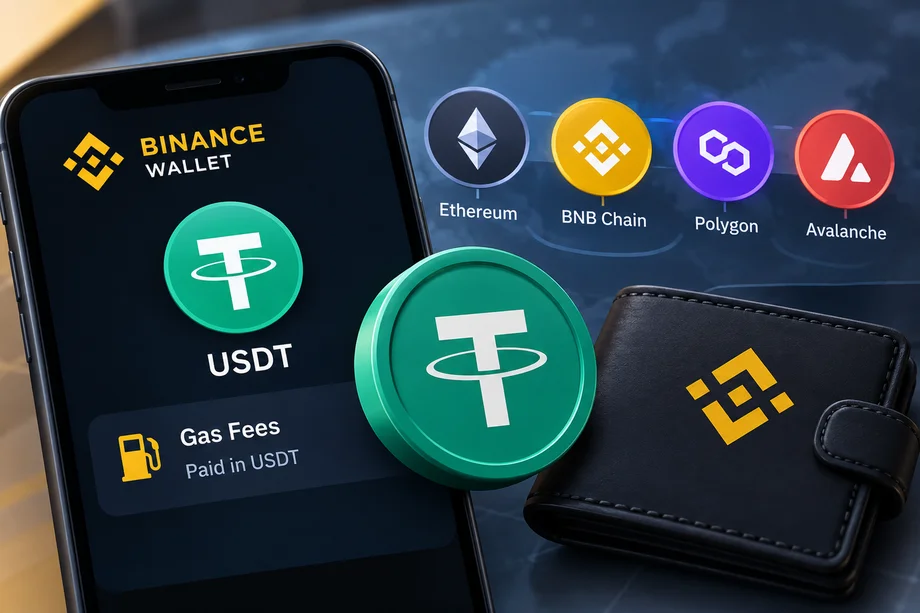
Users can now settle blockchain transaction costs with the popular stablecoin on BNB Smart Chain, Ethereum, Solana and Tron, easing a long-standing barrier for on-chain activity
USDT Option Rolls Out on Major Blockchains
Binance Wallet has expanded its payment capabilities for network fees by supporting the use of Tether in USDT on four prominent blockchains. The change took effect on September 25, 2026, and applies to BNB Smart Chain, Ethereum, Solana and TRON. It allows holders of USDT inside the self-custody wallet to cover gas costs directly without acquiring the respective native token for each chain.
Previously, users faced restrictions based on the chain in question. For BNB Smart Chain, BNB was required; Ethereum needed ETH; Solana demanded SOL; and TRON required TRX. This could leave funds stuck even when the asset to be moved was already in the wallet. The new feature removes that dependency, letting users select USDT as the payment method when initiating supported transactions.
Binance Wallet calculates network fees according to live blockchain conditions. It plans to add more networks in the future, though no specific rollout timeline has been shared.
How Users Can Access the USDT Gas Option
Payments go through the wallet interface. Eligible users choose USDT from their balance to handle the fee at the moment of signing. The stablecoin covers the cost, but Binance confirms that network fees do not flow to the company itself. Instead, they reach blockchain validators or participants responsible for processing the transaction.
If USDT in the wallet is insufficient, users have alternative routes. They can pull from eligible balances held in their Binance Exchange accounts on the same four networks. Supported assets include BNB, USDT, USDC, ETH and SOL across Spot, Funding or Earn positions. Other options involve transferring gas tokens from exchange holdings, receiving them from another wallet or acquiring them via bank card.
On BNB Smart Chain, Ethereum and opBNB, eligible users can also draw BNB directly from their Spot or Funding Account, provided the account holds more than 0.01 BNB.
| Payment Option | Supported Networks | Notes |
|---|---|---|
| USDT in Wallet | BNB Smart Chain, Ethereum, Solana, TRON | Primary method for direct wallet holders |
| Exchange Account Balances | Same four networks | BNB, USDT, USDC, ETH, SOL from eligible holdings |
| Additional Routes | All supported | Transfers from exchange, external receipt or bank purchase |
| BNB Draw | BNB Smart Chain, Ethereum, opBNB | Requires more than 0.01 BNB in Spot or Funding Account |
TRON Users Receive Special Zero-Gas Promotion
Separately, a promotional offering provides zero gas fees for eligible users on TRON. It applies to sending USDT and other TRC-20 tokens through Binance Wallet and runs from September 23 until December 22, 2026. The initiative is backed by TRON DAO and subject to available campaign spots.
After the promotion ends, qualifying transfers will incur a discounted fee of 1 USDT per transaction. Users activate the offer by starting a transfer, selecting the token and network, then confirming the USDT payment method before finalizing the transaction.
Broader Wallet Improvements
This update forms part of ongoing enhancements to Binance Wallet since its rebranding in December 2024. Earlier additions have included a unified interface, perpetual futures trading, Event Rush on BNB Chain and fee waivers for certain swaps. The company continues to refine self-custody features while maintaining clear guidance on network selection to prevent irreversible mistakes.
Binance stresses that users must choose the correct blockchain when moving assets to external wallets, as mismatched networks can result in lost funds. The new USDT capability adds convenience without altering core blockchain mechanics or validator incentives.
Disclaimer
This article was generated by AI using information from multiple industry sources. It has not been reviewed or verified by a human editor and may contain inaccuracies, omissions, or misinformation. Readers are encouraged to independently verify any information before making decisions based on its content.Tired of the noise?
Let the bots trade for you.
Trade 24/7, without emotion, with data-driven strategies.
Associated articles
NOWPayments Data Shows TRON Dominates Volume as Solana Leads Speed in Enterprise Crypto Payouts
Binance Removes Eight Margin Pairs, Sets BNB Chain Wallet Maintenance

Grayscale Identifies Ethereum, Solana, BNB Chain as Top Winners Under New Crypto Rules
The Sandbox to Reimburse Eligible SAND Holders 1:1 After Bridge Exploit
Solana and Arbitrum Founders Clash Over Robinhood Chain Fee Structure
Latest articles

Thai Police Arrest Chinese Man in $75M Crypto Laundering Probe
Cysic Suspends Cross-Chain Bridge After Unauthorized 10 Million CYS Mint

Cardano Founder Builds New Programming Language with Groth16 Proofs

Yuga Labs Debuts Mudwater Trading Cards on Solana With ApeCoin Rewards