Newsroom
Arch Lending Prepares Tokenized Stock Loans Amid Rising Onchain Equity Demand
23 September, 2026 / News / AI / Tags: lending, tokenized, sahay, lenders, equities

Crypto lender Arch Lending plans to offer credit backed by tokenized equities soon, as the market for onchain stocks expands and existing lending options remain limited
Arch Lending is preparing to expand its loan offerings to include collateral from tokenized stocks and exchange-traded funds. The move comes as the value of distributed tokenized equities has increased substantially over the past year, yet credit products supporting those assets have lagged behind issuance growth.
Himanshu Sahay, co-founder and chief revenue officer of Arch Lending, said the firm intends to enter the space "pretty soon." He noted that tokenized equities have expanded quickly while borrowing options against them stay constrained, creating an opening for additional lenders.
Current Portfolio Still Centered on Crypto
Arch Lending’s existing loan book continues to rely heavily on digital assets. Bitcoin accounts for more than 80 percent of the firm’s current exposure. At the same time, the lender has observed rising interest in XRP as collateral, particularly among borrowers based in the United States.
The company has already moved beyond pure cryptocurrency collateral. In recent weeks it launched loans secured by tokenized gold products from Paxos and Tether. These real-world asset facilities mark an early step toward broader collateral categories while crypto remains the core of operations.
Tokenized Equity Market Shows Strong Growth
Distributed tokenized stock value has reached approximately $3.15 billion, compared with roughly $630 million a year earlier. Platforms including Superstate, Robinhood and Securitize have contributed to the expansion of onchain share tokens and related products.
Despite the increase in issued value, Sahay indicated that lending capacity has not kept pace. Borrowers seeking credit against these assets currently face relatively few dedicated options, even as the underlying market matures.
Early Lending Activity Already Underway
Arch Lending would not be the first participant in tokenized equity credit. In February, Ondo Finance introduced DeFi lending markets for two of its tokenized ETFs through an integration with the Morpho protocol. Tokenized versions of the SPDR S&P 500 ETF and Invesco QQQ can serve as collateral for borrowing on Ethereum.
Other platforms have extended eligibility for related uses. In July, Kraken made ten of its xStocks eligible to support futures and margin positions. In August, Coinbase launched B20 stocks on the Base network with price-feed infrastructure designed to enable DeFi borrowing and lending applications.
These developments indicate that tokenized equities are becoming more composable within onchain financial systems. Lenders evaluating the assets must still address practical requirements around valuation, custody, volatility management and liquidation processes that differ from those used for native cryptocurrencies.
Broader Implications for Credit Markets
As tokenized stock issuance continues, lenders that add support for the assets may attract borrowers seeking to access liquidity without selling equity exposure. The combination of rising market size and currently limited credit availability could encourage additional firms to develop competing products.
Arch Lending’s planned entry forms part of a gradual shift in which crypto-native lenders broaden their collateral frameworks to include tokenized traditional assets. Bitcoin still dominates the firm’s book, and any expansion into equities is expected to proceed alongside continued risk assessment of the new asset class.
Further details on supported instruments, valuation methods and launch timing have not yet been announced. Market participants will monitor whether borrower demand grows in parallel with the expanding supply of tokenized equities and whether additional lenders follow with their own offerings.
Disclaimer
This article was generated by AI using information from multiple industry sources. It has not been reviewed or verified by a human editor and may contain inaccuracies, omissions, or misinformation. Readers are encouraged to independently verify any information before making decisions based on its content.Tired of the noise?
Let the bots trade for you.
Trade 24/7, without emotion, with data-driven strategies.
Associated articles

Chainlink Data Feeds Enable Coinbase Tokenized Stocks as DeFi Collateral on Base
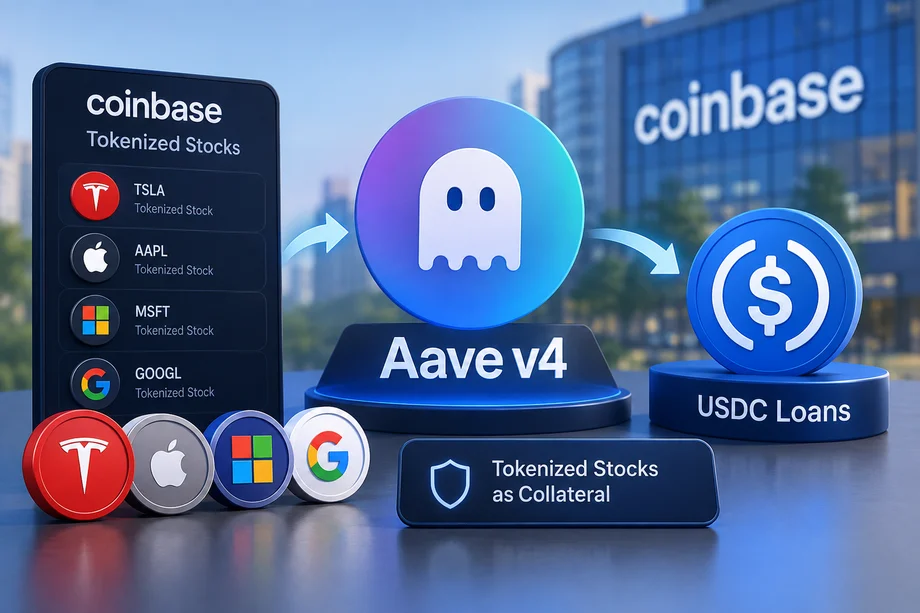
Aave V4 Enables USDC Loans Against Coinbase Tokenized Stocks on Base

Kraken Introduces Onchain Yield Vaults for Tokenized Equities and ETFs

Coinbase Rolls Out Fixed-Rate Bitcoin-Backed USDC Loans via Morpho Midnight

Crypto.com Launches Tokenized Derivatives for 1,500 U.S. Stocks and ETFs
Latest articles

ENS Founder Files Proposal to Activate ENSv2 Upgrade on Ethereum Mainnet

Four Firms Test AI Agents for Secure Crypto Payments Aimed at Japanese Tourists in South Korea

Metaplanet to Raise $329 Million via Zero-Coupon Convertible Bonds for Debt Repayment and Buybacks

Tom Lee Flags Short-Term Ethereum Pressure After Sharp South Korean Equity Sell-Off