Newsroom
Anthropic’s Claude Agents Uncover Novel CRISPR-Like Enzyme System in Bacteriophage DNA
24 September, 2026 / News / AI / Tags: crispr, transcriptase, dna, reverse, array
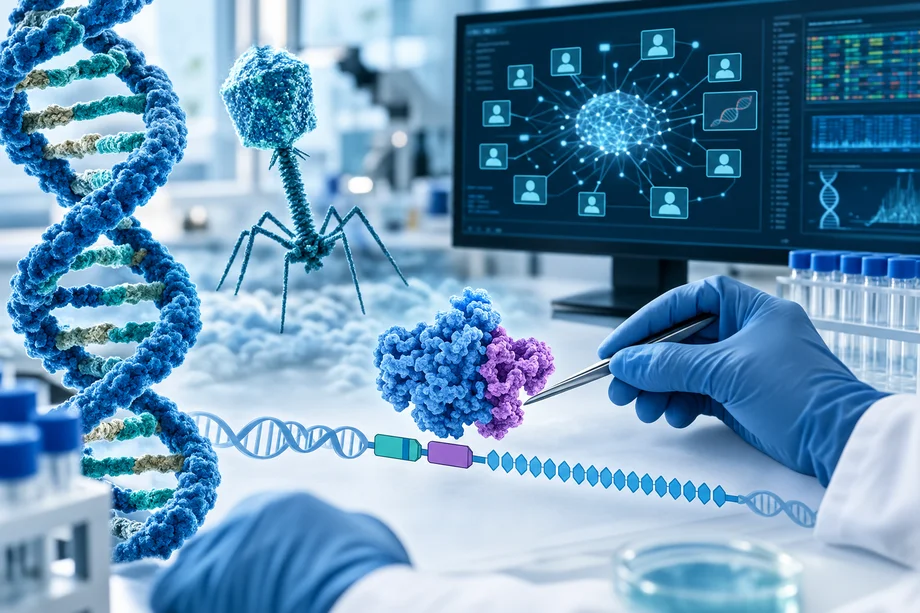
AI agents identified an uncharacterized system called ART after a 21-hour search of genomic data, though its biological role remains unknown and further experiments continue
Anthropic announced that its Claude AI agents have identified a previously uncharacterized enzyme system in the DNA of bacteriophages, the viruses that infect bacteria. Named array-associated reverse transcriptases, or ART, the system consists of a reverse transcriptase enzyme, a neighboring partner gene of unknown purpose, and a long stretch of evenly spaced DNA repeats that structurally resembles the arrays found in CRISPR systems.
The precise biological function of ART has not been determined. No evidence yet shows that the system can cut, copy, or paste DNA, and no gene-editing application has been established. Laboratory work to clarify its role is already underway at Anthropic’s Bay Area facility.
How the Discovery Unfolded
Anthropic’s life sciences team, established in spring 2026, tasked Claude agents with searching large genomic datasets for novel reverse transcriptase systems. Reverse transcriptases convert RNA into DNA and appear in various bacterial and viral defense mechanisms.
Over roughly 21 to 21.5 hours, approximately 950 agents processed about 210 to 215 million tokens. They assembled more than 200,000 reverse transcriptase sequences, identified around 3,500 candidate systems, and narrowed the list to about 20 for detailed human review. One agent, while examining raw DNA sequence next to an unusual reverse transcriptase gene previously noted in a jumbo phage, detected a repeating pattern by visual inspection of the sequence. The agent counted the repeats, measured their spacing, compared the arrangement with known systems, and checked the scientific literature before preparing a report.
The reverse transcriptase itself had appeared in earlier studies, but those reports did not identify the associated repeat array or the partner protein as components of a larger coordinated system. Anthropic scientists supplied only the initial prompt and performed all laboratory experiments; the agents handled sequence analysis, candidate evaluation, and proposal of the finding. When the same search campaign was repeated ten additional times, none of the reruns located the array.
Early Laboratory Findings
Initial experiments showed that the ART repeat array is expressed as distinct short RNAs. In public RNA data from a Staphylococcus phage, these short RNAs accounted for as much as 8 percent of the phage’s RNA fifteen minutes after infection. The arrangement of three to twenty-one short repeats without nearby Cas genes further distinguishes ART from classic CRISPR loci. ART appears primarily in phages rather than in the bacterial hosts that typically carry CRISPR systems.
Only a small number of other known biological systems combine a reverse transcriptase with a non-coding repeat array. Several of those systems are programmable and can act on DNA, but Anthropic has not demonstrated comparable activity for ART.
Scientific Response and Next Steps
Feng Zhang, a professor at MIT and the Broad Institute who helped pioneer CRISPR technology, reviewed the preprint describing the work. He described the identification of RNA-repeat arrays associated with reverse transcriptases as genuinely intriguing and said the finding merits further investigation. Zhang also called the episode an exciting example of how AI agents can contribute to biological discovery.
Anthropic chief executive Dario Amodei noted that the molecular machine could potentially represent a new gene-editing mechanism, while stating that its precise function, biotechnological utility if any, and overall significance remain unclear. He observed that AI performance in new intellectual domains has repeatedly advanced from limited capability to high competence within a few years and suggested biology may follow a similar trajectory.
Other researchers have expressed caution. Microbiologist Kevin Blake of Washington University School of Medicine noted that nothing currently indicates ART could rival CRISPR as a technology or be developed into a therapeutic or practical application. He pointed out that countless CRISPR-like sequences remain uncatalogued because millions of bacterial species have yet to be studied in detail.
Anthropic’s Bay Area laboratory operates at biosafety levels 1 and 2 and does not handle pathogens capable of infecting humans. Human scientists continue to conduct all bench work. The company has released a technical report as a preprint and is inviting outside researchers to submit proposals for additional study of the system.
Shares of several gene-editing companies declined following the announcement, though the company has made clear that any potential applications remain years away and depend on results from ongoing experiments.
Disclaimer
This article was generated by AI using information from multiple industry sources. It has not been reviewed or verified by a human editor and may contain inaccuracies, omissions, or misinformation. Readers are encouraged to independently verify any information before making decisions based on its content.Tired of the noise?
Let the bots trade for you.
Trade 24/7, without emotion, with data-driven strategies.
Latest articles

Google Rolls Out Gemini 4 Argon AI Model With Cybersecurity Focus and Competitive Pricing

France Weighs 31.4% Tax on Crypto Swaps Into Regulated Stablecoins From 2027

Polymarket CEO Teases On-Chain Asset at TOKEN2049, Sparking Token and Airdrop Talk

US September CPI Climbs to 3.7% as Core Inflation Exceeds Forecasts