Newsroom
World Bank Explores USDC Payments With Citi and Circle for Development Funds
18 November, 2026 / News / AI / Tags: circle, bank, world, banga, group
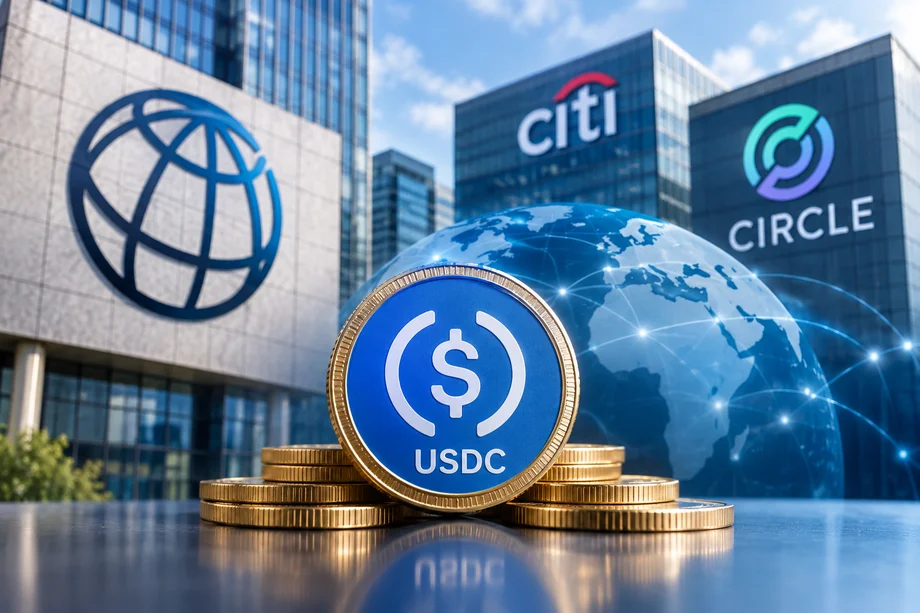
The World Bank Group will work with Citi and Circle to test regulated dollar stablecoins for faster, lower-cost disbursement of development funds to borrower countries
The World Bank Group announced on November 17 that it will explore the use of regulated U.S. dollar stablecoins and blockchain-based payment rails to modernize how it distributes development funds. The effort pairs the institution with Citi and Circle Internet Group, focusing on Circle’s USDC stablecoin as a potential tool to improve speed, cost efficiency, and transparency compared with traditional correspondent banking networks.
Under the planned collaboration, Citi will contribute its established connections to global banking infrastructure, while Circle will supply the technology to mint and settle funds in USDC. The World Bank Group said the approach could operate alongside or enhance its existing funds-disbursement arrangements, which currently rely on intermediary banks that often introduce delays and higher costs.
Building on Existing Blockchain Tracking
The initiative builds directly on FundsChain, a World Bank Group blockchain platform already used to track the flow of development money. More than 350 projects across 96 countries are onboarded to the system’s digital ledgers, allowing project participants and auditors to monitor how funds are spent in near real time.
World Bank Group President Ajay Banga framed the exploration as a practical step toward better outcomes on the ground. He noted that even modest gains in payment efficiency across large volumes of disbursements could free resources for essential work.
Banga added that greater efficiency could mean a health clinic is completed on schedule or a farmer receives payment before the end of the harvest season.
Initial Scope and Structure
The first phase will test an intermediated and interoperable stablecoin payment model. Participation will be limited to borrower countries where the use of digital assets is supported and permitted by local rules. The World Bank Group indicated it plans to consult eligible countries and may bring additional banking partners into the effort over time.
No launch date, transaction volumes, specific blockchain network, or production timeline has been disclosed. Officials described the work as an exploration rather than an immediate shift away from correspondent banking.
Citi’s Shahmir Khaliq said the collaboration aims to deliver round-the-clock payment capabilities at scale so that critical funds can move in real time. Circle CEO Jeremy Allaire described development finance as an important application for blockchain payments, arguing that money moving at internet speed should not be limited to the largest banks and corporations.
Broader Institutional Context
The World Bank Group is a development institution owned by its member countries. It provides loans and grants to governments in low- and middle-income nations to support projects such as schools, health facilities, and water systems. Its decision to examine regulated stablecoins arrives amid growing interest from traditional financial institutions in on-chain dollar instruments.
Recent moves by major banks include a joint stablecoin venture that has attracted roughly $270 million in commitments from institutions including Goldman Sachs, Citigroup, Santander, and Deutsche Bank. Deutsche Bank has also launched a crypto custody service after a multi-year development period. For Circle, whose USDC ranks as the second-largest stablecoin by market capitalization, participation in World Bank payment infrastructure represents a notable institutional endorsement.
The exploration remains carefully scoped. It does not replace existing banking relationships and will proceed only where regulatory conditions allow digital assets. Further details on participating countries, operational mechanics, and any measured efficiency gains are expected as the work advances.

Disclaimer
This article was generated by AI using information from multiple industry sources. It has not been reviewed or verified by a human editor and may contain inaccuracies, omissions, or misinformation. Readers are encouraged to independently verify any information before making decisions based on its content.Tired of the noise?
Let the bots trade for you.
Trade 24/7, without emotion, with data-driven strategies.
Associated articles

Lloyds and Visa Settle $750,000 Using USDC in Cross-Border Pilot

Circle and Nomura Partner for Instant USDC FX Settlement in Japan

21 Global Banks Plan Joint Company for Dollar Stablecoin Launch in 2027

PNC Bank Pilots USDC Receipts for Corporate Clients With Coinbase Conversion to Dollars

Circle Secures OCC Approval for National Trust Bank
Latest articles

Binance Wallet Closes $500 Million Anthropic Tokenized Stock Campaign After Cap Hit
XRP Ledger Secures Independent Verification of Architecture and Resiliency Under Global Framework

ZachXBT Claims Indian Authorities Wrongly Froze $3M Gate Account in Scam Probe

Vitalik Buterin Urges Crypto to Build Long-Term Stability Like Housing