Newsroom
US Sheriffs Group Shifts to Neutral on CLARITY Act Ahead of Senate Vote
4 September, 2026 / News / AI / Tags: sheriffs, association, senate, procedural, neutral
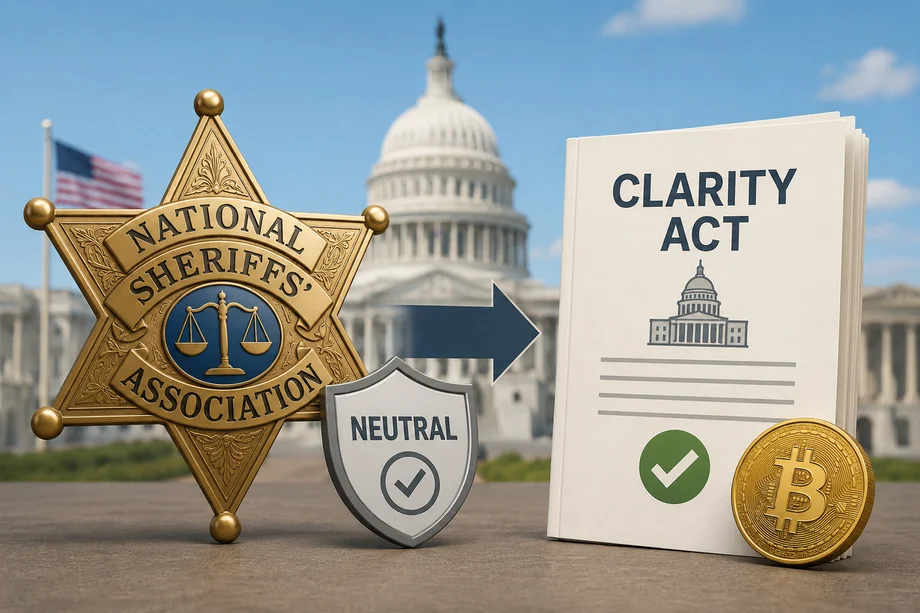
The National Sheriffs’ Association ends formal opposition to the crypto market structure bill, clearing a key law enforcement hurdle days before a critical procedural vote
The National Sheriffs’ Association has withdrawn its opposition to the Digital Asset Market Clarity Act, known as the CLARITY Act, and adopted a neutral position. The change was conveyed in a letter to Senate Majority Leader John Thune and Minority Leader Chuck Schumer, signed by association President Sheriff Troy Wellman and Executive Director and CEO Justin Smith.
The group cited the complexity of the legislation and the volume of details still under consideration. It stated that the most appropriate course is to step back and allow the legislative process to continue toward establishing a clear and effective regulatory framework for digital assets.
The shift does not constitute an endorsement of the bill. The association had previously raised sustained objections, particularly regarding Section 604. That provision aims to shield software developers who create non-custodial tools from being treated as money transmitters when they do not control user funds or conduct transactions on behalf of others.
Prior Concerns Centered on Illicit Finance Risks
In earlier correspondence, the association argued that the section risked creating exemptions that could hinder investigations into money laundering, ransomware, sanctions evasion, and other crimes involving digital assets. Critics within law enforcement contended it might limit requirements for customer verification, record-keeping, and suspicious activity reporting that investigators rely on.
Supporters of the language, including industry groups, maintained that it distinguishes neutral code providers from entities that hold or transmit customer assets, preserving existing anti-money-laundering obligations for those with actual control.
Other law enforcement organizations have taken varied positions. The Fraternal Order of Police endorsed a revised version of the measure after determining that investigative tools and criminal statutes remained intact. The Major County Sheriffs of America earlier moved to a neutral stance. Some national police and federal groups have backed the bill’s overall approach to oversight.
Senate Procedural Vote Set for Mid-September
The House of Representatives passed its version of the legislation, H.R. 3633, by a 294-134 margin in July 2025. The Senate Banking Committee later advanced an amended proposal. A cloture vote on the motion to proceed is scheduled for September 15. The procedural step requires 60 votes to limit debate and advance consideration of the bill.
Republicans hold 53 Senate seats, meaning support from at least seven Democrats would be needed if all senators participate. A successful cloture vote would open the door to further debate, potential amendments, and additional procedural steps rather than final passage.
Senator Cynthia Lummis welcomed the association’s change, stating that the bipartisan bill provides law enforcement with real tools to address illicit finance crimes affecting Americans. House Majority Whip Tom Emmer also noted the development as adding momentum.
Outstanding Issues Include Ethics Provisions
Despite the removal of one prominent law enforcement objection, several policy disputes remain unresolved. Lawmakers continue to debate ethics language intended to address potential conflicts of interest involving elected officials and digital assets. Reporting has noted more than $1.4 billion in crypto-linked income tied to certain family ventures in 2025, intensifying scrutiny of the bill’s related provisions.
Additional points of discussion have included stablecoin rewards, tokenized equities, and the precise division of oversight authority between the Securities and Exchange Commission and the Commodity Futures Trading Commission. The legislation seeks to clarify when a digital asset falls under securities regulation versus commodity treatment and to establish registration pathways for market participants.
Congressional scheduling constraints further complicate the path forward. With limited voting days remaining before the midterm elections, the timeline for completing any conference process between the House and Senate versions is tight even if the Senate advances the measure.
The association’s decision to move to neutral status removes a previously cited obstacle for some lawmakers who had referenced law enforcement concerns. It leaves the core policy negotiations and the September 15 procedural test as the immediate focus for the bill’s supporters and critics.
Disclaimer
This article was generated by AI using information from multiple industry sources. It has not been reviewed or verified by a human editor and may contain inaccuracies, omissions, or misinformation. Readers are encouraged to independently verify any information before making decisions based on its content.Tired of the noise?
Let the bots trade for you.
Trade 24/7, without emotion, with data-driven strategies.
Associated articles

Law Enforcement Shift Boosts CLARITY Act Momentum in Senate

Law Enforcement and Catholic Groups Warn CLARITY Act Could Create Oversight Gaps in Crypto Crime Fighting

Police Union Endorses Revised Clarity Act Amid Growing Crypto Bill Support

Senate Delays Clarity Act Vote Amid Schedule Crunch and Bipartisan Disputes

FLEOA Backs CLARITY Act With Calls for Stronger DeFi Rules Ahead of Senate Vote
Latest articles

Lighter Token Climbs More Than 20% on Planned CFTC Filing and Research Note

Samsung and SK Hynix Upgrade China NAND Factories Amid AI Demand and Local Rivalry

China Prosecutors Move to Confiscate $5.1 Billion Bitcoin Haul Seized in UK Fraud Case

Bank of Korea Holds Rate at 3% After Consecutive Hikes, Eyes Data for Next Move