Newsroom
UK Regulator Prepares Strict Authorisation Rules for DeFi Platforms After Major Exchange Breach
26 November, 2026 / News / AI / Tags: authorisation, decentralised, defi, platforms, authority

The Financial Conduct Authority intends to impose tighter controls on decentralised finance than those in the EU or US, driven by risks of fraud, scams and money laundering exposed by a large recent cryptocurrency theft
The UK’s Financial Conduct Authority is preparing to introduce authorisation requirements for decentralised finance platforms that go beyond current approaches in the European Union and the United States. Officials have linked the planned measures to heightened risks of fraud, scams and money laundering, as well as the practical difficulties customers face in recovering stolen assets or obtaining compensation.
Under the proposed framework, platforms would need authorisation even where they are structured without a single controlling entity. The regulator has indicated that this deliberately rigorous stance responds to operational challenges in the sector.
Binance Breach Cited as Evidence of Risks
Officials pointed to the theft of approximately $6.3 billion from the cryptocurrency exchange Binance on 29 October as a clear illustration of the problems. Attackers, reported to have links to North Korea, moved large volumes of the stolen assets through decentralised protocols, including THORChain. These platforms do not freeze funds in the same way centralised services can, allowing the assets to be converted into other tokens and moved with speed and scale that complicate recovery efforts.
The comments from Moore, reported in coverage of the regulator’s discussions, form part of broader preparations for a new crypto regulatory regime. The authority has already consulted on how existing operational resilience and financial crime rules apply to DeFi, with those consultations closing on 18 November. Final guidance is expected in January 2027, ahead of the wider regime taking effect on 25 October 2027.
Industry Pushback and Competing Views
Crypto executives have been engaging with the regulator, arguing that the planned requirements risk placing the UK at a competitive disadvantage and limiting access for British users to new products. Linda Jeng, chief legal and policy officer at AAVE, the largest DeFi exchange, described the FCA’s position as highly problematic and said she has written seeking clarity on what constitutes a service provider in this context.
George Osborne, the former UK chancellor who now advises the US exchange Coinbase, warned that blocking regulated firms from transferring clients to DeFi platforms would prevent those firms from serving as gatekeepers for the unregulated sector.
Wider Crypto Framework Developments
The DeFi measures sit within a larger package of rules. Earlier this week the authority set out restrictions preventing crypto exchanges from acting as market makers on their own platforms. It has also been considering requirements that would direct all UK retail equity orders, including those involving tokenised stocks, to regulated platforms. An authorisation window for crypto firms opened in September as part of the transition to the new regime.
The regulator has previously approved expanded activities for firms such as Coinbase in the UK, including stocks and derivatives. The forthcoming rules aim to address consumer protection and financial crime concerns while the industry continues to develop technological responses to asset recovery and monitoring challenges.
Disclaimer
This article was generated by AI using information from multiple industry sources. It has not been reviewed or verified by a human editor and may contain inaccuracies, omissions, or misinformation. Readers are encouraged to independently verify any information before making decisions based on its content.Tired of the noise?
Let the bots trade for you.
Trade 24/7, without emotion, with data-driven strategies.
Associated articles

Robinhood Gains UK Crypto Registration Ahead of 2027 Regulatory Overhaul

Ireland Launches First National AML Strategy With Tighter Crypto Wallet Rules
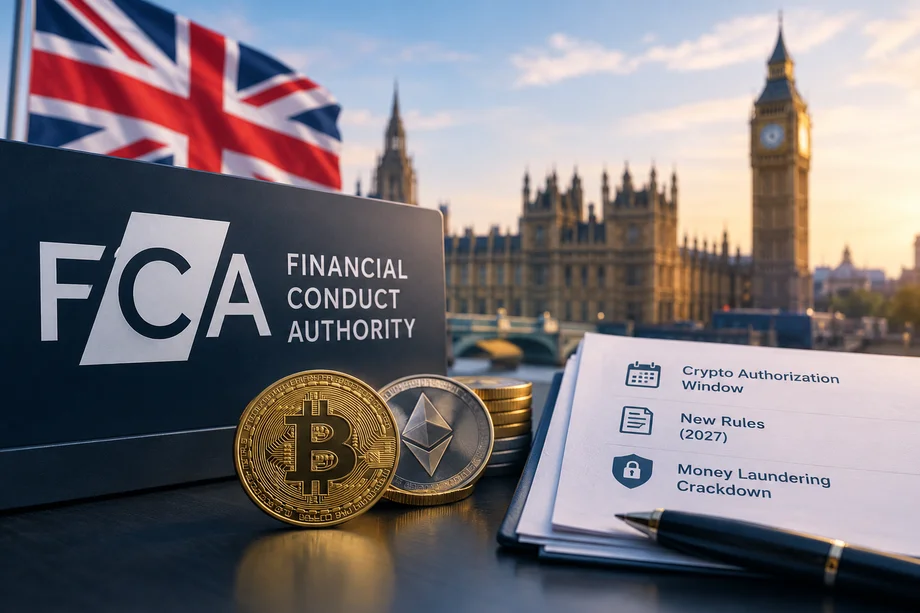
UK FCA Issues Crypto Authorization Guidance Ahead of 2027 Regime as Government Funds Anti-Laundering Drive

MiCA Costs and UK Rules Set to Drive Crypto Sector Consolidation Across Europe

Coinbase Rolls Out Nearly 4,000 U.S. Stocks for UK Users With 24/5 Trading
Latest articles

Telegram Cuts Gift Resale Fees to 2% and Moves Trading Onchain

EU Proposes Country-Wide Ban on Kyrgyz Crypto Exchanges in New Russia Sanctions Package

Bitcoin Core Wallet Rebroadcast Feature Can Link Addresses to Nodes

Switzerland's First Spot Bitcoin ETF Starts Trading on SIX Exchange