Newsroom
Trezor Shipping Partner Breach Exposes Data on 27,000 Orders as Scam Calls Start
17 November, 2026 / News / AI / Tags: trezor, skladon, shipping, email, breach
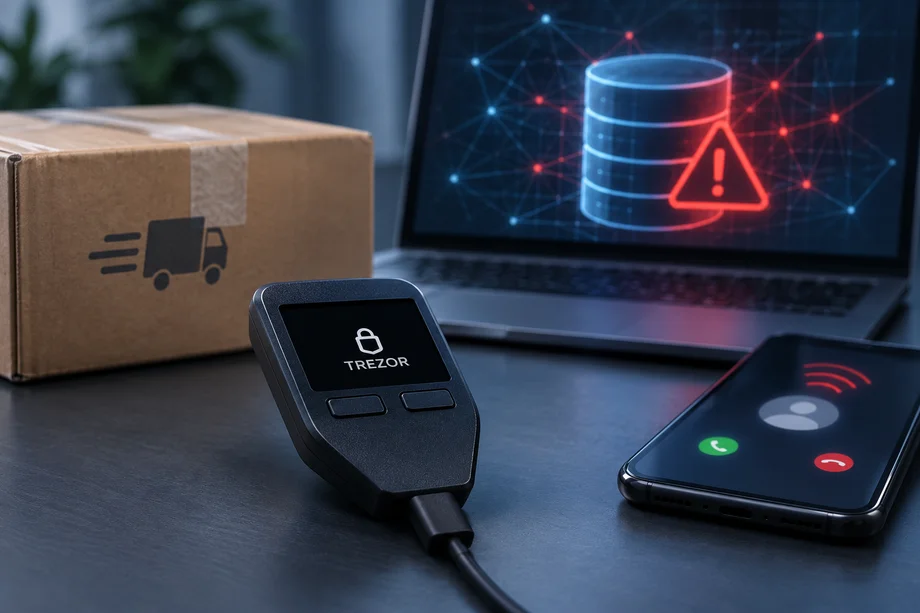
Hardware wallet maker confirms unauthorized access at Skladon exposed customer names, addresses and order details from August to November; company systems remain secure and no seed phrases were involved
Trezor has confirmed that a data breach at one of its shipping partners exposed personal and order information linked to roughly 27,000 hardware wallet purchases. The incident occurred at Skladon on November 7, with the logistics firm notifying Trezor on November 15. An attacker is believed to have exported the records, which cover orders placed between August 9 and November 7.
The exposed information includes full names, phone numbers, delivery addresses, email addresses, order dates, product names and prices. Trezor stated that its own systems were not compromised and that devices remain secure. Wallet backups, recovery phrases, PINs and passphrases were not part of the data held by the shipping partner and were not affected.
Scam Calls Already Reported
Some customers have already reported receiving fraudulent phone calls. Attackers can use the leaked details, such as the exact product purchased and its price, to make unsolicited contact appear legitimate. Trezor has warned users to treat any unexpected call, message or email about an order with caution and to verify concerns only through official channels on its website.
A limited number of buyers who ordered between August 9 and August 14 may also have been affected. Their records had already been anonymized under Trezor’s existing data-retention practices, so the company cannot contact them directly by email. Those customers are being informed through public statements.
Skladon does not handle shipments to the United States, meaning American customers were not included in this particular incident. Trezor has notified the relevant data protection authority and is continuing its investigation into how the unauthorized access occurred.
Pattern of Third-Party Incidents
The Skladon breach is the latest in a series of third-party security issues affecting Trezor customers this year. In August, logistics provider ShipMonk experienced a breach that ultimately involved records for more than 80,000 customers, including older U.S. order data from 2019 to 2021 that had been retained longer than expected. In September, an incident at email provider Brevo led to the export of roughly 347,000 marketing contacts and the distribution of phishing messages through compromised accounts.
These earlier events, combined with the current case, have prompted Trezor to tighten its data-handling requirements for partners. The company is reducing its standard order data retention period from 90 days to 45 days and intends to require shipping partners to adopt the same timeline. Further reductions are under consideration.
Steps to Limit Exposure Going Forward
Trezor has expanded its anonymous pickup option, now available in 18 European countries. The service allows buyers to use an alias and disposable email address and collect unbranded packages from lockers or collection points without providing a home address or phone number. Expansion to the United States is planned, though no launch date has been set.
The company continues to advise customers never to share recovery phrases, never to respond to unsolicited contact claiming to be from support, and to report suspicious activity through official support channels. Payment card details remain with payment processors and were not part of the shipping-partner data set.
Investigation into the Skladon breach remains active. Trezor has said it is reviewing security requirements across its third-party logistics relationships to reduce the risk of similar incidents.
Disclaimer
This article was generated by AI using information from multiple industry sources. It has not been reviewed or verified by a human editor and may contain inaccuracies, omissions, or misinformation. Readers are encouraged to independently verify any information before making decisions based on its content.Tired of the noise?
Let the bots trade for you.
Trade 24/7, without emotion, with data-driven strategies.
Associated articles

Trezor Confirms Additional 67,000 US Customers Hit by ShipMonk Data Breach

Trezor Confirms ShipMonk Breach Exposed Data of 13,689 Hardware Wallet Customers
SafePal Discloses Breach Exposing Order Details of Nearly 40,000 Customers
Keystone Confirms Website Breach Exposing Customer Shipping Details

Trezor and BitBox Warn of Phishing Emails After Third-Party Email Provider Breaches
Latest articles

Hong Kong Authority and Swift Expand Tokenized Deposit Tests for Cross-Border Payments

SELLAS Shares Surge After Phase 3 Leukemia Vaccine Cuts Death Risk by 41%

Grayscale Views Bitcoin Near $64,000 as Attractive Entry After 17% Drop

Uniswap Proposes Declining UNI Threshold to Free $300,000 in X Layer Fees