Newsroom
Thailand Finalizes Rules for Bitcoin and Ether ETFs on Main Exchange
9 October, 2026 / News / AI / Tags: thailand, etfs, notifications, chimphlapibul, bitkub

Thailand’s securities regulator completed a framework of 11 notifications allowing locally established Bitcoin and Ether exchange-traded funds to list on the Stock Exchange of Thailand, with the rules taking effect on October 16, 2026
Thailand’s Securities and Exchange Commission announced on October 8 that it has finalized regulations enabling the creation and listing of cryptocurrency exchange-traded funds. The new framework covers 11 notifications issued by the Capital Market Supervisory Board and the SEC’s office. These rules open a domestic channel for investors to gain exposure to Bitcoin and Ether through products traded exclusively on the Stock Exchange of Thailand.
The effective date of October 16 does not guarantee that any ETF will begin trading immediately. Asset management companies must first meet the full set of requirements covering fund structure, custody, personnel and systems before any product can launch.
Eligibility Limited to Bitcoin and Ether in Initial Phase
During the first stage, only Bitcoin and Ether qualify as underlying assets. Future expansion to additional cryptocurrencies will depend on factors such as liquidity, market acceptance, network security and investor protection standards. Each crypto ETF must operate as a passive vehicle designed to track the price of its single underlying asset. Funds are required to maintain an average net exposure of at least 80 percent of net asset value to that cryptocurrency over each accounting year.
Asset managers seeking approval must demonstrate qualified staff, adequate operating systems and appropriate arrangements with service providers. They may outsource digital asset investment management only to firms holding the relevant licenses. Fund assets must be held with digital asset custodians licensed and supervised in Thailand. Supervisors may appoint sub-custodians, provided digital asset custody services are performed by licensed entities. The regulator left open the possibility of allowing qualified overseas custodians at a later stage.
Investor Protections and Trading Restrictions
Brokers are prohibited from providing margin loans for purchases of crypto ETFs. Before trading, securities firms must explain the characteristics and risks of the products, and investors must confirm they understand those risks. Fund issuers are required to disclose details of investment structures, service providers and custody arrangements.
Access to overseas crypto ETFs remains restricted for retail clients. Securities companies may not facilitate investments in foreign crypto ETFs for customers who do not qualify as institutional or ultra-high-net-worth investors. Products linked to foreign crypto ETFs, including depositary receipts, are not permitted in the initial phase. Thai mutual funds and private funds may invest in the newly authorized domestic crypto ETFs, subject to existing investment limits. Previously, those vehicles could invest only in foreign crypto ETFs.
Chimphlapibul added that the actual results in Thailand will depend on the readiness of operators and the response from investors. Bitkub Online stated it is prepared to support transactions involving asset management companies planning Bitcoin and Ether ETFs, subject to applicable regulations. Nirun Fuwattananukul, chief executive of Binance TH by Gulf Binance, welcomed the decision and said the firm is ready to support fund launches through liquidity services and cooperation with asset managers.
Nares Laopannarai, president of the Thai Digital Asset Association, noted that institutional and traditional stock market investors have shown limited interest in digital assets so far, and that ETFs have not yet attracted substantial popularity in Thailand. The association plans to encourage cooperation among asset managers, brokers and digital asset companies on crypto ETFs and tokenized products.
Consultation Process and Implementation Timeline
The SEC conducted consultations on policy principles in April and May, followed by a further round on draft notifications in August and September. According to the regulator, most respondents supported the proposed framework. The final package includes Notification Sor Nor. 15/2569, which specifies the eligible cryptocurrencies, along with notifications addressing fund management, prospectus disclosures, client services, supervision and margin lending.
The October 16 start date marks the point at which asset managers may begin formal applications under the completed rules. No issuer, ticker symbol or confirmed trading launch date has been identified. Market participants will now focus on how quickly qualifying funds can be established and listed under the new domestic framework.


Disclaimer
This article was generated by AI using information from multiple industry sources. It has not been reviewed or verified by a human editor and may contain inaccuracies, omissions, or misinformation. Readers are encouraged to independently verify any information before making decisions based on its content.Tired of the noise?
Let the bots trade for you.
Trade 24/7, without emotion, with data-driven strategies.
Associated articles
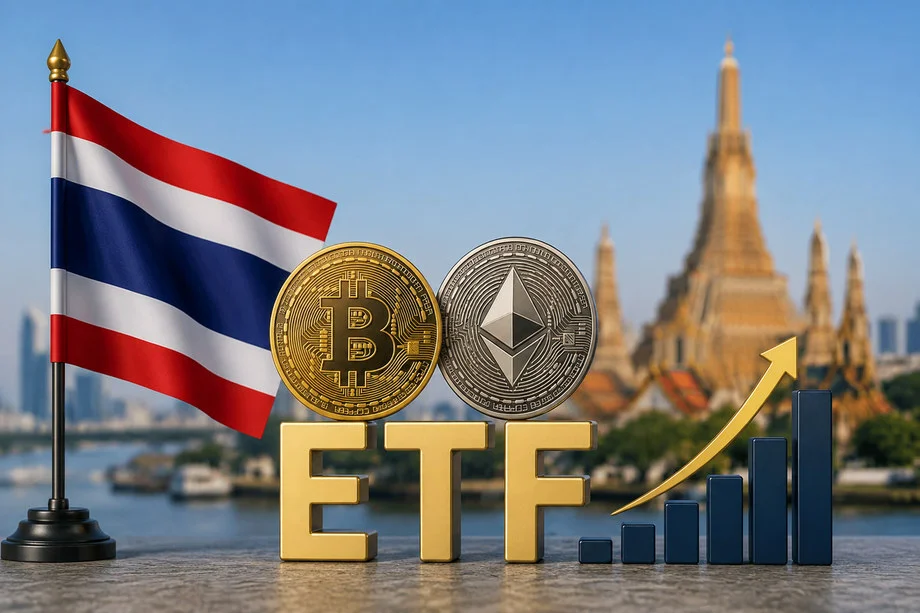
Thailand SEC Advances Draft Rules for Local Spot Bitcoin and Ether ETFs

Sberbank Prepares Crypto-Backed Corporate Loans as Russia’s New Rules Near

SEC Proposes Crypto Custody Framework for Investment Advisers and Funds

Japan Prepares Path for First Bitcoin ETF by 2028

Franklin Templeton Files for Bitcoin DRIP ETFs That Reinvest Stock Dividends Into Crypto
Latest articles
Blockchain.com Seeks CFTC Approval to Launch U.S. Event Contracts and Crypto Derivatives

New York Bans Celsius Founder Mashinsky for Life, Secures Up to 35 Million in Settlement

Bessent Warns of $1 Billion Iran Crypto Seizure as US Tightens Sanctions

MARA Holdings Transfers 996 Bitcoin Worth $81 Million to Galaxy Digital