Newsroom
Tether Gains Backing from 15 Mining Firms for Open Automation Platform
25 October, 2026 / News / AI / Tags: mdk, tether, mining, manufacturers, pools
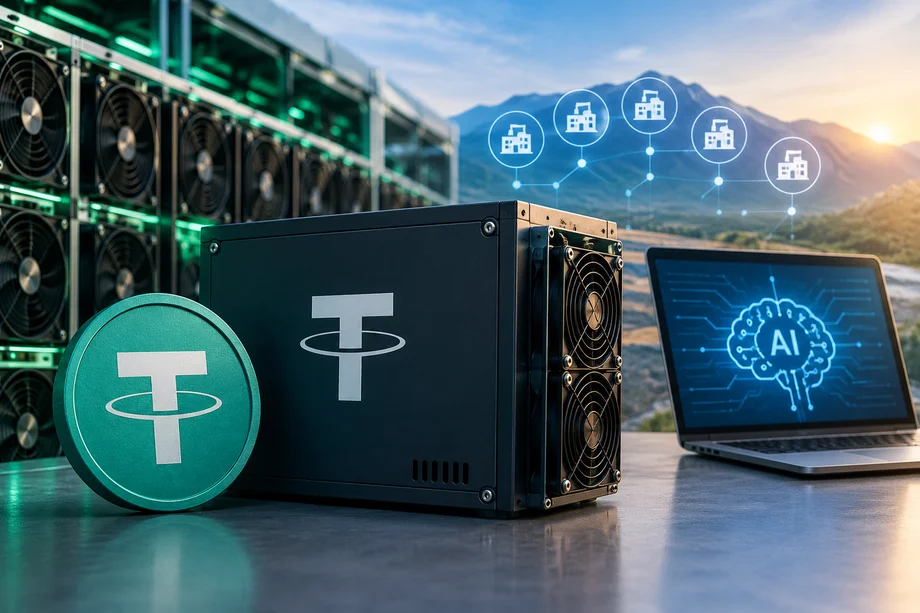
Fifteen Bitcoin mining companies, including major hardware makers and pools, have committed to integrating Tether’s open-source Mining Development Kit for shared control and AI readiness
Tether announced on October 24 that 15 Bitcoin mining industry participants have pledged to build and maintain integrations with its Mining Development Kit, or MDK. The open-source framework aims to give operators a single interface for machines and systems from different manufacturers, paving the way for broader automation and AI-driven management. The commitments were revealed at the Plan ₿ Forum in Lugano.
The signatories span hardware producers, mining pools and related operators. They include Bitmain, MicroBT, Canaan, Bitdeer and Proto by Block among the equipment side, along with pools such as Foundry Digital, F2Pool, Luxor Technology, OCEAN, SpiderPool and EMCD. Additional participants are ACME Swisstech, Elektron Energy, Heatbit and Stratum V2.
Shared Interface Across Manufacturers and Pools
Large mining operations commonly run equipment from multiple vendors alongside different cooling systems and pool connections. Each typically requires its own management software, forcing operators to maintain separate tools or custom links. MDK addresses this through components called Workers. Each participating company will develop and maintain a Worker that acts as a translation layer, converting its proprietary protocols into MDK’s common format.
The architecture includes a Kernel that receives data and issues instructions, plus a Gateway that exposes a unified interface for applications and dashboards. Companies retain full control of their systems and decide which functions to expose. Developers can then build monitoring tools, control systems or AI agents once against the shared layer instead of adapting code for every manufacturer and pool.
The public repository is released under the Apache 2.0 license. It already includes an MCP server based on the Model Context Protocol for AI agent connections and a component library for building dashboards. The software is designed to run on Windows, macOS and Linux and to scale from home setups to industrial facilities.
AI Agents and the QVAC Demonstration
Tether positions MDK as infrastructure for the next phase of mining automation, in which software actively manages physical equipment rather than only reporting status. The company stated that its QVAC mining agent already operates directly on MDK. QVAC is Tether’s AI platform. Specific tasks performed by the agent and the sites where it runs were not disclosed.
The common interface is intended to let AI applications monitor equipment, detect issues and adjust operations in response to changing conditions without requiring separate connections for each system. No independent performance data on electricity use, output or maintenance costs was provided.
Development Path and Remaining Questions
MDK builds on earlier work. Tether released MiningOS, an open-source operating system for mining sites, in February. MDK followed on April 27 as the development foundation for MiningOS and other applications. Version 0.11 was presented at the Lugano forum. The first stable release, version 1.0, is targeted before the end of 2026.
The October announcement covers commitments to develop and maintain Workers. It does not state that any integrations are already live across production sites, nor does it set individual delivery deadlines. Governance rules for protocol changes, financial arrangements between Tether and the participants, and direct statements from the signatories were not detailed.
Developers can already access the framework, including a demonstration environment with mock hardware, to test integrations and build applications. Tether has invited additional manufacturers, pools, operators and software developers to join.
For site operators, the practical value lies in reduced dependence on proprietary vendor software and the ability to automate across mixed fleets. For manufacturers and pools, participation allows selective exposure of functions while remaining inside a shared ecosystem. Real-world results will depend on the quality and reliability of the completed Workers and on how sites implement permissions and override controls when software issues commands to industrial equipment.
Disclaimer
This article was generated by AI using information from multiple industry sources. It has not been reviewed or verified by a human editor and may contain inaccuracies, omissions, or misinformation. Readers are encouraged to independently verify any information before making decisions based on its content.Tired of the noise?
Let the bots trade for you.
Trade 24/7, without emotion, with data-driven strategies.
Associated articles

Tether Ignites Local-First AI Revolution with New Developer Grants Program
Nvidia Unveils Open Agent Safety Platform to Contain Autonomous AI Systems

Ripple Joins x402 Foundation to Advance AI Agent Payments on XRP Ledger

Poolin, Once Bitcoin's Top Mining Pool, Files for Chapter 11 Bankruptcy
Nvidia Reportedly Agrees to $12.9 Billion Purchase of Hugging Face
Latest articles
Keystone Confirms Website Breach Exposing Customer Shipping Details

Hamilton ETFs Declare Monthly Distributions for Four Canadian Financial Funds

Kraken Ends Trading on 13 Tokens, Sets January 2027 Withdrawal Deadline

Trump Announces $4.2 Billion Audi Plant in Georgia Ahead of Midterms