Newsroom
Study Finds Nearly Two-Thirds of Amazon Religious Books Likely Written by AI
24 August, 2026 / News / AI / Tags: witchcraft, amazon, written, originality, fraiman
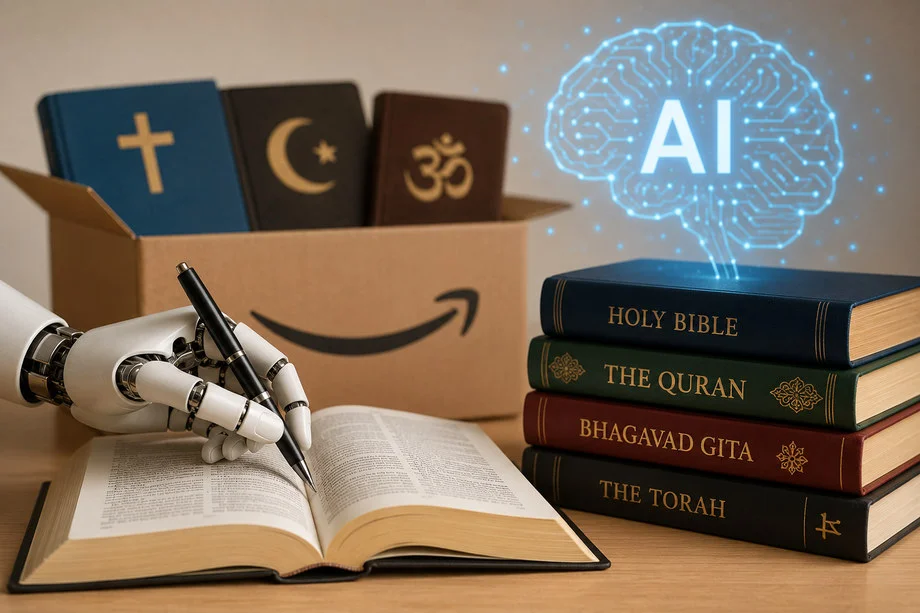
Originality.ai analysis of more than 2,000 titles shows witchcraft, Hinduism and Taoism categories with the highest rates of probable machine-generated content
A new analysis by AI detection firm Originality.ai has found that 63 percent of recently published religious and spiritual books sold on Amazon were likely produced by artificial intelligence rather than human authors. The study examined 2,034 titles across 14 faith and belief categories and classified 1,272 of them as likely AI-written.
Researchers applied the company’s scoring model to book descriptions, author biographies and text samples available on the platform. Content scoring 50 or higher was labeled “Likely AI.” Report author Michael Fraiman stressed that the results measure probability, not definitive proof of authorship.
Highest Rates in Witchcraft, Hinduism and Taoism
The witchcraft category, drawn from Amazon’s Wicca, Witchcraft & Paganism listings, recorded the highest share at 78 percent. Many of those titles focused on healing crystals, herbal remedies and methods for cleansing negative energy. Fraiman noted that such books often target readers seeking self-help or detox solutions and face no requirement to meet scientific standards.
Hinduism followed at 76 percent and Taoism at 74 percent. Categories covering Sikhism, Buddhism, Islam, Catholicism, Protestantism, Orthodox Christianity and Judaism fell in the middle range. Mormonism registered 42 percent, atheism 40 percent and Satanism the lowest at 22 percent. The researchers cautioned that sample sizes differed substantially across categories, limiting direct comparisons.
In the witchcraft titles, the team also examined factual claims that could be verified. They flagged 53 percent of those claims as potentially false, raising questions about the reliability of AI-generated spiritual guidance on health and wellness topics.
Amazon’s Disclosure System and Broader Concerns
Amazon requires authors to self-identify AI-written works under an honor system. Originality.ai shared no findings with the company before publication and has no data on how many authors actually disclose AI involvement. Amazon did not immediately respond to requests for comment.
The findings arrive amid separate scrutiny of how physical books are used to train AI systems. An investigation tracked rare volumes to an Amazon facility in Las Vegas where workers removed bindings and scanned pages. The company confirmed it purchases books through commercial channels to develop and improve products and services, though it stopped short of detailing AI training use.
Limitations of Detection Technology
AI detection tools remain imperfect. Tests of multiple detectors on the U.S. Declaration of Independence in 2024 produced sharply conflicting results, ranging from nearly 98 percent AI-generated to entirely human-written. In a more recent case, Colombia’s Supreme Court rejected a legal filing flagged as AI-generated; the same detector later rated the court’s own ruling as 93 percent AI-written.
Fraiman said the research team manually reviewed many flagged titles and has developed confidence in distinguishing likely machine-generated prose from human writing. Still, the company frames its scores as estimates of likelihood rather than conclusive evidence.
The study underscores the growing presence of machine-generated text in commercial religious publishing and the limited transparency surrounding both content disclosure and the sourcing of training material for the systems that produce it.

Disclaimer
This article was generated by AI using information from multiple industry sources. It has not been reviewed or verified by a human editor and may contain inaccuracies, omissions, or misinformation. Readers are encouraged to independently verify any information before making decisions based on its content.Tired of the noise?
Let the bots trade for you.
Trade 24/7, without emotion, with data-driven strategies.

Latest articles

Malaysia Central Bank Unveils Tokenized Bond Platform Enabling Round-the-Clock Settlement

Securitize Partners with Anchorage Digital Bank for Direct Stablecoin Minting

Kalshi Partners With BitGo on Crypto-Backed Loans for Perpetual Futures Margin

Shinhan Card and SBI Units to Test Yen Stablecoin Payments for Japan-Korea Travel