Newsroom
SpaceX Strikes $8 Billion Deal for Nationwide 800 MHz Spectrum to Power Starlink Mobile
9 October, 2026 / News / AI / Tags: spectrum, grain, satellite, mobile, spacex
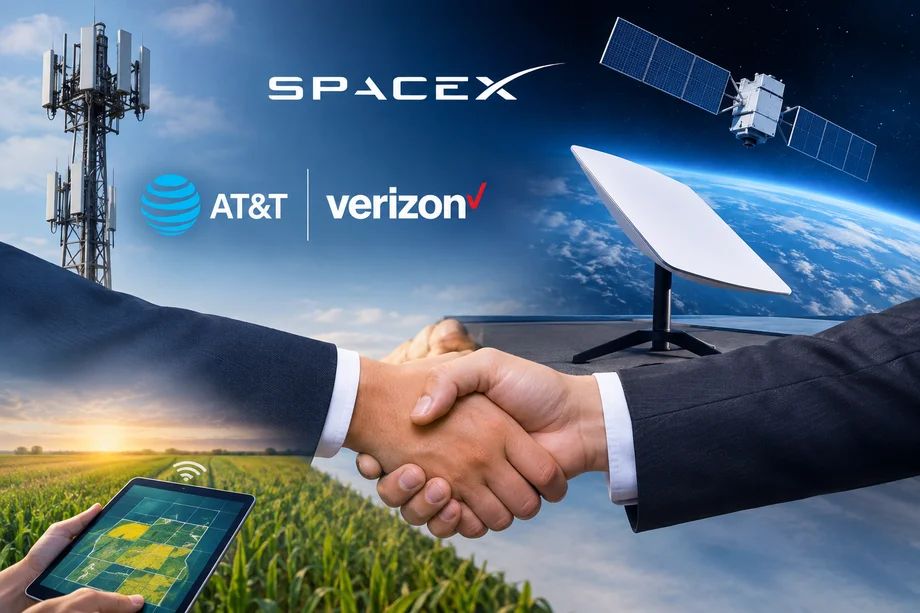
The cash purchase of low-band licenses from Grain Management aims to enable direct-to-device satellite service and fuller U.S. mobile coverage, pending FCC approval, while pressuring major carrier shares in after-hours trading
SpaceX has agreed to acquire a nationwide portfolio of 800 MHz low-band spectrum licenses from Grain Management in a transaction valued at approximately $8 billion in cash. The deal, announced on October 8, 2026, covers up to 14 megahertz of paired spectrum and is intended to support the expansion of Starlink Mobile into broader U.S. wireless services.
The licenses would allow SpaceX to combine its satellite network with terrestrial capabilities, addressing indoor coverage limitations that have constrained satellite-to-cell offerings. Low-band spectrum travels farther and penetrates buildings more effectively than higher-frequency bands, and it is already supported by most existing mobile devices. SpaceX plans to integrate the spectrum with Starlink’s satellite-to-cell service once regulatory hurdles are cleared.
Deal Terms and Regulatory Path
The agreement is structured as an all-cash transaction and remains subject to Federal Communications Commission approval along with other customary closing conditions. Grain Management holds the full nationwide portfolio, which it acquired from T-Mobile in August 2026 through a combination of cash and its own 600 MHz spectrum. The FCC had approved that earlier transfer in a July 2026 order that also established a framework for direct-to-device satellite deployment.
Grain Management, founded in 2007 and focused on digital infrastructure investments including fiber, data centers, wireless spectrum and cell towers, described the sale as placing scarce low-band spectrum into productive use for next-generation satellite services. BDT & MSD Partners advised Grain on financial aspects, with Milbank providing legal counsel and Latham & Watkins handling regulatory matters.
SpaceX Chief Executive Elon Musk characterized the acquisition as a significant step toward nationwide mobile coverage.
He further described the spectrum as a key remaining resource needed for Starlink to deliver complete phone coverage across the United States and to position Starlink Mobile as a major carrier.
Market Reaction and Competitive Implications
Shares of major U.S. wireless carriers declined sharply in after-hours trading following the announcement. AT&T fell 7.3 percent, while T-Mobile and Verizon each dropped 6.6 percent in one set of reports; other accounts noted declines exceeding 5 percent across the three carriers. Later trading showed partial recovery, with AT&T closing at $23.23, up 1.63 percent on the day, and Verizon finishing at $43.52, up 1.27 percent.
SpaceX shares, trading under the ticker SPCX, rose 1.5 percent immediately after the news in one report. On the regular session they closed at $160.57, down 4.19 percent from the prior close of $167.60, before rebounding to $165.48 in after-hours activity. Volume reached approximately 68.5 million shares against an average near 93 million. The company continues to report a trailing twelve-month loss, with earnings per share at -1.10.
The transaction expands SpaceX’s role beyond pure satellite connectivity into services that compete more directly with established terrestrial operators. Until now, Starlink’s mobile efforts have largely relied on partnerships, including arrangements with T-Mobile for basic remote coverage. Ownership of the 800 MHz licenses could enable SpaceX to offer service directly to consumers over time by blending satellite links with small cells, rooftop equipment or conventional towers.
Separately, the FCC has already authorized up to 15,000 next-generation satellites for direct-to-cell operations, providing additional regulatory support for the technical approach SpaceX intends to pursue. Completion of the spectrum purchase would mark a concrete advance in that strategy, though the timeline remains dependent on the Commission’s review.
The deal places Grain’s earlier acquisition from T-Mobile into a new context of satellite-terrestrial convergence. Grain had explored multiple potential uses for the portfolio after purchasing it; the agreement with SpaceX advances the objective of expanding connectivity for consumers while aligning with the FCC’s stated goals of broader coverage and productive spectrum utilization.
Details on the precise deployment timeline and commercial model for Starlink Mobile remain limited pending regulatory clearance. Market attention is expected to focus on the FCC process, any responses from incumbent carriers, and further information on how the spectrum will be paired with the satellite constellation.

Disclaimer
This article was generated by AI using information from multiple industry sources. It has not been reviewed or verified by a human editor and may contain inaccuracies, omissions, or misinformation. Readers are encouraged to independently verify any information before making decisions based on its content.Tired of the noise?
Let the bots trade for you.
Trade 24/7, without emotion, with data-driven strategies.
Associated articles
SpaceX Shares End Week Lower Amid Analyst Optimism on Revenue Surge and Caution on Mobile Plans

Helium Token Surges Nearly 100% After Texas City Converts Wi-Fi to Mobile Coverage
SpaceX Stock Rebounds From Record Low as Earnings and $104 Billion Share Unlock Loom

Cathie Wood's ARK Invest Adds $18.3M to SpaceX Stake at Post-IPO Low

Solana Company Posts $30.3 Million Q2 Loss as Digital Asset Write-Downs Offset Staking Income
Latest articles
Blockchain.com Seeks CFTC Approval to Launch U.S. Event Contracts and Crypto Derivatives
New York Bans Celsius Founder Mashinsky for Life, Secures Up to 35 Million in Settlement

Bessent Warns of $1 Billion Iran Crypto Seizure as US Tightens Sanctions
MARA Holdings Transfers 996 Bitcoin Worth $81 Million to Galaxy Digital