Newsroom
Shinhan Card and SBI Units to Test Yen Stablecoin Payments for Japan-Korea Travel
22 October, 2026 / News / AI / Tags: sbi, shinhan, card, xdc, yen
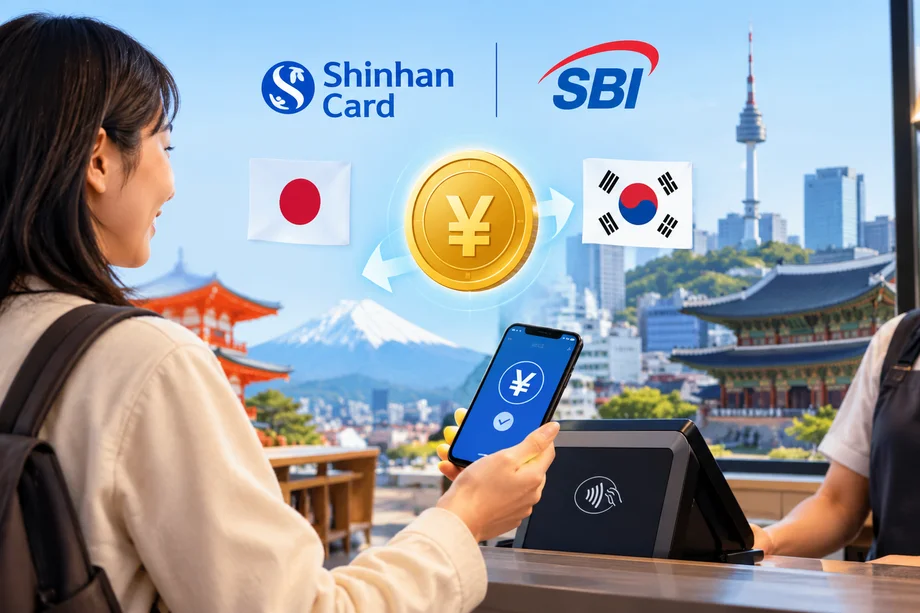
South Korea’s Shinhan Card and two SBI Holdings subsidiaries signed an agreement to explore yen-backed stablecoin use in card payments, wallet transfers and trade settlement between the countries
South Korean credit card issuer Shinhan Card has entered a memorandum of understanding with two units of Japan’s SBI Holdings to examine the use of yen-denominated stablecoins for cross-border payments. The pact, signed in Tokyo on October 20 and announced the following day, focuses on proof-of-concept work rather than an immediate commercial service.
The partners are SBI VC Trade, a licensed cryptocurrency exchange within the SBI Group, and SBI XDC Network APAC, a joint venture focused on blockchain infrastructure for trade finance. Together with Shinhan Card they plan to assess whether yen stablecoins can support in-store card payments by Japanese visitors in South Korea, peer-to-peer wallet transfers, and settlement of commercial trade transactions.
Scope of the Collaboration
Under the agreement the companies will test card-linked merchant payments that aim to preserve a conventional checkout experience while using stablecoin balances. Parallel workstreams cover wallet-to-wallet transfers and the application of stablecoins to cross-border trade settlement. The trials will also evaluate anti-money-laundering procedures and fraud-detection systems required for digital-asset payments.
No specific yen stablecoin has been designated for the tests, and the parties have not published trial dates, merchant lists or transaction limits. The initiative remains at the exploratory stage; the companies have stated that further details will be released as the work progresses. SBI Holdings described the effort as a phased collaboration intended to connect digital assets with existing financial and payment infrastructure.
Shinhan Card serves approximately 20 million cardholders. The agreement does not indicate whether those members will participate in the trials or how pilot users would be selected.
Tourism Corridor and Prior Digital-Asset Work
Official tourism statistics show substantial two-way travel that could form a natural use case. In the first eight months of 2026, Japan recorded 7.42 million arrivals from South Korea, while South Korea recorded 2.7 million arrivals from Japan. Combined visitor arrivals exceeded 10.1 million.
Shinhan Card previously completed a proof-of-concept exercise on stablecoin payments and overseas settlement in April. Its parent, Shinhan Financial Group, later agreed with Visa in August to explore stablecoin issuance, transfers and card settlement. On the Japanese side, SBI VC Trade obtained authorization in March 2025 to handle electronic payment instruments and began offering Circle’s USDC. SBI also distributes JPYSC, a yen-backed stablecoin issued by SBI Shinsei Trust Bank, which had approximately 20.1 billion yen, or $127 million, in circulation as of early September. The companies have not confirmed whether JPYSC will be used in the Shinhan trials.
Additional Workstreams
Beyond consumer payments, the partners will examine whether stablecoins can improve the speed and efficiency of commercial settlement between Japanese and South Korean businesses. SBI XDC Network APAC and Shinhan Card will also review potential participation in the XDC Network node ecosystem and related infrastructure development. No commitment to operate a new node has been announced.
The October 20 signing ceremony in Tokyo was attended by Shinhan Card President Park Chang-hoon, SBI VC Trade President Tomohiko Kondo and SBI XDC Network APAC Chief Operating Officer Tadashi Yoshida. Both Japanese executives are associated with the SBI units involved in the project.
The collaboration does not launch a payment service. Any decision on commercial viability will follow the planned assessments of transaction processes, user experience and operating arrangements.
Disclaimer
This article was generated by AI using information from multiple industry sources. It has not been reviewed or verified by a human editor and may contain inaccuracies, omissions, or misinformation. Readers are encouraged to independently verify any information before making decisions based on its content.Tired of the noise?
Let the bots trade for you.
Trade 24/7, without emotion, with data-driven strategies.
Associated articles

SBI Group and Kyobo Life Complete Direct Yen-Won Stablecoin Cross-Border Pilot

Four Firms Test AI Agents for Secure Crypto Payments Aimed at Japanese Tourists in South Korea

Dunamu and Visa Form Partnership to Explore Stablecoin Payments and AI Commerce
Toss Bank Partners with Solana for Stablecoin Remittance Pilot
SBI DigiTrust Partners with Korean Firms on Japan-South Korea Stablecoin QR Payments
Latest articles

French 10-Year Bond Yield Surpasses 5% for First Time Since 2002
Ledger Rolls Out Bitcoin-Backed Stablecoin Loans in Wallet App via Morpho
Malaysia Central Bank Unveils Tokenized Bond Platform Enabling Round-the-Clock Settlement

Securitize Partners with Anchorage Digital Bank for Direct Stablecoin Minting