Newsroom
Prediction Markets Show Wide Price Gaps on Identical 2026 Midterm Questions
28 August, 2026 / News / AI / Tags: kalshi, polymarket, predictions, odds, free
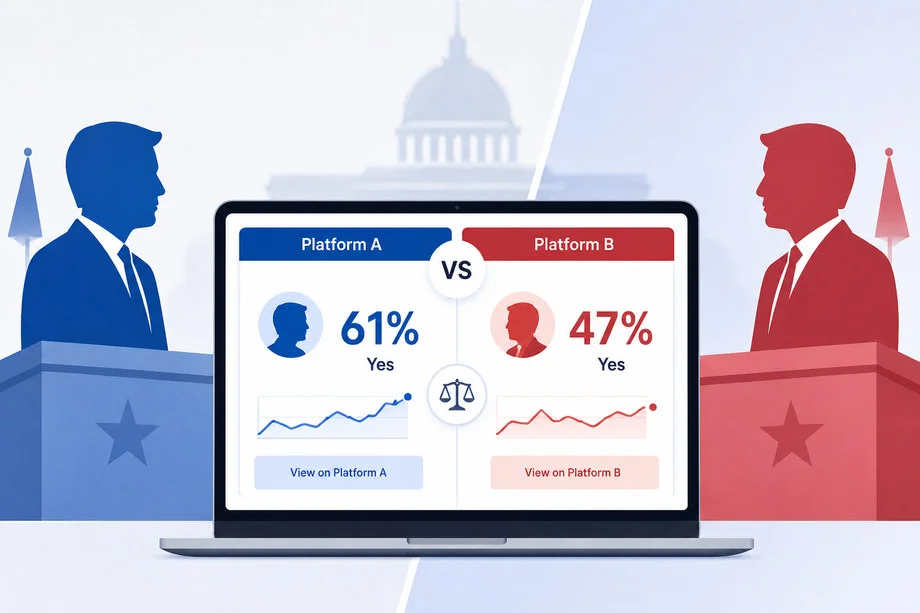
Predictions.io introduces free tools to compare odds and fees across Kalshi, Polymarket and Manifold as volumes hit records and regulatory attention grows
Prediction markets reached unprecedented scale in July, yet identical questions on different platforms continue to produce markedly different prices. A new aggregation service now makes those differences visible in one place and supplies free calculators that show the true cost of a trade after fees.
Record Volume Meets Regulatory Pressure
Kalshi, Polymarket and Polymarket US together recorded $50.59 billion in combined trading volume during July. Kalshi alone accounted for approximately 74.5 percent of that total. The same month brought heightened scrutiny: New York City opened an investigation into the two leading venues, a Washington judge directed Kalshi to stop most wagering in the state, and the Commodity Futures Trading Commission began an internal examination of so-called mention markets.
Against this backdrop, an elementary issue has received less attention. When two platforms list the exact same question, do their prices agree?
Identical Wording, Divergent Odds
Data compiled by Predictions.io show that they frequently do not. On the question “Blue tsunami in 2026?” the price stood at 44.5 percent on Polymarket and 36.0 percent on Kalshi. The question “Blue wave in 2026?” traded at 82.5 percent on one venue and 74.0 percent on the other. Both gaps measured 8.5 percentage points even though the wording matched precisely. Across a broader sample of binary markets that appear on more than one platform, the median difference exceeded four points, and nearly half of the pairs differed by five points or more. The figures were recorded at 05:08 UTC on 28 August 2026.
Such spreads mean that a single quoted probability can be misleading. A contract priced at 44.5 percent on one venue and 36.0 percent on another does not represent one market-implied likelihood; it represents two. Which number is reported becomes an arbitrary choice unless both figures are disclosed.
Aggregation and Free Comparison Tools
Predictions.io gathers contracts from Kalshi, Polymarket and Manifold and matches equivalent questions so users can view the same event side by side. The service currently covers more than 9,700 event pages spanning 23 categories that include United States politics, economics, cryptocurrency, sport and geopolitics.
Two free utilities accompany the comparison pages. A fee calculator accepts any proposed trade and returns the fee, total outlay and effective all-in price on each venue. It incorporates Kalshi’s taker formula of 0.07 multiplied by price multiplied by one minus price, together with maker discounts, and contrasts those charges with Polymarket’s zero-fee standard markets. An odds converter translates American, decimal and fractional odds into implied probabilities and prediction-market prices while also displaying the vig-free line.
The platform itself does not operate markets and holds no positions in any contract. It functions solely as a data and comparison service, neither an exchange nor a broker nor an investment adviser.
By placing prices from the major venues next to one another and quantifying the after-fee cost of each trade, the tools aim to give traders and journalists a clearer view of where prediction-market consensus begins and ends.
Disclaimer
This article was generated by AI using information from multiple industry sources. It has not been reviewed or verified by a human editor and may contain inaccuracies, omissions, or misinformation. Readers are encouraged to independently verify any information before making decisions based on its content.Tired of the noise?
Let the bots trade for you.
Trade 24/7, without emotion, with data-driven strategies.
Associated articles
Senate Democrats Push for Public Hearing on Prediction Markets After Private Kalshi Meeting

Meta Enters Prediction Markets with Arena App
LayerZero Unveils ATLAS Trading Infrastructure as ZRO Climbs Over 16%

LeBron James Teases Partnership With Polymarket After Free Agency Move

ESMA Flags Authorization Shortfalls for Polymarket and Kalshi in EU Prediction Markets
Latest articles

SpaceX and Tesla Set Up Committees to Explore Merger That Would Combine Holdings of Over 30,000 Bitcoins

UK Banks Face Thousands of Complaints Over Crypto Transfer Restrictions
Ripple Backs SEC Proposed Crypto Asset Rules After $150 Million Legal Battle

Blockchain.com Introduces Options Trading on Seven Major Crypto Assets