Newsroom
Phantom Opens Kalshi Prediction Markets to US Users Amid State Legal Challenges
25 October, 2026 / News / AI / Tags: phantom, kalshi, states, prediction, sports
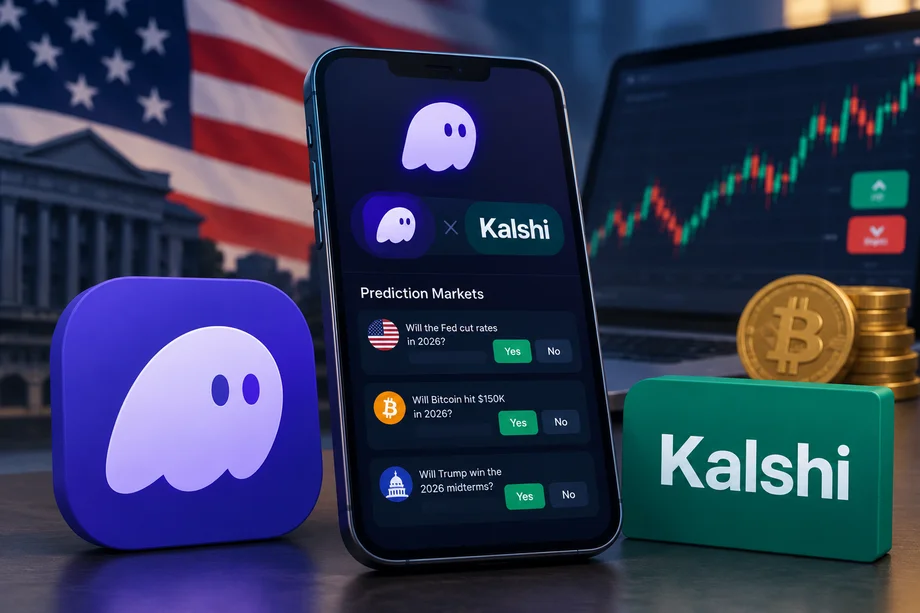
Crypto wallet begins staged rollout of regulated event contracts for eligible Americans, with identity checks, stablecoin funding and selective market limits in three states
Phantom has begun offering eligible United States users access to Kalshi prediction markets inside its mobile wallet application. The staged rollout started on October 23, 2026, and will expand over the coming weeks, allowing customers to trade event contracts on sports, politics, economics, culture and other categories without leaving the app.
Users must create or link a Kalshi account and complete the exchange’s identity verification process before placing trades. Verification typically requires a United States phone number, legal name, date of birth, residential address, Social Security number and government-issued identification. Kalshi may use third-party providers for document checks or live selfies. Once approved, funds are deposited at Kalshi for trading while available proceeds return to the user’s Phantom Cash account.
Funding, Fees and Operational Details
Trades are primarily funded with CASH, Phantom’s dollar-pegged stablecoin issued on Solana. Money moves from the Phantom Cash balance to Kalshi, where it is converted for settlement. Winning positions or cash-outs flow back to the Cash account, usually within seconds to minutes after settlement, though small residual amounts below Kalshi’s withdrawal threshold may remain at the exchange.
Combined trading fees total $0.02 per contract—$0.01 charged by Phantom and $0.01 charged by Kalshi—plus a variable network fee for transferring funds. Users see a full quote including fees before confirming any order. Phantom operates as a non-custodial interface and does not hold customer assets or exercise discretion over order routing. Kalshi remains the registered exchange that sets market rules, executes trades and determines outcomes.
Regulatory Framework and No-Action Relief
The launch rests on conditional no-action relief granted by the Commodity Futures Trading Commission’s Market Participants Division in March 2026. Staff Letter 26-09 stated that the agency would not recommend enforcement action against Phantom for failing to register as an introducing broker solely for providing specified software that routes orders directly to registered partners. The relief permits transaction-based fees and revenue-sharing arrangements provided disclosures are made and funds securing positions are held by a clearing organization or futures commission merchant. Phantom does not hold customer assets under the arrangement.
The letter’s terms require users to retain independent access to the partner exchange and remain in effect until Commission rulemaking or guidance supersedes them. Phantom has stated that the model applies only to a custodial arrangement with a registered exchange partner and excludes decentralized finance derivatives or tokenized prediction markets.
State Restrictions and Ongoing Litigation
Access is subject to temporary category-based limits in three states while litigation continues. In Michigan, sports markets are blocked. Nevada restricts sports, elections, politics and entertainment contracts. Washington imposes the broadest limits, covering sports, elections, politics, entertainment, culture, science and technology, mentions and geopolitics. Phantom has indicated these restrictions may adjust as court cases progress.
Multiple states are contesting Kalshi’s position that federal derivatives oversight preempts state gambling laws. Utah filed a civil lawsuit seeking recovery of fees the state views as unlawful, while other jurisdictions have pursued geolocation controls or injunctions. Phantom has said it will observe existing state limits during the disputes and expects the United States Supreme Court may ultimately resolve the core jurisdictional questions.
Kalshi has made its full catalog available; Phantom determines which markets appear in the wallet interface. The company previously offered prediction-market access outside the United States through different arrangements and shifted certain non-United States activity to an on-chain protocol earlier in 2026. The current United States offering is a separate, regulated channel through Kalshi itself.
Users are advised that displayed profits do not guarantee immediate exits, as cashing out requires a counterparty and thin liquidity can result in no quote or a lower sale price. Market-resolution disputes and account restrictions are directed to Kalshi, while other support matters are handled by Phantom.
Disclaimer
This article was generated by AI using information from multiple industry sources. It has not been reviewed or verified by a human editor and may contain inaccuracies, omissions, or misinformation. Readers are encouraged to independently verify any information before making decisions based on its content.Tired of the noise?
Let the bots trade for you.
Trade 24/7, without emotion, with data-driven strategies.
Associated articles

CFTC Blocks Michigan Court Order, Forces Kalshi to Honor Trades
CFTC Warns Prediction Markets Against American-Style Gambling Odds

Federal Judge Blocks Minnesota Prediction Market Ban Ahead of August Deadline

Judge Denies Kalshi Bid to Block New York Gambling Law Enforcement

CFTC Orders Kalshi to Keep Trading After New York Seeks $36 Billion Shutdown
Latest articles

Mysterious Poems Repeatedly Appear on Bitcoin Blockchain Over 12 Days

Arthur Hayes Closes Maelstrom Positions With $22.28 Million Token Sales

Global X Canada Sets Monthly Distributions Across Four ETFs

IRS Plans Lower Penalties and Faster Resolutions for Voluntary Tax Disclosures, Including Crypto