Newsroom
Payward Spends Billions to Transform Kraken Parent Into Broad Financial Infrastructure Platform
26 September, 2026 / News / AI / Tags: payward, sethi, kraken, arjun, infrastructure
Parent of crypto exchange Kraken deploys capital across futures, banking, tokenization and institutional services while targeting 2027 launches with major stock exchanges
Payward, the Wyoming-based parent company of the cryptocurrency exchange Kraken, has invested billions of dollars over the past two years to expand far beyond digital-asset trading. The firm is assembling capabilities in futures, banking, asset management and enterprise services with the aim of operating a unified financial infrastructure platform.
Co-CEO Arjun Sethi described the approach as building around a single ledger that allows money and assets to move between products without the multiple intermediaries common in traditional finance. “We’re not a holding company,” Sethi said. “It’s one platform, one balance sheet, one regulatory stack.”
Major Acquisitions and Banking Ambitions
Payward paid $1.5 billion to acquire NinjaTrader, securing a U.S. futures brokerage along with its technology and regulatory permissions. Management indicated that building equivalent capabilities from scratch would have been both costly and time-consuming. The company followed that purchase with a $550 million deal for Bitnomial, which added a regulated derivatives exchange, a clearinghouse and futures brokerage infrastructure.
Sethi confirmed that Payward is preparing to buy a bank in Europe but did not name the target. Earlier reports linked the plan to a Lithuanian lender. In the United States, the group already operates Kraken Financial, a Wyoming-chartered special-purpose depository institution that supports payments and related banking functions.
Tokenization Partnerships With Nasdaq and London Stock Exchange
Nasdaq agreed this month to invest $100 million in Payward while deepening collaboration on Nasdaq Equity Tokens and market-surveillance technology. The companies plan to launch the tokens in the second quarter of 2027, with Payward supplying distribution, trading and post-trade infrastructure.
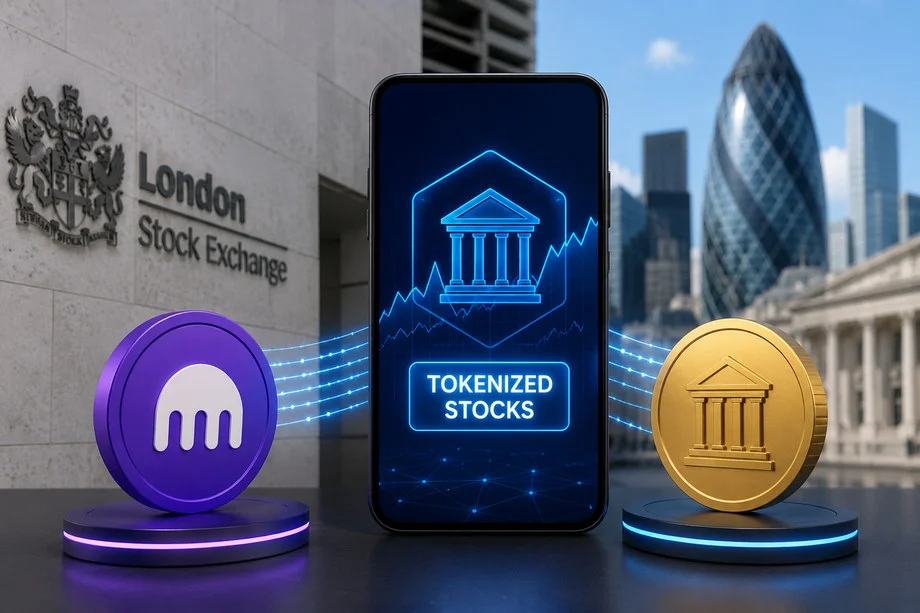
Separately, the London Stock Exchange is working with Payward on tokenized public equities. Subject to regulatory approval, xStocks—tokenized representations of publicly traded shares—are expected to list on the forthcoming LSE 24 platform in 2027.
Sethi framed these partnerships as complementary rather than competitive, noting that established exchanges possess listing expertise and regulatory relationships that blockchain infrastructure alone cannot replace. “Trust is their currency,” he said.
Four Business Pillars and Institutional Reach
Payward has organized its operations into four pillars: the Kraken trading platform, banking, asset management and Payward Services, the division that sells infrastructure to external firms. Kraken currently serves approximately 6.6 million funded accounts holding between $40 billion and $50 billion in assets across more than 190 countries and territories. Average daily spot trading volume stood near $1.1 billion in the first four months of 2026.
Payward Services packages custody, liquidity, compliance, risk controls, payments and settlement into a single API. At least 25 companies, including Hyperliquid, are expected to launch products on the infrastructure this year. The asset-management arm is formalizing custody, staking and yield offerings, beginning with tokenized equities and a recent partnership with Bitwise.
Architect Partners, a digital-assets investment bank, characterized Payward’s strategy as an “Everything Financial Infrastructure” model that can power products across multiple brands and partner channels, distinct from approaches that concentrate activity inside a single consumer-facing exchange.
Financial Performance and Public Listing Timeline
Payward reported $508 million in adjusted revenue for the second quarter of 2026, a 17 percent increase from the same period a year earlier. The company remains profitable and is financing its expansion from its balance sheet rather than relying on external capital for operations. Recent fundraising rounds have brought in strategic partners such as Citadel Securities and Nasdaq.
Payward confidentially submitted an IPO application in November 2025. It does not expect to list shares before the second quarter of 2027 at the earliest. Sethi said the timing will depend on what is appropriate for the business, shareholders and regulators.
On the regulatory front, Sethi expressed limited concern about the absence of comprehensive U.S. crypto market-structure legislation. “Bitcoin has been around for 17 years without a market-structure bill,” he said. “Rights come first and laws come later and legislation comes downstream.”
The company’s long-term objective is to use blockchain technology to simplify financial infrastructure so that individual users can access the same rails employed by sophisticated trading firms.
Disclaimer
This article was generated by AI using information from multiple industry sources. It has not been reviewed or verified by a human editor and may contain inaccuracies, omissions, or misinformation. Readers are encouraged to independently verify any information before making decisions based on its content.Tired of the noise?
Let the bots trade for you.
Trade 24/7, without emotion, with data-driven strategies.
Associated articles
Kraken Parent Payward Delays IPO to Mid-2027 Amid Market Pressures
Nasdaq Invests $100 Million in Kraken Parent Payward at $21 Billion Valuation

Payward Posts 17% Revenue Gain in Q2 as Profit Drops Amid Expansion Push
Wells Fargo in Talks With Kraken Parent Payward for Crypto Trading Liquidity
LSE Partners with Payward to Tokenize 100 Largest UK Stocks for Global Onchain Access
Latest articles

Scammer Loses $4.8 Million in Bitcoin on Tampered Ledger Devices

Visa Moves USDC Prefunding for Cross-Border Payouts into Commercial Production

Schwab Rolls Out Bitcoin and Ether Trading to Millions of Retail Clients

U.S. Fiscal 2026 Deficit Climbs to $1.99 Trillion as Interest Payments Surge