Newsroom
Open-Source Device Turns Radioactive Decay Into Offline Bitcoin Seed Phrases
14 September, 2026 / News / AI / Tags: entropy, bytes, decay, device, firmware
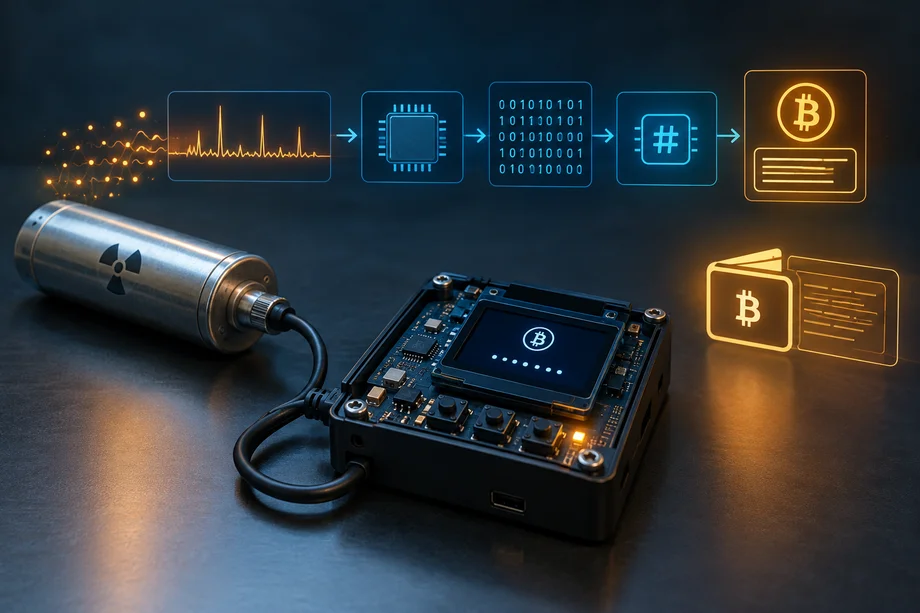
Entropy32 Plus uses Geiger counter timing and SHA-256 to produce BIP39 recovery phrases, though its entropy source remains unvalidated
An experimental open-source hardware project released in September 2026 generates Bitcoin recovery phrases by capturing the unpredictable timing of radioactive decay events. Known as Entropy32 Plus and also called The Universe Bifurcator, the device converts physical radiation pulses into standard BIP39 seed phrases while operating entirely offline.
Developer Alexander Higgins published the full project files, including firmware, circuit-board designs, fabrication data and printable enclosures. The system relies on a Geiger counter connected through a 3.5-millimeter jack to detect decay events from either a dedicated radioactive source or ambient background radiation.
How the Device Captures Physical Randomness
Radioactive decay is fundamentally unpredictable at the atomic level. Entropy32 Plus measures the intervals between successive detection events rather than depending on software-based random number generators. An LM393 comparator converts each analog pulse into a clean digital signal that is fed to an ATmega328P microcontroller.
The firmware records event times with microsecond precision and compares consecutive intervals. A longer interval produces a one bit; a shorter interval produces a zero. Equal intervals are discarded, and measurements shorter than 200 microseconds are rejected as possible noise. Collection continues until 512 comparison bits have been gathered.
Once the pool is full, the device runs the entire 64-byte block through an onboard SHA-256 implementation. For a 12-word phrase it retains the first 16 bytes of the hash; for a 24-word phrase it uses all 32 bytes. The resulting bits are then mapped to the standard BIP39 English wordlist according to the official specification, including the required checksum bits.
Hardware Constraints and Offline Operation
The complete BIP39 wordlist alone occupies 13,117 bytes, roughly 43 percent of the ATmega328P’s 30,720-byte flash memory. Combined with the SHA-256 routine, state machine and user interface, the finished firmware fills 30,006 bytes, leaving only 714 bytes free. As a result, conventional graphics libraries were omitted in favor of a compact text-only OLED driver.
Users interact with the device through two buttons and a 0.91-inch OLED screen. Generated word indexes reside only in RAM. After the user records the phrase, a dual-button confirmation overwrites the data and restarts collection. The design includes no wireless modules, no persistent seed storage and no secure element. Temporary buffers are cleared after processing.
| Component | Memory Usage (bytes) |
|---|---|
| BIP39 wordlist | 13,117 |
| SHA-256 routine | 2,278 |
| State machine and UI | 3,000+ |
| Total firmware | 30,006 |
| Flash capacity | 30,720 |
Validation Status and Developer Caution
Higgins has stated that the entropy source has not been evaluated under NIST Special Publication 800-90B. The repository contains no independent audit results, raw event datasets or formal minimum-entropy measurements. The developer recommends users verify any radiation source they intend to employ and advises against placing substantial funds on phrases generated by the device until such testing is complete.
The project is presented as an educational and experimental build. All source code, schematic files and enclosure designs are publicly available for inspection and independent construction. Firmware includes a self-test of the SHA-256 implementation that must pass before entropy collection begins, but the test does not evaluate the quality of the physical input.
Entropy32 Plus remains under active development. Its initial public commit appeared in early September 2026, followed by iterative updates to firmware, board layout and enclosure design. No production release or formal security-assessment timetable has been announced.

Disclaimer
This article was generated by AI using information from multiple industry sources. It has not been reviewed or verified by a human editor and may contain inaccuracies, omissions, or misinformation. Readers are encouraged to independently verify any information before making decisions based on its content.Tired of the noise?
Let the bots trade for you.
Trade 24/7, without emotion, with data-driven strategies.
Associated articles

Coinkite Issues Coldcard Firmware Update to Fortify Seed Generation After $112 Million Exploit

Coinkite Issues Urgent Coldcard Warning After $38 Million Bitcoin Drain

CZ Urges Crypto Holders to Diversify Wallets After $70 Million Coldcard Exploit
Peter Todd Warns Single-Signature Bitcoin Wallets Exposed After Coldcard Vulnerability Linked to $38 Million Theft

Coldcard Firmware Flaw Enables $88 Million Bitcoin Drain, Sparking Custody Debate
Latest articles

Blockchain Association Presses Congress for Crypto Tax Overhaul Amid Stalled Market Structure Bill

New York AG Seeks $1.37 Billion From NovaTech Founders in Crypto Fraud Case

US Senator Seeks Records on Tether Payments to Firm Tied to Former White House Crypto Adviser

Bitcoin Core Revises Security Policy as AI Tools Simplify Bug Discovery