Newsroom
NextBlock Commits $3 Million to Soda Labs for Programmable Privacy on Public Blockchains
9 October, 2026 / News / AI / Tags: soda, bubble, labs, privacy, nextblock
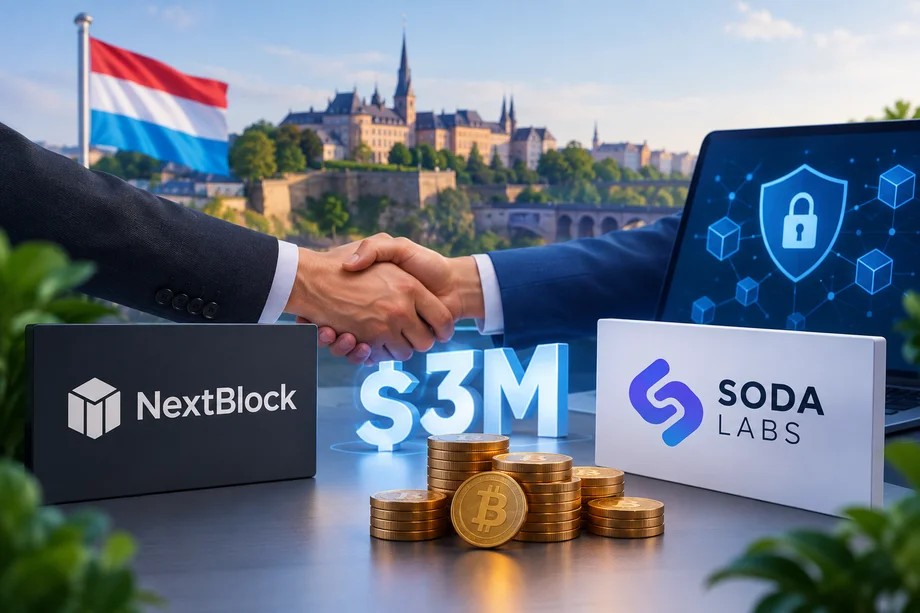
Luxembourg venture firm fully funds the seed round as the startup scales its chain-agnostic privacy layer for banks, payments and tokenization platforms
Luxembourg-based venture capital firm NextBlock has provided the entire $3 million seed round for Soda Labs, a cryptographic infrastructure company developing programmable privacy tools that allow regulated financial activity to occur on public blockchains without exposing sensitive data.
The closed round, announced on October 8, 2026, supplies Soda Labs with a 12- to 18-month runway to expand commercial operations, grow its validator network, deepen integrations with financial institutions and convert existing pilots into production deployments.
Addressing Transparency Barriers for Institutions
Public blockchains offer liquidity, users and established financial applications, yet their radical transparency creates obstacles for banks, asset managers and payment companies. These entities cannot readily broadcast every position, trade, balance or client transaction to the open internet. Soda Labs positions its technology as a solution that preserves the benefits of public networks while introducing controlled confidentiality.
Van Poecke described the investment as a strategic commitment to institutional infrastructure rather than a speculative position. He noted that programmable privacy can protect sensitive data while still enforcing regulatory rules and permissions, allowing confidential execution to coexist with compliance requirements.
Soda Bubble: Chain-Agnostic Privacy Infrastructure
Soda Labs has spent approximately two and a half years building a privacy engine that combines garbled circuits with multiparty computation, known as GC-MPC. The system relies on established cryptography including AES and SHA256 and operates on ordinary cloud CPUs without specialized hardware. This design enables private, developer-defined computations while applications remain connected to existing public blockchain infrastructure.
The company’s primary product is Soda Bubble, a chain-agnostic coprocessor that processes private workloads originating from multiple blockchains. Sensitive data remains confidential both from the public and from Soda Labs itself. The Bubble Validator Network allows participants to mathematically verify that computations involving private data have been performed correctly.
Bubble is already live across Ethereum, Polygon, Arbitrum, Base and COTI. Expansion to non-EVM networks, including Solana, is underway. The technology has processed more than 100 million transactions on the COTI network, supporting applications such as tokenization platform Zoniqx and perpetuals exchange PriveX, which has handled more than $20 billion in trading volume.
Unlike solutions that deliver full anonymity, Bubble provides confidentiality with selective disclosure. Transaction details such as sender, receiver, amount and token type remain hidden from public view, yet authorized parties can access the information when required for compliance or auditing purposes.
Performance Claims and Commercial Focus
Soda Labs reports that recent testing on Arbitrum measured the full transaction lifecycle—including encryption, multiparty computation, consensus and settlement—and delivered a five- to tenfold improvement over previously published benchmarks. The company states that its GC-MPC architecture can achieve approximately 10 to 100 times greater throughput and 100 to 1,000 times lower cost per transaction than currently available alternatives while running on standard cloud hardware. Updated performance figures are expected to be released in the coming weeks.
Publicly available metrics indicate the system sustained 500 confidential transactions per second on Arbitrum during testing that processed more than 15,000 transfers in July 2026, at a reported cost of $0.14 per million transfers. The technology stack undergoes regular audits by security firm Hacken and is protected by three granted U.S. patents.
NextBlock cited Soda Labs’ existing working product, paying customers, differentiated technical intellectual property and commercial orientation as key factors in the decision to fund the full round. The firm, which focuses on foundational infrastructure for privacy-preserving computation and institutional digital finance, launched its first Luxembourg alternative investment fund in July 2025 with $40 million in initial commitments.
Use of Proceeds and Next Steps
Proceeds will support go-to-market activities, expansion of the validator network and blockchain coverage, team growth, and integrations with banks, payment companies, tokenization platforms and other financial infrastructure providers. Soda Labs is advancing several undisclosed pilots with financial and infrastructure organizations, with the goal of moving those trials into full production.
The company was founded by Avishay Yanai, who holds a PhD in cryptography and serves as CEO, and Meital Levy, who holds a PhD in algorithms and serves as CTO. Together they bring more than 20 years of experience in security. Soda Labs’ earlier gcEVM privacy layer remains live on COTI, where the firm was the first recipient of that network’s $25 million ecosystem fund in 2024.
As tokenized assets, stablecoins and other forms of regulated capital continue to migrate onchain, demand is rising for infrastructure that enables confidential computation without sacrificing the liquidity and interoperability of public networks. Soda Labs’ seed financing positions the company to scale that capability across additional chains and institutional use cases over the next year and a half.
Disclaimer
This article was generated by AI using information from multiple industry sources. It has not been reviewed or verified by a human editor and may contain inaccuracies, omissions, or misinformation. Readers are encouraged to independently verify any information before making decisions based on its content.Tired of the noise?
Let the bots trade for you.
Trade 24/7, without emotion, with data-driven strategies.
Associated articles

Beldex Secures $8 Million Funding to Build Privacy Tools for Web3 and AI Agents

Vitalik Buterin Outlines Lean Ethereum Roadmap for Quantum Security and Scaling

Cosmos Forms 17-Firm Partner Network to Advance Bank Tokenization Beyond Pilots

Circle Activates Arc Mainnet With USDC Gas and Major Financial Validators
BNB Chain Dominates Franklin Templeton's $1.5 Billion Benji Tokenized Platform
Latest articles

Blockchain.com Seeks CFTC Approval to Launch U.S. Event Contracts and Crypto Derivatives

New York Bans Celsius Founder Mashinsky for Life, Secures Up to 35 Million in Settlement

Bessent Warns of $1 Billion Iran Crypto Seizure as US Tightens Sanctions

MARA Holdings Transfers 996 Bitcoin Worth $81 Million to Galaxy Digital