Newsroom
Kevin O’Leary Sees Bitcoin at $1 Million if Quantum Computing Risks Are Cleared
19 September, 2026 / News / AI / Tags: leary, quantum, encryption, bitcoin, kevin
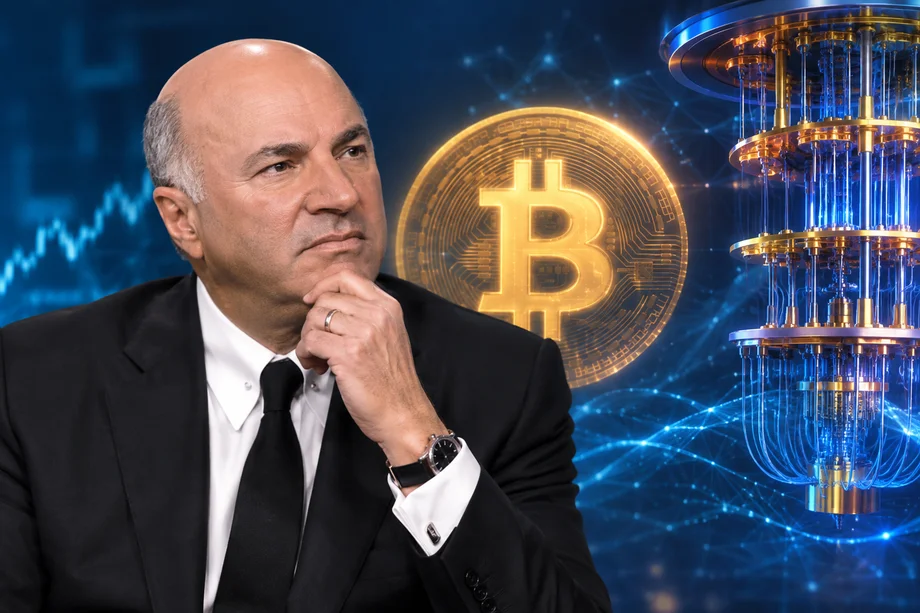
The Shark Tank investor, speaking at the Avalanche Summit in New York, ties a seven-figure Bitcoin target to resolving encryption threats known as Q-Day while rebuilding crypto positions
Kevin O’Leary, chairman of O’Leary Ventures and a well-known investor from Shark Tank, has returned to active cryptocurrency investing and set a conditional $1 million price target for Bitcoin. Speaking at the Avalanche Summit in New York, he stated that the asset could reach that level only after the industry addresses growing concerns over quantum computing’s ability to compromise the network’s encryption.
O’Leary described the theoretical moment when a sufficiently powerful quantum computer could break the digital signatures and cryptographic algorithms securing Bitcoin wallets as “Q-Day.” No such machine exists today, yet the uncertainty is already influencing institutional behavior.
Institutional Allocations and Quantum Exposure
O’Leary said large funds currently limit Bitcoin exposure to roughly 1 percent to 3 percent of alternative-asset portfolios, a level comparable to gold holdings. He previously indicated in February that institutions would not exceed a 3 percent allocation until the quantum question is settled. Some market participants have taken more decisive steps: Jefferies strategist Christopher Wood removed a 10 percent Bitcoin position from a model portfolio over the same concern.
On-chain data adds weight to the risk assessment. Analytics firm Glassnode calculated in May that approximately 6.04 million Bitcoin, or 30.2 percent of the issued supply, sits in addresses whose public keys are already visible on the blockchain. Those coins would present the most immediate targets if quantum key-breaking becomes practical.
Hardware estimates have also shifted. Google Quantum AI stated earlier this year that breaking Bitcoin’s elliptic-curve cryptography could require fewer than 500,000 physical qubits, lower than earlier projections. The U.S. National Institute of Standards and Technology aims to phase out vulnerable encryption by 2030 and ban it by 2035, while Google has set its own post-quantum migration deadline for 2029.
Some investors are already positioning defensively by allocating capital to quantum-computing software developers as a security hedge rather than betting against Bitcoin itself.
Rebuilding Positions and Shifting Blockchain Views
O’Leary announced he is actively buying new cryptocurrency positions ahead of what he calls the next market cycle. He told interviewers he is putting capital to work after a period on the sidelines.
His longer-term thesis has evolved. Eighteen months earlier he believed Bitcoin and Ethereum together captured roughly 97 percent of the industry’s upside because markets would standardize on Ethereum. That view has been abandoned. O’Leary now says Ethereum is neither fast enough nor secure enough and that different industries will ultimately select different blockchain platforms. Conversations with chief executives across sectors reveal no consensus on a single winning chain, leaving the market open.
The most significant catalyst, in his assessment, would be adoption of blockchain technology by a major stock exchange. Such a move would compel other financial institutions to follow the chosen technical and compliance standards, settling current fragmentation.
Regulation, Tokenization and Broader Portfolio Focus
On the policy front, O’Leary expects the CLARITY Act, intended to clarify U.S. regulatory oversight of digital-asset trading, to remain stalled until after the midterm elections. He anticipates a bipartisan version may be revisited later. Tax policy, he argued, will likely drive further regulation because any framework for taxing the asset class requires clear definitions and oversight.
Beyond Bitcoin, O’Leary linked the growth of crypto to broader tokenization. He argued that digitization of assets will become an additional sector serving the existing components of the equity market. The Securities and Exchange Commission’s recent innovation exemption for tokenized stocks was cited as supporting that direction.
His artificial-intelligence exposure centers on energy infrastructure rather than specific models. Positions include power projects in Norway, Finland, Alberta and Utah, along with a first uranium investment intended to support small modular reactors for data centers.
Bitcoin traded near $81,000 around the time of the remarks, with the asset rising more than 4 percent in the session that followed. Avalanche’s native token also advanced sharply as attention focused on the summit commentary.
O’Leary’s $1 million scenario remains explicitly conditional on the industry first removing institutional doubt surrounding quantum-era cryptography. Until that occurs, he expects portfolio allocations to stay limited to gold-like percentages.

Disclaimer
This article was generated by AI using information from multiple industry sources. It has not been reviewed or verified by a human editor and may contain inaccuracies, omissions, or misinformation. Readers are encouraged to independently verify any information before making decisions based on its content.Tired of the noise?
Let the bots trade for you.
Trade 24/7, without emotion, with data-driven strategies.
Associated articles
Crypto Experts Warn of AI Threat to Blockchain Encryption, Urge 'Bunker Mode'

Glassnode Flags Quantum Risk for Nearly 10% of Bitcoin Supply
Grayscale Assigns XRP 26% Stake in Bitcoin-Free Model Portfolio for Advisors

Europol Warns Quantum Computers Pose Risk to Crypto Wallet Keys, Urges Early Industry Preparations
ARK Invest Shifts $31.5 Million Toward Coinbase and Circle in Crypto Equity Rebalancing
Latest articles
Blockchain.com Seeks CFTC Approval to Launch U.S. Event Contracts and Crypto Derivatives
New York Bans Celsius Founder Mashinsky for Life, Secures Up to 35 Million in Settlement

Bessent Warns of $1 Billion Iran Crypto Seizure as US Tightens Sanctions

MARA Holdings Transfers 996 Bitcoin Worth $81 Million to Galaxy Digital