Newsroom
Irish Crime Gangs Rent Private Vaults to Conceal Crypto Keys, Asset Bureau Warns
7 September, 2026 / News / AI / Tags: gubbins, bureau, ireland, superintendent, detective
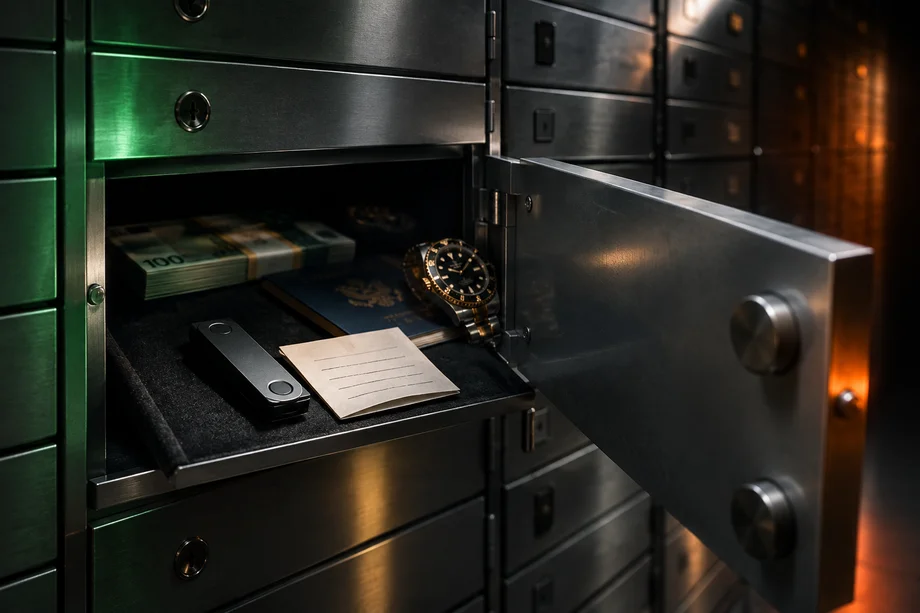
Organized crime groups in Ireland are storing cryptocurrency seed phrases and private keys in rented safe deposit boxes alongside cash and valuables, according to the head of the Criminal Assets Bureau, as authorities prepare for stricter EU rules
Organized crime groups operating in Ireland have begun renting private vaults and safe deposit boxes to store the seed phrases and private keys that control their cryptocurrency wallets. The credentials are kept together with cash, luxury watches, passports and other valuables, making it more difficult for investigators to locate and seize the digital assets.
Detective Chief Superintendent Michael Gubbins, who leads Ireland’s Criminal Assets Bureau, disclosed the practice. Investigators encountered it during their own cases and formally raised the issue with the government’s Anti-Money Laundering Steering Committee.
Low-Tech Storage Offers Perceived Anonymity
Rather than relying solely on technical methods such as mixers or anonymous exchanges, criminals seal hardware wallets or paper records of 24-word recovery phrases inside rented boxes. The cryptocurrency itself remains visible on the blockchain, but without the private keys or seed phrases the funds cannot be moved or recovered by authorities even if the wallets are identified.
Gubbins noted that gangs turn to cryptocurrency in part to spread the risk of asset seizure and because they associate digital assets with anonymity.
He also pointed to practical drawbacks for criminals, including the volatility of cryptocurrency prices and the risk of permanently losing access if passwords or recovery information are misplaced.
Cash Still Dominates Criminal Proceeds
Despite the emergence of this storage method, Gubbins described cryptocurrency use among Irish criminal groups as still quite basic. Cash continues to form the bulk of proceeds, especially in drug trafficking.
Professional money launderers remain active in the networks. Some operate hawala systems, informal value-transfer arrangements in which funds deposited with one operator in one country are paid out by another operator elsewhere without the physical movement of cash. Commissions charged for these services are typically around 6 percent. In one investigation the bureau seized the equivalent of approximately $267,000 from a safe deposit box held at a private vault company.
Legal Hurdles Complicate Seizures
Renting a safe deposit box is entirely lawful. To obtain a forfeiture order, the Criminal Assets Bureau must demonstrate that the contents constitute the proceeds of crime. This evidentiary requirement is higher than the threshold needed to freeze funds held in a conventional bank account, creating an additional obstacle for investigators.
Progress on Major Bitcoin Seizure
The bureau continues to work through one of its largest cryptocurrency recoveries. In 2019 it seized 6,000 bitcoin from convicted cannabis grower Clifton Collins. The holdings had been divided across 12 wallets of roughly 500 bitcoin each. Private keys were written on paper and concealed inside the aluminum cap of a fishing-rod case at a rented property; the equipment later disappeared after the property was cleared.
In March 2026, with technical support from Europol’s European Cybercrime Centre, the bureau gained access to the first of the wallets, containing 500 bitcoin then valued at approximately $34.8 million. Subsequent recoveries brought the total accessible amount higher. By recent accounts more than the equivalent of $151 million of a total holding once valued near $418 million has been realized. Over the past decade the bureau has sold seized cryptocurrency amounting to roughly $7.5 million in earlier cases. Last year it returned nearly $17.4 million in recovered assets to the Irish exchequer.
New EU Rules Approaching
The disclosures come as Ireland prepares for the next phase of European Union anti-money-laundering legislation scheduled to take effect in summer 2027. The rules will prohibit cash payments above the equivalent of about $11,600 and require identification of customers making cash transactions of $3,480 or more. Crypto-asset service providers, luxury-goods retailers and crowdfunding platforms will face tighter customer-due-diligence obligations, including enhanced checks on transfers involving self-hosted wallets above certain thresholds.
Ireland published its first national anti-money-laundering strategy earlier this year and continues to refine domestic measures targeting digital assets. The Criminal Assets Bureau is also examining additional legislative tools for the seizure and freezing of cryptocurrency.
Disclaimer
This article was generated by AI using information from multiple industry sources. It has not been reviewed or verified by a human editor and may contain inaccuracies, omissions, or misinformation. Readers are encouraged to independently verify any information before making decisions based on its content.Tired of the noise?
Let the bots trade for you.
Trade 24/7, without emotion, with data-driven strategies.
Associated articles

Brazilian Federal Police Arrest Nine in Crypto-Linked Cocaine Trafficking Probe

UK Police Forfeit £1 Million in Crypto Linked to Historic Darknet Markets

Australia Seizes $5.7M Bitcoin in Historic Darknet Marketplace Bust

Ireland Launches First National AML Strategy With Tighter Crypto Wallet Rules

Thai Police Arrest Chinese Man in $75M Crypto Laundering Probe
Latest articles

SpaceX and Tesla Set Up Committees to Explore Merger That Would Combine Holdings of Over 30,000 Bitcoins

UK Banks Face Thousands of Complaints Over Crypto Transfer Restrictions
Ripple Backs SEC Proposed Crypto Asset Rules After $150 Million Legal Battle

Blockchain.com Introduces Options Trading on Seven Major Crypto Assets