Newsroom
Ethereum Schedules Oct. 6 Sepolia Fork for Glamsterdam Upgrade Ahead of Q4 Mainnet
27 September, 2026 / News / AI / Tags: glamsterdam, sepolia, fork, eip, upgrade
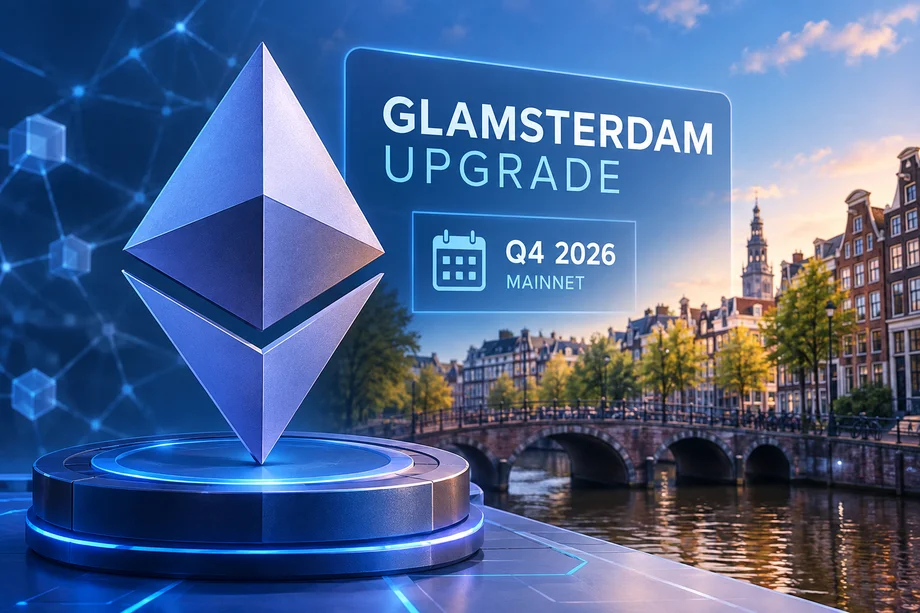
Ethereum developers have set an October 6 Sepolia testnet activation for the Glamsterdam upgrade, with mainnet deployment targeted for the fourth quarter of 2026 as key scaling features near completion
Ethereum is moving into public testnet preparation for its Glamsterdam upgrade, a major protocol change designed to boost throughput through parallel processing, expand network capacity and curb long-term database growth. The Sepolia fork is scheduled for October 6, 2026, at 9:53:36 a.m. ET, corresponding to epoch 353,024.
Mainnet rollout remains planned for the fourth quarter of 2026, though no exact date has been fixed. The upgrade merges the Gloas consensus-layer changes with the Amsterdam execution-layer updates and is tracked under Meta EIP-7773, whose final scope could still shift before activation.
Testnet Timeline and Development Progress
Ethereum Foundation researcher Toni Wahrstätter recently stated that work on Glamsterdam and EIP-7928, which introduces Block-Level Access Lists, is nearing its final stages. He described the outlook as strongly positive and noted that the upgrade ranks among the largest forks the network has undertaken, given its broad technical ambition.
Public testing began earlier with the Platåberget fork on August 20. The sequence will continue across Sepolia and Hoodi before any mainnet deployment. An earlier proposal had placed the Sepolia activation on September 28; the October 6 date now stands as the next concrete milestone.
Client teams, validators and infrastructure operators will use the Sepolia fork to validate the new code under real network conditions. Wallets, indexers and gas estimators that depend on fixed maximum-gas assumptions may need updates because Glamsterdam alters certain gas-related behaviors.
Core Technical Features
Glamsterdam centers on three practical goals: accelerating transaction processing via parallelism, raising overall capacity and improving sustainability by limiting database bloat. Additional improvements include faster and simpler node synchronization through snap v2.
Two headline components drive these gains. Enshrined proposer-builder separation, or ePBS under EIP-7732, reworks the block validation pipeline so that more block-building activity moves inside the protocol itself and trust assumptions are reduced. Block-Level Access Lists, or BALs under EIP-7928, make state access within each block more explicit. That explicitness allows transactions that do not touch the same data to execute concurrently rather than sequentially.
The design is intended to remain compatible with future technologies such as zkEVMs, partially stateful nodes and inclusion lists. Because Glamsterdam is a pure protocol upgrade rather than an asset migration, Ether holders will not need to convert or upgrade their balances after the hard fork.
Node Efficiency Gains and Longer-Term Roadmap
Separate improvements already under way are making full nodes lighter and faster to sync. After pruning, a Geth node can occupy roughly 461 GiB. With EIP-4444 and enhanced snap sync, a full node can be brought online in about 12 hours, placing the hardware requirements within reach of many high-performance workstations already used for other computing tasks. Glamsterdam is expected to accelerate base-layer synchronization still further.
Ethereum co-founder Vitalik Buterin has outlined the network’s direction beyond the coming upgrades. He indicated that the Hegota fork, planned for next year, is likely to be the last ordinary hard fork whose features would still feel familiar to developers who knew the protocol in 2015.
After Hegota, the roadmap points toward recursive STARKs, automated formal verification and consensus algorithms engineered for quantum resistance. PeerDAS is viewed as the first step in this broader shift. The longer-term objective is a system that delivers cheaper, more scalable and more private high-security computation than earlier blockchain designs alone could provide.
Glamsterdam therefore functions as a near-term bridge: it addresses immediate constraints on throughput, sync speed and database growth while the subsequent phases tackle deeper architectural questions about security and capability in a post-quantum environment.

Disclaimer
This article was generated by AI using information from multiple industry sources. It has not been reviewed or verified by a human editor and may contain inaccuracies, omissions, or misinformation. Readers are encouraged to independently verify any information before making decisions based on its content.Tired of the noise?
Let the bots trade for you.
Trade 24/7, without emotion, with data-driven strategies.
Associated articles

Ethereum Activates Glamsterdam Upgrade on Sepolia Testnet

Ethereum Confirms Glamsterdam Sepolia Test for Oct. 6 Amid Builder Abuse Warnings
Ethereum Schedules Frame Transactions for 2027 Hegotá Upgrade to Enable Native Account Abstraction

Ethereum Foundation Warns Wallets and Tools Risk Failure in Glamsterdam Upgrade

Ethereum Node Requirements Drop as AI Hardware Enables Home Validation
Latest articles

Scammer Loses $4.8 Million in Bitcoin on Tampered Ledger Devices

Visa Moves USDC Prefunding for Cross-Border Payouts into Commercial Production

Schwab Rolls Out Bitcoin and Ether Trading to Millions of Retail Clients

U.S. Fiscal 2026 Deficit Climbs to $1.99 Trillion as Interest Payments Surge