Newsroom
Elon Musk Pledges SpaceX Shares Worth Over $10.5 Billion to Every American Child
19 October, 2026 / News / AI / Tags: spacex, musk, shares, child, children
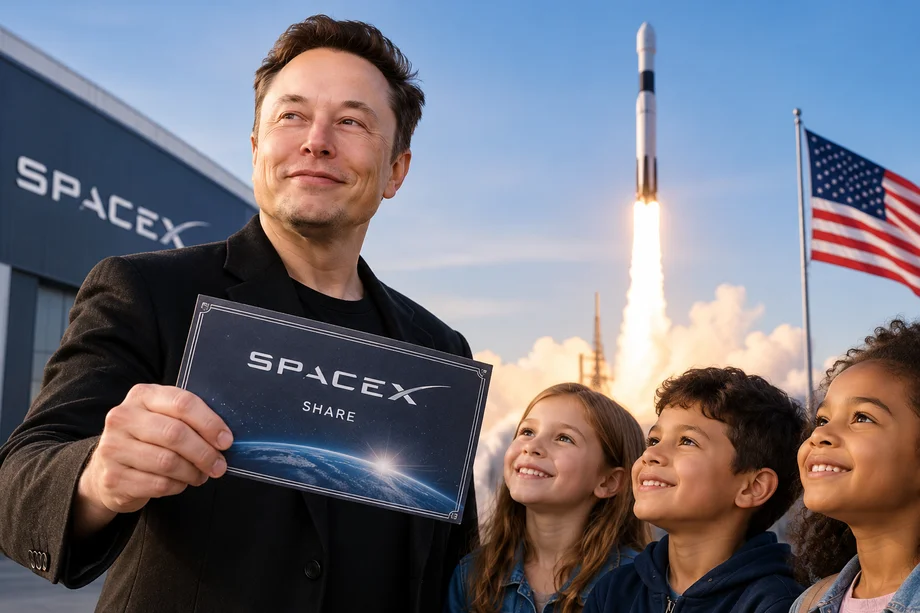
The SpaceX CEO announced plans to transfer one share from his personal holdings to each U.S. child under 18 in 2027, describing the move as the start of a broader series of distributions
Elon Musk said on Monday that he will give one of his SpaceX shares to every child in the United States next year. In a post on the social media platform he owns, the SpaceX chief executive wrote that the transfer would mark “the first of many.”
The pledge targets the roughly 72 million to 73 million Americans under age 18, according to U.S. Census Bureau estimates. SpaceX shares closed at $146.03 on the preceding Friday. At that price, one share for each child would carry a combined value of approximately $10.5 billion to $10.7 billion.
Announcement Follows Anthropic’s Equity Commitment
Musk’s statement came hours after Anthropic disclosed plans to set aside 5 percent of its shares for a public benefit fund intended to address social and economic challenges linked to artificial intelligence. Musk responded by recommending that the company distribute shares directly to the public and stated that this approach was the one he would pursue.
The SpaceX founder has previously argued in favor of direct transfers of value to citizens rather than centralized government or corporate ownership structures, particularly in discussions about artificial intelligence and workforce changes.
Potential Role of Trump Accounts
Musk indicated the transfers could occur through the Invest America program, known as Trump Accounts. These tax-advantaged accounts were established for eligible U.S. children and opened to stock donations earlier in the year. Nearly 70 million such accounts have been allocated by the Treasury Department and can be claimed through identity verification.
SpaceX President Gwynne Shotwell and her husband earlier pledged company shares to more than 2 million children through the same accounts, focusing on those aged 11 to 17 in lower-income areas. Other business leaders, including the founders of Dell, have also directed large contributions into the program.
Regulations issued in recent months clarified that donated securities must be publicly traded, issued by domestic corporations, and free of certain transfer restrictions. Shares contributed this way generally carry a minimum holding period of five years or until the account holder reaches the end of the program’s growth period.
Scale Relative to Musk’s Holdings
According to an August Securities and Exchange Commission filing, Musk beneficially owned approximately 6.42 billion SpaceX shares as of June 30, including shares held in trusts, restricted stock, and options. That stake represents about 48.4 percent of the company. A distribution of 72 million shares would account for roughly 1 percent of those holdings.
SpaceX completed its initial public offering in June, pricing shares at $135. The stock has since traded in a range between about $105 and $226. Shares rose nearly 1 percent in premarket trading on Monday following the announcement. The company is scheduled to report third-quarter results after the market close on Tuesday.
Open Questions on Implementation
Musk provided no further details on eligibility criteria, the precise timing within 2027, the mechanics of the share transfers, tax treatment, or how minors would hold the equity. Private-company transfer rules no longer apply because SpaceX is now publicly traded, yet practical and regulatory steps for a mass distribution of this size remain undefined.
The final number of recipients and the ultimate value of the transfers will depend on eligibility rules and the share price at the time of distribution. Implementation details are expected in the coming months.

Disclaimer
This article was generated by AI using information from multiple industry sources. It has not been reviewed or verified by a human editor and may contain inaccuracies, omissions, or misinformation. Readers are encouraged to independently verify any information before making decisions based on its content.Tired of the noise?
Let the bots trade for you.
Trade 24/7, without emotion, with data-driven strategies.
Associated articles

Strategy Bitcoin Holdings Swing to Profit as Price Surges Past $75,385

SpaceX Joins Nasdaq 100: $4.3 Billion Passive Buying Set for July 7

Strategy Reaches 848,000 Bitcoin Holdings After Modest Weekly Buy While Spending Heavily on Preferred Stock

Morgan Stanley Reaffirms $300 Target for SpaceX Shares as Stock Climbs on AI Valuation Case

Strategy Sells 1,638 Bitcoin for $105 Million, Begins Tracking 200-Week Average
Latest articles
SkyAI Exits Solana Holdings Completely, Launches $201 Million Share Buyback
Strategy Buys 267 Bitcoin and Raises Preferred Share Buyback Cap to $3 Billion

Dormant 2013 Bitcoin Wallets Shift Over $67 Million After More Than a Decade

Binance Rolls Out AI Pro Tool for Chat-Based Automated Trading Strategies