Newsroom
Curve Founder Labels Pump.fun a Casino of Scams, Criticizes Phantom Wallet
17 August, 2026 / News / AI / Tags: pump, egorov, solana, phantom, casino

Michael Egorov’s sharp remarks on Solana’s leading memecoin platform and wallet have drawn industry pushback amid ongoing legal pressure
Michael Egorov, founder of Curve Finance, publicly criticized Pump.fun and the Phantom wallet in a post on X, describing the Solana-based memecoin launchpad as a casino of scams and detailing friction when pairing Phantom with a hardware wallet. The comments, posted on August 16, 2026, have reignited debate over memecoin risks, platform responsibility, and user experience on Solana.
Egorov’s Direct Criticism
Egorov stated that Pump.fun operates as a casino of scams through its memecoin listings, arguing that most tokens launched on the platform deliver little lasting value to traders. Pump.fun functions as an on-chain launchpad that enables users to create and trade memecoins directly rather than as a traditional exchange.
He separately described a difficult process connecting Phantom, Solana’s widely used wallet, to a hardware device. The pairing eventually succeeded, yet Egorov called the overall user experience worse than MetaMask on Ethereum. He did not identify the specific hardware wallet brand or provide technical details of the failures.
On the broader network, Egorov credited the Solana Foundation with strong ecosystem support while contending that the strongest projects built on Solana fall short of expectations. He offered no specific examples.
Industry Response and Counterpoints
ClawPump co-founder Tomi204 replied in the same thread, defending the platform’s role. ClawPump operates as a Solana toolkit that allows AI agents to launch tokens on Pump.fun without gas fees, building on rather than competing with the launchpad’s infrastructure.
Tomi204 argued that Pump.fun supplies only the underlying service and that individual users bear responsibility for how they use it. He framed the memecoin market as a free-market reality that would persist even without Pump.fun’s dominance. On the wallet side, he maintained that Phantom remains suitable for average, non-technical users despite occasional setup friction for more experienced operators.
Egorov later expanded his remarks, suggesting that wallets and trading platforms often decline in quality after achieving broad market recognition. He presented this as a personal observation rather than a documented industry pattern.
Legal Context Surrounding Pump.fun
Egorov’s language overlaps with claims in an active federal lawsuit, Aguilar v. Baton Corporation Ltd., filed in the Southern District of New York. The complaint alleges that Pump.fun sold unregistered securities and operated an illegal casino. Defendants named in the case include Pump.fun founders Alon Cohen, Dylan Kerler, and Noah Tweedale, along with Solana Labs, the Solana Foundation, and Solana co-founder Anatoly Yakovenko. Judge Colleen McMahon is overseeing the matter.
Plaintiffs’ counsel have cited alleged retail losses of between $4 billion and $5.5 billion across more than 4.25 million wallets that traded on the platform in 2024, with over 60 percent of those wallets reportedly losing money. These remain allegations, not adjudicated findings. Pump.fun has contested aspects of the litigation, including defeating a sanctions motion in January that accused its lawyers of witness intimidation.
Additional pressure includes reported whistleblower materials detailing alleged insider activity and MEV bots that extracted liquidity from retail traders via automated bonding-curve strategies. Court filings have also referenced internal messages in which a co-founder acknowledged that most traders lose money on low-market-cap tokens.
Platform Performance and Ongoing Scrutiny
Despite the criticism and legal challenges, Pump.fun has continued to generate substantial revenue. Reports place weekly revenue near $12 million, positioning it as the third-highest-earning crypto protocol behind Tether and Circle. Cumulative revenue since early 2024 has surpassed $1.2 billion, derived from trading fees, graduation fees, and related services such as PumpSwap.
The episode underscores a persistent divide between established Ethereum-based DeFi participants and Solana’s high-volume memecoin activity. Questions about platform accountability for speculative and fraudulent tokens, wallet usability for hardware security, and the durability of consumer applications remain central to the discussion. As of the latest reports, neither Pump.fun, Phantom, nor the Solana Foundation had issued a public response to Egorov’s comments.


Disclaimer
This article was generated by AI using information from multiple industry sources. It has not been reviewed or verified by a human editor and may contain inaccuracies, omissions, or misinformation. Readers are encouraged to independently verify any information before making decisions based on its content.Tired of the noise?
Let the bots trade for you.
Trade 24/7, without emotion, with data-driven strategies.
Associated articles
Pump.fun Launches Bitcoin and Ethereum Perpetual Futures with Hyperliquid
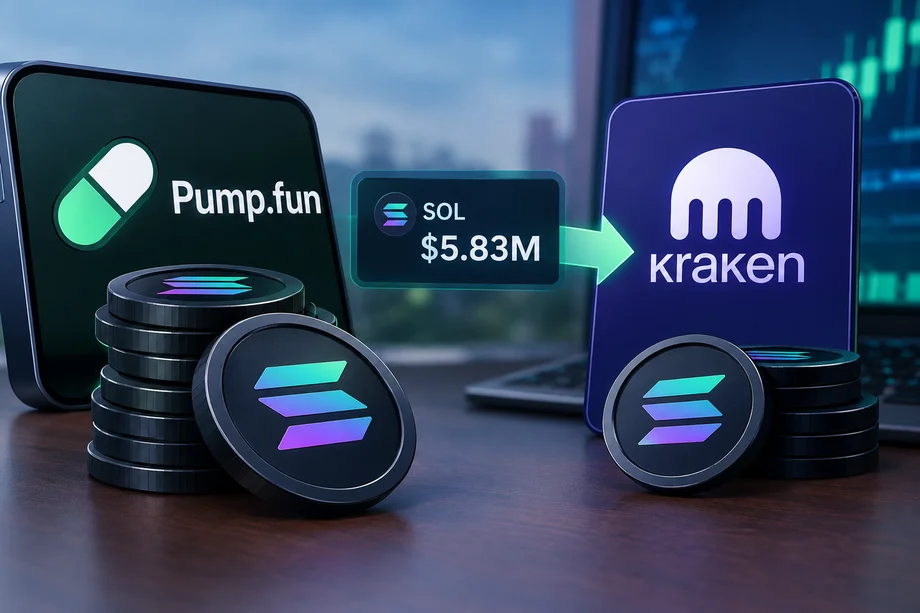
Pump.fun Transfers Another $5.83 Million in SOL to Kraken as Cumulative Sales Hit $848 Million

Pump.fun Laid Off Staff Weeks Before Major Token Vesting
Pons Surges to $5.95M Daily Fees on Robinhood Chain as Uniswap Labs Acquires Token Stake

AmericanFortress Proposes Quantum-Safe Wallet Scheme Without Fund Migration
Latest articles
SkyAI Exits Solana Holdings Completely, Launches $201 Million Share Buyback
Strategy Buys 267 Bitcoin and Raises Preferred Share Buyback Cap to $3 Billion
Dormant 2013 Bitcoin Wallets Shift Over $67 Million After More Than a Decade

Binance Rolls Out AI Pro Tool for Chat-Based Automated Trading Strategies