Newsroom
Core Scientific to End Bitcoin Mining by Late 2026, Shift Fully to AI Colocation
6 November, 2026 / News / AI / Tags: mining, colocation, quarter, million, nygaard
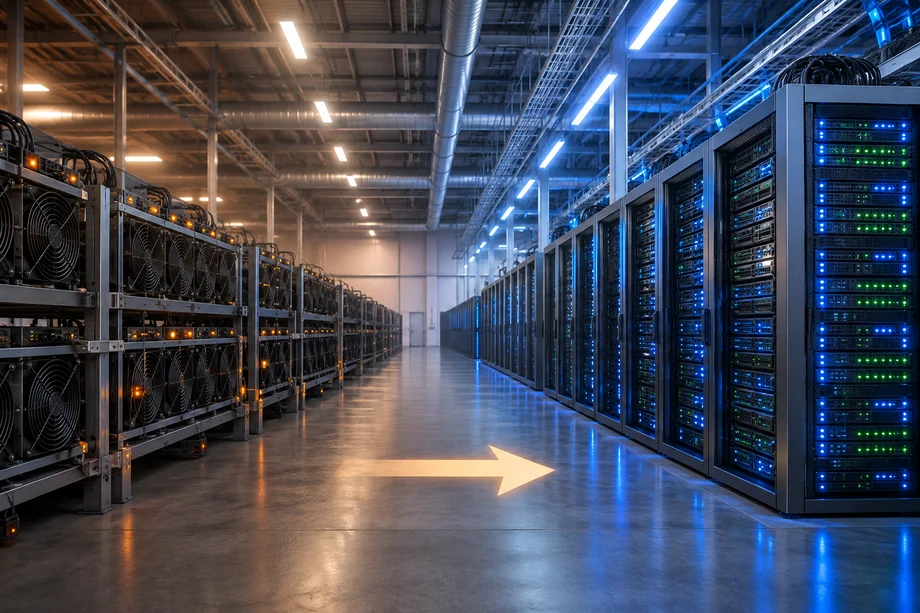
The company will complete its mining wind-down in the fourth quarter and operate solely as a high-density colocation provider for artificial intelligence and high-performance computing from 2027 onward
Core Scientific confirmed during its third-quarter earnings call that it will fully exit Bitcoin mining operations by the end of 2026. Management stated the remaining mining activities will be wound down in the fourth quarter, allowing the firm to begin 2027 as a pure-play high-density colocation provider focused on artificial intelligence and high-performance computing workloads.
Chief Financial Officer Jim Nygaard told investors the company expects to complete the wind-down during the fourth quarter. Chief Executive Officer Adam Sullivan stated the firm expects to complete its exit from Bitcoin mining by year end. The comments firm up earlier guidance from a July filing that had already scheduled the end of hosted mining by December 31 while self-mining continued to contract.
Mining Revenue Shrinks Sharply in Third Quarter
Third-quarter results show how far the transition has already progressed. Total revenue reached $232.9 million. Colocation services generated $215.4 million, accounting for approximately 92 percent of the total and rising nearly 60 percent from the prior quarter. Self-mining revenue fell to $12.3 million from $57.4 million a year earlier, while revenue from hosting third-party miners declined to $5.2 million from $8.7 million. Combined Bitcoin mining activity contributed $17.5 million, or 7.5 percent of overall revenue.
Colocation operations produced $128.4 million in gross profit at a 60 percent margin. Self-mining recorded a $7.5 million gross loss. Adjusted EBITDA more than tripled sequentially to $133.6 million, with the margin expanding to 57 percent from 25 percent.
| Segment | Q3 Revenue | Share of Total |
|---|---|---|
| Colocation | $215.4 million | ~92% |
| Self-mining | $12.3 million | ~5% |
| Hosted mining | $5.2 million | ~2% |
At the end of September the company operated nearly 50 percent fewer miners than at the end of 2025. Digital asset holdings on the balance sheet stood at $2.7 million, down from $49.7 million three months earlier and $222 million at year-end 2025.
AI Capacity Expands Under Major Contracts
Core Scientific is billing for 485 megawatts of colocation capacity as of September 30, an increase of 90 megawatts in the quarter. The remaining capacity under its CoreWeave agreement is in final commissioning and is expected to bring total CoreWeave-contracted capacity to 590 megawatts in the coming months.
A separate AMD-backed agreement covers 530 megawatts across five campuses. Initial delivery is targeted for the first half of 2027, with full delivery by the end of 2028. Combined, the two relationships represent approximately 1.1 gigawatts. Once fully operational and billing, management projects the portfolio will generate $1.8 billion in average annual run-rate revenue and $1.6 billion in net operating income.
The pivot began in 2024 with an initial CoreWeave hosting agreement in March followed by a larger deal in June. At the time the company presented AI hosting as complementary to mining. By late 2025 the firm had indicated a possible mining wind-down by 2028. The current 2026 target accelerates that timeline.
Transition Costs and Broader Industry Context
Mining economics have pressured the balance sheet. In the first quarter of 2026 the company recorded $266.5 million in mining-related asset impairments, citing weaker Bitcoin prices, historically low hashprice, and declining secondary-market values for mining equipment. In the second quarter it terminated a mining equipment agreement with Block and Proto, recording a $41.9 million loss.
Liquidity at the end of the third quarter totaled approximately $1.7 billion, including roughly $800 million in cash, after capital spending on new sites and acquisitions. Sullivan described the reorganization as positioning the business for more attractive long-term growth opportunities. Nygaard noted that a simplified profit-and-loss statement without mining would provide clearer visibility into the colocation run rate beginning in 2027.
Several other public miners have also redirected capacity toward AI and high-performance computing infrastructure, citing higher revenue potential from the same power resources under long-term colocation contracts compared with Bitcoin mining. The shift is occurring amid increased scrutiny of data-center expansion in the United States, including concerns over electricity costs and local resource demands following recent midterm election outcomes.

Disclaimer
This article was generated by AI using information from multiple industry sources. It has not been reviewed or verified by a human editor and may contain inaccuracies, omissions, or misinformation. Readers are encouraged to independently verify any information before making decisions based on its content.Tired of the noise?
Let the bots trade for you.
Trade 24/7, without emotion, with data-driven strategies.
Associated articles

Core Scientific Seals Multi-Gigawatt AMD Partnership to Accelerate AI Data Center Shift

Public Bitcoin Miners Cut Hashrate 13.4% as AI Demand Reshapes Operations

TeraWulf AI Compute Revenue Overtakes Bitcoin Mining in Q1 2026 Milestone

American Bitcoin Posts $57.2 Million Q2 Loss, Expands Holdings Past 8,000 BTC

Bitcoin Miners Invest Billions in AI Infrastructure as Returns Trail Spending
Latest articles

Greece Passes 10% Crypto Gains Tax With €500 Annual Exemption

GOPAX Halts All Services After Hack Threat, Moves Assets to Cold Storage

Keel Infrastructure Dumps Entire Bitcoin Treasury for $192 Million as It Shifts to AI

Hyperliquid Strategies Applies for U.S. Futures Broker License to Access Onchain Perpetual Markets