Newsroom
Coldcard Postmortem Details Five-Year Seed Flaw Behind Bitcoin Thefts
24 November, 2026 / News / AI / Tags: coinkite, firmware, seeds, generator, postmortem
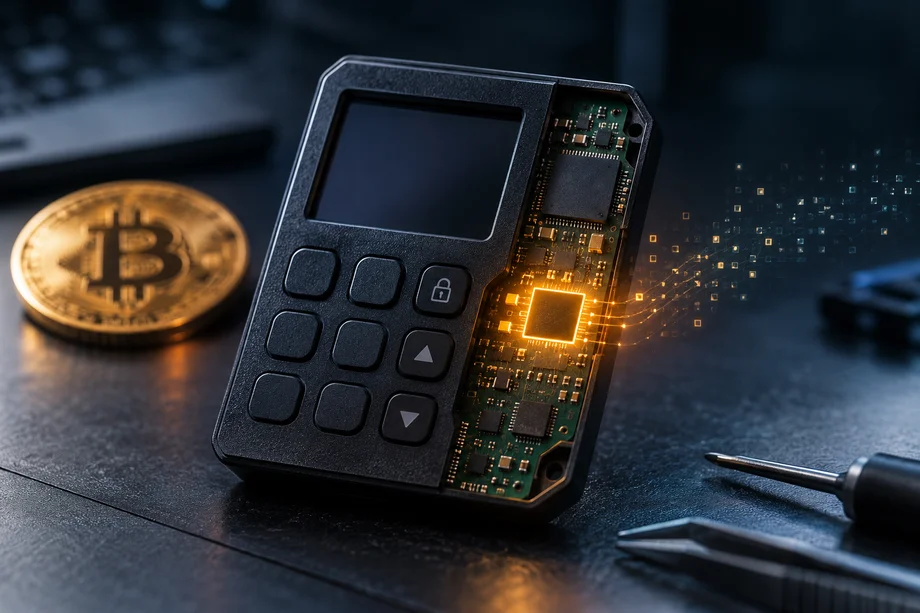
Coinkite’s postmortem details how a software random-number generator replaced the hardware source in firmware from 2021 to 2026, producing weak wallet seeds that attackers regenerated without device access
Coinkite has released a detailed postmortem examining a critical defect in its Coldcard hardware wallets that allowed thieves to drain bitcoin from affected devices beginning in late July. The 18-page report, modeled on an aviation accident investigation format and dated November 23, confirms that no physical device was compromised. Instead, attackers reconstructed private keys offline from seeds that contained far less entropy than intended.
The flaw originated in firmware shipped between March 29, 2021, and July 30, 2026. Coldcard devices were designed to draw randomness for seed generation from the hardware random-number generator inside their STM32 processor. A configuration setting disabled that hardware source, and a protective check inside Coinkite’s libNgU library failed to detect the change. Seed creation then silently fell back to Yasmarang, a software pseudo-random number generator included with MicroPython.
The resulting seeds appeared ordinary. Coinkite estimates they provided roughly 40 bits of effective security on older Mk2 and Mk3 models and about 72 bits on Mk4, Mk5 and Q devices, against the target of 128 bits. That reduction made exhaustive offline search feasible.
How the Defect Persisted Through Multiple Reviews
Release processes confirmed that hardware-RNG code existed in the firmware image, yet they never verified that seed-generation routines actually invoked it. Statistical randomness tests likewise could not separate output from the defective generator from properly seeded material.
At least 15 independent review efforts between 2021 and 2026 missed the issue. Those included two paid third-party audits, physical-security analysis by Ledger Donjon, and an AI-assisted firmware examination that generated 85 candidate findings. Each examination answered a related but incomplete question rather than confirming end-to-end use of the hardware source.
Unexpected outgoing transactions from affected seeds began on July 29. Coinkite identified the root cause the following day and released corrected firmware for every supported track on July 31.
Scale of Reported Losses
As of mid-November, Coinkite had logged approximately 300 loss-related support tickets linked to 242 customer accounts, representing about 0.21 percent of its estimated user base. Because Coldcard is self-custodial, the company can only tally losses that owners report and states the true total is likely higher.
Galaxy Research has linked more than 8,600 addresses to the incident and calculated 1,778.84 bitcoin removed, valued at roughly $107 million at recent market prices. Earlier estimates placed the figure above $115 million based on prices at the time of the transfers. White-hat operators later moved a portion of exposed coins into a recovery trust.
The identity of those who discovered and exploited the weakness remains unknown, and law-enforcement investigations continue. Coinkite describes AI-assisted discovery as a plausible hypothesis rather than an attribution, noting that the first thefts occurred two days after full weights of the Kimi K3 model became available.
Remediation and Remaining Obligations
An independent review by Keylabs, published in mid-October, concluded that the defect is fully closed in current standard Mk5 firmware versions 5.6.2 and 5.6.3 and Q firmware versions 1.5.2Q and 1.5.3Q. The review did not extend to Edge preview releases.
Newer firmware requires users to supply additional entropy through key presses, dice rolls or coin flips and combines that input with three hardware sources. Boot-time and build-time checks now verify that seed generation reaches the hardware generator and halt operation if it does not.
A firmware update cannot repair a seed already created under the defective code. Owners whose seeds were generated on affected versions must install verified fixed firmware, create a new seed and transfer funds. Seeds produced with at least 50 private dice rolls were not weakened by the flaw.
Three of the report’s 15 internal recommendations remain open, including the question of customer compensation. Coinkite stated it has reached no decision on a compensation plan. The company asked anyone holding the stolen bitcoin to return it via [email protected].
The postmortem closes by reiterating that the stolen keys were reconstructed offline from weak seeds and that no Coldcard device was remotely or physically breached.
Disclaimer
This article was generated by AI using information from multiple industry sources. It has not been reviewed or verified by a human editor and may contain inaccuracies, omissions, or misinformation. Readers are encouraged to independently verify any information before making decisions based on its content.Tired of the noise?
Let the bots trade for you.
Trade 24/7, without emotion, with data-driven strategies.
Associated articles

Coinkite Issues Urgent Coldcard Warning After $38 Million Bitcoin Drain

Coinkite Issues Coldcard Firmware Update to Fortify Seed Generation After $112 Million Exploit

Coldcard Firmware Flaw Enables $88 Million Bitcoin Drain, Sparking Custody Debate

Galaxy Research Puts Coldcard Wallet Losses Near $130 Million as Fourth Attack Wave Emerges

CZ Urges Crypto Holders to Diversify Wallets After $70 Million Coldcard Exploit
Latest articles

Utah Drops Criminal Charges Against Kalshi After Platform Halts Services in State
Senators Warren and Wyden Probe Tether Loan Tied to Commerce Secretary Lutnick’s Family Trust

Ledn Rolls Out US Custody Accounts for Bitcoin, Gold and Stablecoins

South Korea Proposes End to Nine-Year ICO Ban Under Strict Disclosure Rules