Newsroom
Citi Research Positions Aave as Key Player in Tokenized Collateral Markets
20 October, 2026 / News / AI / Tags: aave, mobility, collateral, tokenized, onchain
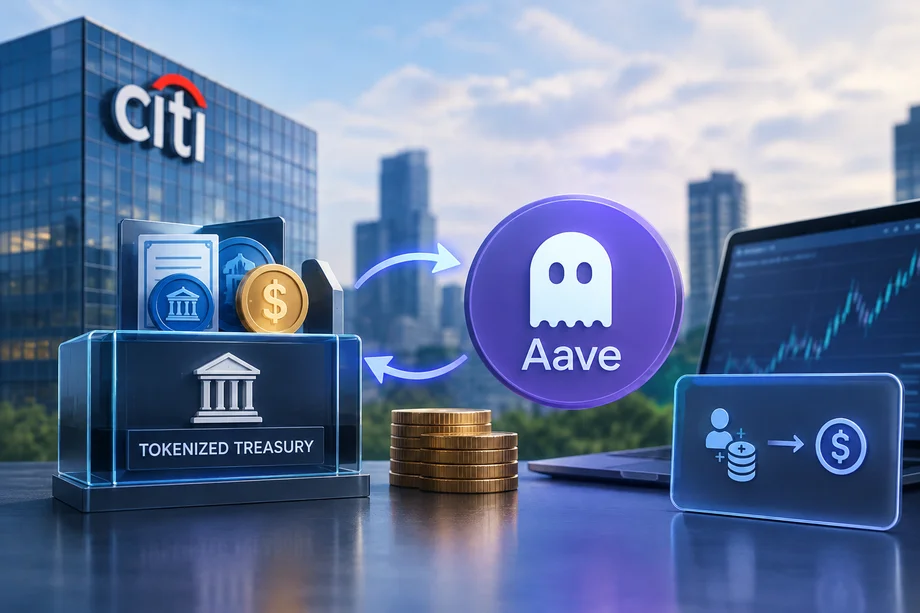
Bank analysts describe the DeFi lending protocol as a potential mobility layer for tokenized assets that could support functions involving tens of trillions of dollars in traditional finance activity
Citi Research has identified decentralized lending protocol Aave as a potential core infrastructure provider for tokenized capital markets, focusing on its capacity to enable efficient collateral movement. In a research note dated October 19, analysts argued that collateral mobility ranks among the most significant applications of tokenization, positioning Aave to handle financing and reuse of onchain assets at scale.
The note, prepared by Peter Christiansen and Aditi Balachandran, frames Aave less as a pure cryptocurrency lender and more as a decentralized collateral mobility ecosystem. According to the analysis, as tokenization expands beyond stablecoins into money market funds, private credit, government bonds and eventually equities, the ability to finance and redeploy those assets becomes central. Aave is seen as capable of performing functions that currently involve tens of trillions of dollars across traditional finance.
Understanding Collateral Mobility
In traditional markets, collateral such as bonds, cash or equities often remains siloed across separate venues. Moving or reusing it requires time-consuming processes that create operational friction and idle capital. Tokenization places these assets on blockchain networks, enabling near-instant, round-the-clock transfers and pledges.
Aave already operates markets that allow users to supply assets and borrow against them. Its Horizon market, launched for qualified institutions, accepts real-world assets including tokenized funds linked to U.S. Treasuries and high-grade collateralized loan obligations as collateral for stablecoin loans. This setup provides a live illustration of tokenized collateral in use, where holders can access liquidity without selling underlying positions.
Additional markets have expanded the range of eligible assets. One instance on the Base network permits eligible non-U.S. users to post Coinbase tokenized U.S. shares as collateral for USDC borrowing. These developments align with the broader institutional shift toward onchain infrastructure for treasury, margin and settlement activities.
Scale of Traditional Finance Opportunity
Citi Research places the discussion in the context of a global bank that oversees approximately $2.8 trillion in assets. The analysts did not issue a price target for the AAVE token. Instead, they emphasized structural potential: if tokenized Treasuries and similar instruments become standard collateral, protocols like Aave could serve as the lending layer facilitating their use and reuse.
Earlier industry work involving major financial institutions has examined collateral mobility alongside interoperability, legal certainty, investor protection and operational resilience. Those themes provide background for viewing decentralized protocols as possible components of future institutional digital markets.
| Aspect | Traditional Finance | Tokenized Approach |
|---|---|---|
| Collateral Types | Bonds, cash, equities | Tokenized bonds, funds, cash equivalents |
| Transfer Speed | Venue-specific, limited hours | Onchain, continuous |
| Protocol Role | Limited or none | Lending, borrowing and mobility layer |
Current Market Context
As of October 20, the AAVE token traded near $149.71, with a market capitalization of roughly $2.32 billion and 24-hour trading volume around $220 million. The research note itself does not constitute a product launch or partnership announcement between Citi and Aave. Market reaction remains tied to broader conditions rather than the publication alone.
Growth metrics in institutional-facing markets such as Horizon, including deposits of tokenized funds and evolving loan-to-value parameters, will serve as practical indicators of whether the collateral-mobility thesis gains traction. Aave continues to develop its architecture to support securities finance use cases, including potential onchain equivalents of repurchase agreements against high-quality tokenized collateral.
The Citi analysis adds institutional recognition to an ongoing trend in which regulated assets migrate onchain and require efficient financing rails. Whether decentralized protocols ultimately capture significant volumes depends on regulatory clarity, risk management standards and institutional adoption of the available markets.

Disclaimer
This article was generated by AI using information from multiple industry sources. It has not been reviewed or verified by a human editor and may contain inaccuracies, omissions, or misinformation. Readers are encouraged to independently verify any information before making decisions based on its content.Tired of the noise?
Let the bots trade for you.
Trade 24/7, without emotion, with data-driven strategies.
Associated articles

Standard Chartered Forecasts $3,500 AAVE Target by 2030 on DeFi and Tokenization Growth

Aave V4 Launches on Avalanche to Support Tokenized Asset Lending

Morpho Raises $175M to Build the World's Biggest Open Credit Network

Chainlink Data Feeds Enable Coinbase Tokenized Stocks as DeFi Collateral on Base
BlackRock Rolls Out Tokenized Money Market Funds Aimed at Stablecoin Reserves
Latest articles

Revolut Services Disrupted by Google Cloud Power Event in London

Mt. Gox Trustee Extends Creditor Repayment Deadline to October 2027

JPMorgan Forecasts 10% Annual Bitcoin Returns, Surpassing Stocks and Gold Over Next Decade

Bitget Plans Acquisition of Licensed Thai Crypto Exchange to Enter Local Market