Newsroom
Circle’s EURC Euro Stablecoin Crosses €400 Million Threshold
18 August, 2026 / News / AI / Tags: eurc, euro, circle, stablecoin, million
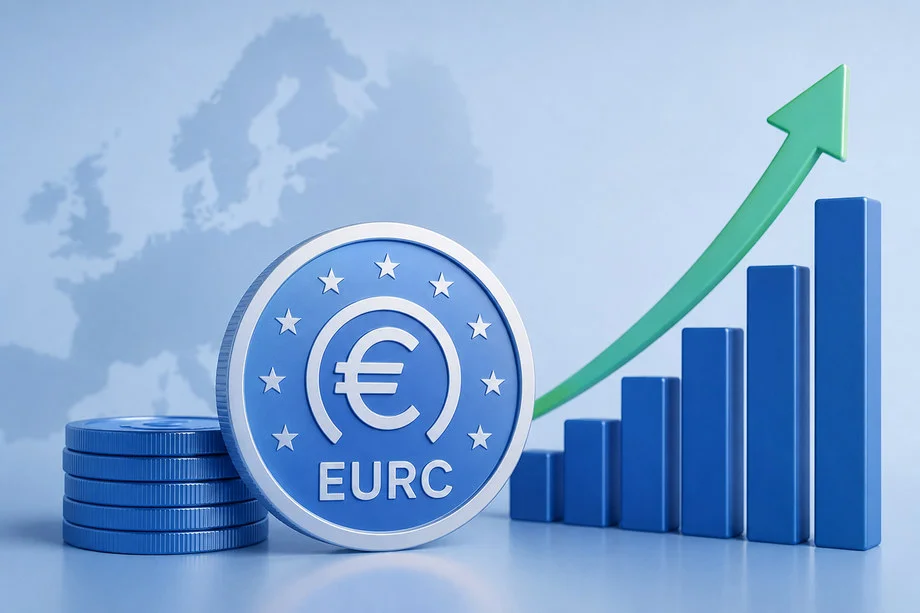
The euro-pegged token issued by Circle has passed €400 million in circulation after more than doubling over the past year, marking a first for any euro stablecoin amid continued dollar dominance in the sector
Circle’s euro stablecoin EURC has surpassed €400 million in circulation for the first time, the company confirmed in mid-August 2026. The milestone arrives nearly four years after the token’s launch and follows a period of steady expansion driven by multi-chain availability, exchange listings and regulated institutional channels.
Supply stood at roughly €80 million by the end of 2024 across five blockchains. It reached €310 million by December 31, 2025, representing 284 percent year-over-year growth, then continued climbing to €394.6 million by July 27, 2026, before crossing the €400 million mark. Circle reported that supply increased by more than 100 percent over the preceding twelve months. One executive described the figure as more than ten times the level recorded at the start of the European Union’s Markets in Crypto-Assets regulatory period two years earlier.
Four-Year Expansion Across Chains and Platforms
EURC debuted on Ethereum in June 2022. Native issuance later extended to Avalanche, Stellar, Solana and Base. By late 2024 the token was live on five networks. Trading pairs against both the euro and the dollar became available on major venues including Bitpanda, Bitstamp, Bybit, Coinbase and Kraken. Institutional custody providers such as Cobo, Copper and Fireblocks added support, while on-ramp and off-ramp services from Mercuryo, MoonPay, Ramp and Transak integrated the token.
Payment networks also incorporated EURC into settlement products. Visa and Mastercard extended stablecoin settlement capabilities to include the euro token, enabling acquirers in selected regions to settle with merchants using Circle’s assets. In August 2026 the payments firm Thunes activated EURC prefunding across Ethereum, Solana, Base and Stellar, allowing euro-denominated transfers outside conventional banking hours without intermediate conversion into dollar stablecoins.
MiCA Compliance and Limited Competition
EURC is issued as an electronic money token under the European Union’s Markets in Crypto-Assets framework through Circle’s licensed electronic money institution in France, supervised by the Autorité de Contrôle Prudentiel et de Résolution. Reserves are fully segregated and subject to regular third-party attestations. Eligible institutional clients can redeem the token one-to-one for euros.
Under MiCA, most euro stablecoin issuers lack simultaneous authorization as both an e-money token issuer and a crypto-asset service provider. That dual licensing is required to custody their own tokens for clients and to process certain automated corporate payouts. Only Circle and Société Générale-Forge currently hold both permissions. The restriction has limited the service range available from other issuers and contributed to EURC’s share of the euro-denominated market.
Earlier euro tokens exited the market rather than meet the new standards. Tether discontinued EURT. Newer compliant issuers entered, yet the overall euro stablecoin segment remains modest. Total euro-denominated stablecoin circulation rose from about €400 million in June 2025 to approximately €650 million by June 2026, with EURC accounting for a substantial portion of that total.
Dollar Stablecoins Still Dominate Global Activity
Despite the growth in euro tokens, dollar-pegged assets continue to account for the overwhelming majority of stablecoin value. A Bank for International Settlements paper published in May 2026 estimated that nearly 98 percent of stablecoin value is dollar-denominated. The global stablecoin market stood near $300 billion at the start of 2026. Euro stablecoins, even after recent gains, represented well under 1 percent of that total.
Users historically faced thinner on-chain liquidity for euro tokens and often routed transactions through dollar stablecoins or bridges. That friction has begun to ease as regulated distribution channels expand, yet the scale differential remains large. Local-currency stablecoin transfer volume reached $1.2 billion in the period ending February 2026, up roughly 90 percent, with euro-based tokens comprising more than 80 percent of that market capitalization and 85 percent of transfer volume. EURC itself processes between $10 billion and $20 billion in monthly volume. Unique addresses interacting with non-dollar stablecoins rose from an estimated 40,000 in January 2023 to more than 1.2 million by early February 2026.
| Date | EURC Circulation | Context |
|---|---|---|
| May 31, 2024 | €37.0 million | Early baseline from reserve report |
| January 1, 2025 | ~€70 million | Beginning-of-year level |
| December 31, 2025 | €310 million | +284 percent year-over-year |
| July 27, 2026 | €394.6 million | Approaching €400 million threshold |
| August 2026 | Above €400 million | First euro stablecoin to reach the mark |
Euro-area M2 money supply exceeded €16 trillion in late 2025, underscoring the distance between current on-chain euro stablecoin holdings and the broader euro monetary base. Competition is also emerging from European banking groups preparing their own MiCA-compliant euro tokens. One consortium of dozens of institutions is advancing plans for a regulated euro stablecoin under Dutch supervision.
Circle has separately called for adjustments to certain proposed European market-integration rules that could restrict institutional settlement functions for tokens not classified as significant e-money tokens. EURC does not currently meet the significance threshold under the existing criteria. The company maintains that greater flexibility would support further development of euro-denominated on-chain liquidity and settlement capacity.

Disclaimer
This article was generated by AI using information from multiple industry sources. It has not been reviewed or verified by a human editor and may contain inaccuracies, omissions, or misinformation. Readers are encouraged to independently verify any information before making decisions based on its content.Tired of the noise?
Let the bots trade for you.
Trade 24/7, without emotion, with data-driven strategies.
Associated articles
AllUnity Debuts MiCA-Compliant USD Stablecoin USDAU Across Six Blockchains

European Stablecoin Issuers Push for Regulated USD Tokens Amid Global Trade Needs

ECB and EU Central Banks Urge Removal of MiCA Bank Deposit Rules for Stablecoins

Anchorage Digital Expands Custody to Etherlink Assets Including Tokenized Uranium
Revolut Begins Phased Rollout of EURR Euro Stablecoin in Three EU Markets
Latest articles

Samsung and SK Hynix Upgrade China NAND Factories Amid AI Demand and Local Rivalry

China Prosecutors Move to Confiscate $5.1 Billion Bitcoin Haul Seized in UK Fraud Case

Bank of Korea Holds Rate at 3% After Consecutive Hikes, Eyes Data for Next Move

Starknet Community Approves Research Into Independent Post-Quantum Layer 1