Newsroom
Brazil Markets Plunge as Lula Secures Historic Fourth Term in Upset
26 October, 2026 / News / AI / Tags: bolsonaro, lula, brazilian, percent, ibovespa
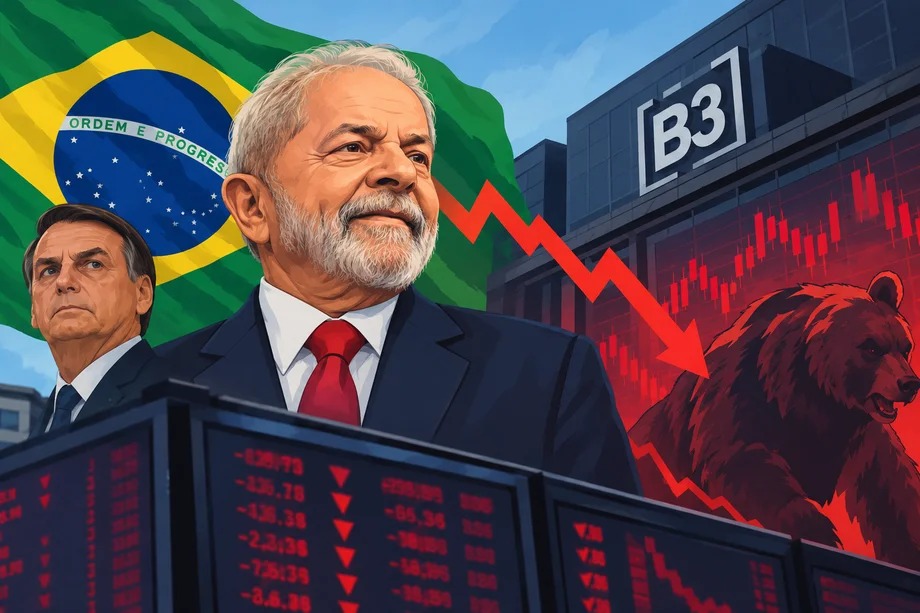
Stocks and currency tumble after prediction markets favored rival; exchange triggers first circuit breaker since pandemic
Brazilian financial markets suffered one of their sharpest selloffs in years on Monday after President Luiz Inácio Lula da Silva defeated Senator Flávio Bolsonaro in Sunday’s presidential runoff, a result that reversed weeks of investor positioning and overturned odds set by major prediction platforms.
Lula secured 51.79 percent of valid votes to Bolsonaro’s 48.21 percent, according to official tallies from Brazil’s Superior Electoral Court. The margin of roughly 4.4 million votes delivered Lula an unprecedented fourth term and made him the first Brazilian president to win a runoff after trailing in the first round.
Sharp Reversal of Pre-Election Rally
Investors had bid up Brazilian assets after Bolsonaro unexpectedly finished ahead in the October 4 first-round vote, taking 47.03 percent against Lula’s 45.16 percent. The Ibovespa benchmark index jumped nearly 8 percent the following session and later reached record territory above 205,000 points. The iShares MSCI Brazil ETF, which tracks large Brazilian companies and trades in New York, gained more than 10 percent in the same period as traders priced in expectations of tighter fiscal policy and lower interest rates.
Monday’s session erased those gains. The Ibovespa fell as much as 17 percent, touching an intraday low near 169,516 points. At its worst, the decline wiped more than $200 billion from the market’s value. The index later recovered some ground but still posted its steepest one-day drop since the early days of the pandemic in 2020.
The Brazilian real weakened by as much as 12 percent against the U.S. dollar, with the greenback rising above 5.60 reais at the low. For dollar-based investors the combined equity and currency moves produced losses of roughly 26 percent at the extremes, matching the performance of the EWZ ETF, which sank as much as 26 percent from Friday’s close before trimming some of the decline.
Bond Market and Treasury Response
Pressure extended beyond equities. Brazil’s Treasury cancelled scheduled auctions of fixed-rate and inflation-linked bonds. Longer-dated sovereign bonds sold off, with the 2056 maturity losing about 2.5 cents. Interest-rate futures rose sharply as investors reassessed the path of monetary policy under a continued Lula administration.
Financial institutions and domestically oriented companies were among the hardest hit, reflecting concerns over future borrowing costs, public spending, and debt dynamics. Public debt already exceeds 80 percent of GDP, and markets have long questioned the government’s ability to deliver a sustained primary surplus.
Prediction Markets Missed the Outcome
The result also represented a clear miss for prediction markets. In the final days before the vote, Polymarket priced Bolsonaro’s chances near 82 to 84 percent, while Kalshi showed roughly 80 percent. Those platforms had correctly called Bolsonaro’s first-round lead. On election night the odds flipped rapidly as early returns showed stronger Lula performance in key areas, eventually settling in his favor. One Brazil election contract on Polymarket attracted more than $249 million in volume.
Traditional polls had been closer to a toss-up. A late Datafolha survey showed the candidates tied at 50 percent among valid votes, while another poll had Bolsonaro narrowly ahead. Lula’s final margin exceeded most pre-election surveys.
Political Uncertainty Persists
Bolsonaro refused to concede. Speaking outside his campaign headquarters in Brasília, he said he did not recognize the result and would seek to annul the election in the courts. He objected to a Supreme Court decision that extended voting hours until 7 p.m. at the request of Lula’s campaign, calling the change mid-process unfair. His own campaign had sought extra time in parts of three states.
The legal challenge adds another layer of uncertainty for markets already focused on the next administration’s fiscal plans, potential cabinet appointments, and the 2027 budget framework.
Brazilian assets had priced in a different policy mix after the first round. Monday’s trading session forced a rapid reappraisal of those assumptions across equities, currency, and fixed-income markets.
Disclaimer
This article was generated by AI using information from multiple industry sources. It has not been reviewed or verified by a human editor and may contain inaccuracies, omissions, or misinformation. Readers are encouraged to independently verify any information before making decisions based on its content.Tired of the noise?
Let the bots trade for you.
Trade 24/7, without emotion, with data-driven strategies.
Associated articles



Latest articles

Zcash Co-Founder Proposes Redirecting 8% of Block Subsidies to Network Reserve

Bitcoin Monte Carlo Simulations Point to Median Value of $1.03 Million in 2033

S&P Global Completes Acquisition of OpenZeppelin Smart Contract Security Firm

Franklin Templeton Files Two ETFs to Convert US Stock Dividends into Bitcoin