Newsroom
Blockchain Association Presses Congress for Crypto Tax Overhaul Amid Stalled Market Structure Bill
24 October, 2026 / News / AI / Tags: tax, association, senate, lummis, rules
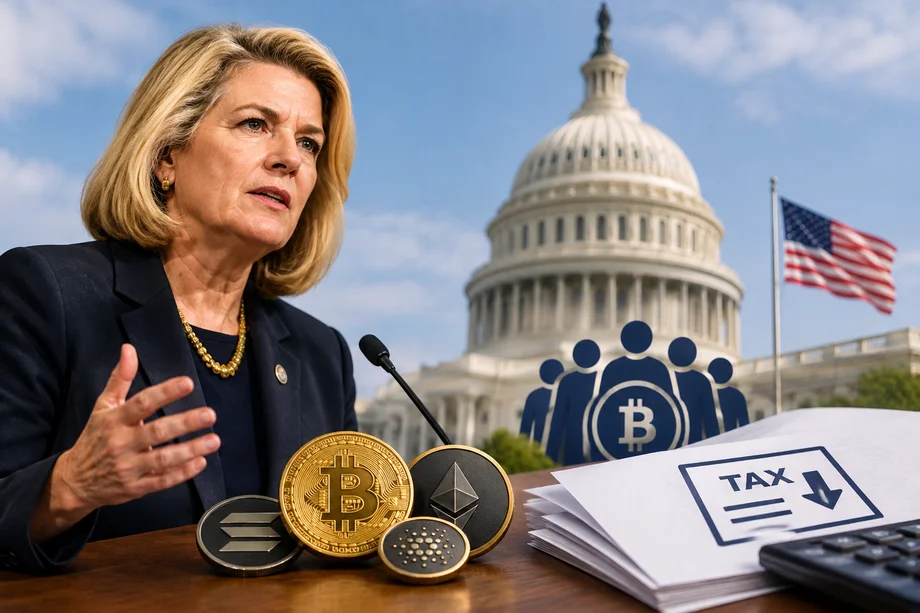
Industry group seeks bipartisan reforms for 67 million U.S. digital asset holders, including small-transaction exemptions and deferred taxation of mining and staking rewards, as the Clarity Act remains blocked in the Senate
The Blockchain Association has called on congressional leaders to pass bipartisan legislation modernizing U.S. tax rules for digital assets. In a letter sent Thursday to Senate Majority Leader John Thune, Senate Minority Leader Chuck Schumer, House Speaker Mike Johnson and House Minority Leader Hakeem Jeffries, the group argued that existing requirements, written for an earlier era, create uncertainty and heavy compliance burdens for the estimated 67 million Americans who hold or use cryptocurrencies.
The letter, signed by Chief Policy Officer Lindsay Fraser, outlines a set of Digital Asset Tax Principles. The association also launched TaxClarityforAmerica.com to help constituents contact their representatives in support of the proposed changes.
Core Proposals for Tax Relief and Clarity
Central to the request is a meaningful de minimis exemption so that small, everyday crypto transactions do not trigger the same capital-gains calculations required for major investment sales. The group also seeks cash-like tax treatment for qualifying stablecoins, which would reduce reporting obligations for routine payments.
On mining and staking, the association proposes treating rewards as self-created property that becomes taxable only upon sale or other disposal, rather than at the moment of receipt. This approach would avoid creating tax liabilities on rewards that have not yet been converted into cash.
Additional recommendations include limiting broker reporting rules under Form 1099-DA to intermediaries that hold or control customer assets. Non-custodial software developers and blockchain infrastructure providers would fall outside those obligations, a step the group says would protect privacy while preserving enforcement tools.
Transfers of digital assets between wallets controlled by the same person, interactions with smart contracts, or movements across blockchains would not count as taxable events when economic ownership and market exposure remain unchanged. The association also supports extending wash-sale rules to crypto to prevent artificial loss harvesting, while designing the provisions so ordinary transactions are not penalized.
Further items on the list include a statutory safe harbor for foreign investors trading on U.S. exchanges, optional mark-to-market accounting for assets with readily available prices, simplified rules for charitable donations of regularly traded cryptocurrencies, recognition of blockchain development as eligible research-and-development activity for tax credits, and clearer treatment of staking inside retirement accounts, grantor trusts and regulated investment vehicles.
Legislative Backdrop and Timing Challenges
The push arrives after the Clarity Act, a broader market-structure measure, failed a Senate cloture vote 49-50 on September 15. No Democrat supported advancing the bill, and several Republicans also opposed it. Senator Cynthia Lummis noted that the legislation already incorporates higher civil penalties for digital-asset violations, a change Democrats had sought.
In the House, the Ways and Means Committee approved the Digital Asset Tax Certainty Act (H.R. 10357) shortly after the Senate setback. That package includes an exemption for network fees under $10 from capital-gains reporting, with a carve-out for high-volume transferors, and extends wash-sale and constructive-sale rules to digital assets. Provisions that would have deferred taxation of mining and staking rewards until disposition were removed from the final committee text; those rewards are instead treated as ordinary income upon receipt.
In the Senate, Senator Steve Daines introduced the ADAPT Act on September 30 with cosponsors including Lummis, Bernie Moreno and Tim Scott. It offers stablecoin purchase exemptions, the same $10 fee threshold and wash-sale rules with certain grandfathering. An earlier Lummis bill proposing a $300 per-transaction de minimis exemption capped at $5,000 annually remains in the Finance Committee. Neither chamber’s current text fully matches the industry’s call for a broader small-purchase exemption covering bitcoin and other assets.
Congress is in recess until after the November 3 midterm elections. The subsequent lame-duck session will be brief, and digital-asset tax measures will compete with other priorities such as government funding. Lummis, a leading Senate voice on the issue, is scheduled to leave office in January 2027.
Industry Position and Next Steps
The Blockchain Association, which represents more than 100 member companies, did not endorse either existing bill by name. It maintains that workable, bipartisan legislation would give taxpayers and businesses greater predictability, support innovation and encourage firms to remain in the United States. The proposals themselves remain recommendations; any change would require formal legislative action before taking effect.
Regulators continue to issue rules in the interim. The Office of the Comptroller of the Currency finalized its GENIUS Act stablecoin guidance this week, while the Securities and Exchange Commission and Commodity Futures Trading Commission advance market-structure policy through existing authorities.
Disclaimer
This article was generated by AI using information from multiple industry sources. It has not been reviewed or verified by a human editor and may contain inaccuracies, omissions, or misinformation. Readers are encouraged to independently verify any information before making decisions based on its content.Tired of the noise?
Let the bots trade for you.
Trade 24/7, without emotion, with data-driven strategies.
Associated articles
House Unveils Digital Asset Tax Certainty Act Ahead of Committee Markup
House Tax Panel Advances First Federal Crypto Tax Framework After Senate Setback

Trump Urges Senate to Advance CLARITY Act in Critical Week

FLEOA Backs CLARITY Act With Calls for Stronger DeFi Rules Ahead of Senate Vote

Senate Delays CLARITY Act Vote Until September Amid Ethics Deadlock
Latest articles

New York AG Seeks $1.37 Billion From NovaTech Founders in Crypto Fraud Case
US Senator Seeks Records on Tether Payments to Firm Tied to Former White House Crypto Adviser

Bitcoin Core Revises Security Policy as AI Tools Simplify Bug Discovery

Singapore, Malaysia and Thailand Central Banks Expand BLOOM for Cross-Border Digital Money Settlement