Newsroom
BlackRock Sees AI Agents Fueling Demand for Stablecoins and Bitcoin as Machine-Native Money
23 September, 2026 / News / AI / Tags: blackrock, agents, machine, economy, stablecoins
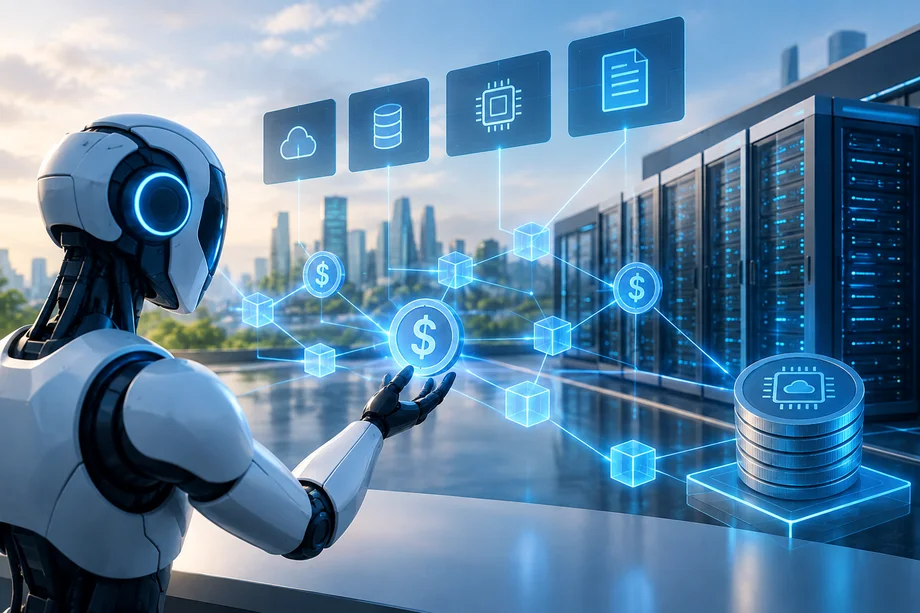
The world's largest asset manager argues that autonomous AI systems will require programmable payment rails, positioning digital assets as core infrastructure for an emerging machine economy
BlackRock has outlined a detailed case that artificial intelligence could become a major, underappreciated driver of demand for digital assets. In a research paper titled “The Machine-Native Economy,” the firm’s digital assets team contends that as AI agents grow more autonomous, they will need payment systems built for machines rather than people. Traditional cards and bank transfers, the authors argue, fall short for high-frequency, always-on transactions that require no human approval.
The paper, written by Will Su, Robert Mitchnick, Jay Jacobs and William Helm, frames AI as a structural catalyst for digital asset adoption while positioning those assets as potential enablers of the AI economy itself. “Together, these developments position AI as a structural catalyst for digital asset adoption and digital assets as a potential facilitator of the AI economy,” the authors wrote. “This relationship remains underappreciated and could expand the role of digital assets as core infrastructure for an increasingly autonomous digital economy.”
Why Conventional Payment Rails Fall Short
BlackRock identifies clear mismatches between existing financial infrastructure and the needs of AI agents. Account setup, credentialing and authorization still typically require human involvement. Merchant fees can render low-value or sub-cent transactions uneconomic. Settlement and finality times also vary across providers, creating friction for continuous machine-to-machine activity.
In contrast, the firm says stablecoins, native cryptocurrencies and other on-chain assets are better suited to high-frequency, round-the-clock payments. “Several types of digital assets may support agentic commerce, but stablecoins are likely to lead transactional use,” the paper states. These instruments can settle instantly, operate without banking hours and support programmable conditions that agents can execute autonomously.
A Two-Tier Model: Stablecoins for Spending, Bitcoin for Savings
BlackRock proposes separating the functions of machine money. Stablecoins would serve as the primary spending medium for everyday agent transactions, while Bitcoin would function as a store of value for longer-term holdings. The firm cites a February 2026 study by the Bitcoin Policy Institute that tested 36 frontier AI models from Anthropic, OpenAI, Google, xAI and DeepSeek. Across 9,072 responses, the models selected Bitcoin for storing value 79.1 percent of the time and stablecoins for spending 53.2 percent of the time. Traditional bank money was chosen less than 9 percent of the time in both categories.
BlackRock notes that it has commercial exposure to this market through a money-market fund launched earlier this year to hold reserves for stablecoin issuers.
Tokenized Compute as a Potential New Asset Class
Beyond payments, the paper explores a longer-term opportunity in the market for computing capacity. AI training and inference require large volumes of processing power. Analyst estimates cited by BlackRock project that revenue from the major cloud businesses of Amazon, Microsoft and Google could reach approximately $1.1 trillion by 2030.
The firm suggests that claims on this capacity could eventually be represented as tokens, allowing them to be transferred, pledged as collateral or traded. AI agents could then query real-time marketplaces for price, latency, location and hardware type, provision resources on demand and settle payments automatically. “This could in turn broaden institutional investor participation and establish compute as a new opportunity for the broader digital asset ecosystem,” the authors wrote. BlackRock cautions, however, that standardized contracts and liquid markets for compute remain at an early, largely speculative stage and that robust infrastructure for permissions, identity and compliance still needs development.
Emerging Protocols and Industry Alignment
Infrastructure supporting agentic payments is already taking shape. BlackRock highlights Coinbase’s x402 protocol, which revives the HTTP 402 “Payment Required” status code so agents can pay for data or services transaction by transaction. Other efforts include Tempo’s Machine Payments Protocol, Circle’s agent wallets and USDC tools, and OKX’s Agent Payments Protocol designed for recurring and escrow-style arrangements.
These developments align with views expressed by industry executives. Coinbase CEO Brian Armstrong has argued that AI agents will require programmable money rather than traditional banking rails. “AI being a megatrend takes nothing away from crypto,” Armstrong wrote. “If anything, it makes crypto more important.”
Cautious Outlook on Timing and Competition
BlackRock stops short of forecasting a crypto-only future. The paper acknowledges competing payment initiatives from Stripe, OpenAI, Google and Visa, some of which continue to settle in conventional bank money. It also notes that live AI agent payment volume remains small at present. Forward-looking statements are carefully qualified with language such as “could” and “can,” and the document carries a disclaimer that it is not a financial forecast.
The research nonetheless places institutional weight behind the idea that autonomous software systems may increasingly rely on digital assets for both commerce and resource allocation. As AI agents begin to transact independently, the demand for programmable, machine-native money rails could expand the practical role of stablecoins, Bitcoin and related on-chain infrastructure within the broader digital economy.
Disclaimer
This article was generated by AI using information from multiple industry sources. It has not been reviewed or verified by a human editor and may contain inaccuracies, omissions, or misinformation. Readers are encouraged to independently verify any information before making decisions based on its content.Tired of the noise?
Let the bots trade for you.
Trade 24/7, without emotion, with data-driven strategies.
Associated articles

Coinbase CEO Argues AI Agents Will Boost Crypto Demand as Base Surpasses 100 Million Payments
Coinbase Base Targets AI Agent Startups With $100K Accelerator as x402 Payments Surge
Block Joins x402 Foundation, Adds Bitcoin Lightning for AI Agent Payments

Coinbase Rolls Out Tools for AI Agents to Pay Businesses in USDC

Coinbase Advances AI Agent Finance with Isolated Accounts and Trading Tools
Latest articles

Bumble Agrees to $1.3 Billion Take-Private Deal with Ithaca Holdings

Interactive Brokers Launches Ethereum Staking to Boost Client Rewards on Holdings
Sberbank Receives Approval to Trade Bitcoin and Ether
S&P Dow Jones Executes First On-Chain OTC Swap Referencing Tokenized Index on Canton