Newsroom
Bitmine’s $257M ETH Staking Revenue Funds Operations and Share Buybacks
13 August, 2026 / News / AI / Tags: staking, bitmine, ether, annualized, income
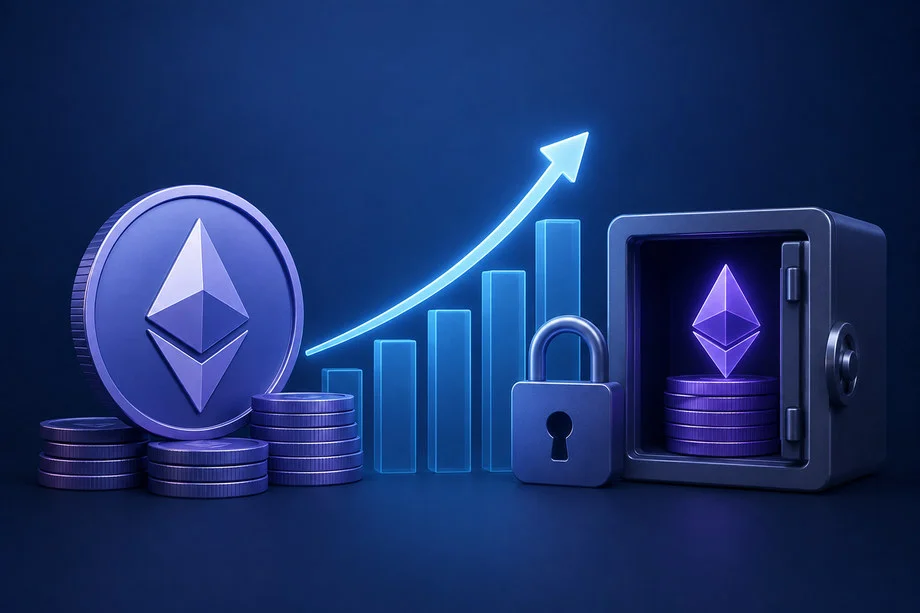
Bitmine Immersion Technologies reports 5.81 million staked Ether generating an estimated $257 million in annualized income, covering costs and repurchases without selling holdings
Bitmine Immersion Technologies, the largest corporate holder of Ether, has crossed a major threshold in its staking strategy. The company announced on Monday that its Ether holdings reached 5.81 million tokens, with the majority staked, projecting roughly $257 million in annualized staking-related revenue.
This income stream has become central to the firm’s financial model. Analysts noted that staking accounted for nearly all of Bitmine’s revenue in the most recent reported period, allowing the company to cover operational needs and advance a substantial share repurchase program without liquidating any of its Ether position.
Staking Dominates Revenue and Supports Capital Returns
For the fiscal quarter ending May 31, Ether staking produced $45.7 million of Bitmine’s $46.5 million in total revenue, or about 98 percent. This concentration underscores how staking has shifted from a secondary activity to the primary source of cash flow for the company.
The ability to fund both day-to-day operations and the buyback authorization without disposing of Ether is viewed as a structural advantage. It reduces the pressure to sell during periods of price weakness and preserves the underlying position for potential longer-term appreciation.
Ether as a Yield-Bearing Treasury Asset
Corporate interest in Ether has grown in part because of its capacity to generate native yield through staking, a feature that distinguishes it from Bitcoin, which is more commonly treated as a balance-sheet appreciation asset. Bitmine’s scale demonstrates how this model can operate at institutional levels.
Market participants treat the projected $257 million figure as an annualized estimate rather than a guaranteed fixed return. Actual receipts will vary with changes in the staking yield, Ether’s market price, and the company’s ability to maintain validator performance and manage liquidity constraints.
Price Declines Create Reporting Pressure Across the Sector
While staking provides recurring income, large Ether holders remain exposed to mark-to-market effects. Ether’s spot price declined roughly 23 percent during the second quarter of 2026, contributing to significant unrealized losses at other treasury-focused firms.
SharpLink, identified as the second-largest corporate Ether holder, reported a $394 million net loss for the second quarter of 2026. Nearly all of that figure, $391 million, stemmed from unrealized crypto losses. The contrast illustrates a core tension: staking can generate cash without sales, yet reported results still move with the underlying asset’s market value.
At the time of the latest comparative data, Bitmine held approximately 5.54 million Ether valued at about $9.4 billion, while SharpLink held 863,000 Ether worth roughly $1.46 billion.
Network Staking Conditions
Ether staking currently offers an annual percentage rate of 2.61 percent. More than 34 percent of the total Ether supply is staked across 897,064 validators. These network-wide figures provide the backdrop for corporate strategies that treat staking income as a buffer against price volatility.
One independent analysis has argued that annualized staking receipts can be modeled with less direct dependence on short-term spot price movements, offering a degree of topline predictability. Still, the durability of that income depends on sustained yields, operational execution, and the evolving regulatory environment for institutional validators.
Bitmine’s latest disclosure positions the company at the forefront of this emerging corporate treasury approach, combining large-scale Ether ownership with active yield generation to support both operations and shareholder returns.


Disclaimer
This article was generated by AI using information from multiple industry sources. It has not been reviewed or verified by a human editor and may contain inaccuracies, omissions, or misinformation. Readers are encouraged to independently verify any information before making decisions based on its content.Tired of the noise?
Let the bots trade for you.
Trade 24/7, without emotion, with data-driven strategies.
Associated articles

Bitmine Launches $300M Preferred Stock Raise as Ethereum Treasury Nears 5% Milestone

BitMine Holds Nearly 5% of Ethereum With $16.2 Billion Treasury

BitMine Ethereum Staking Generates $45.7 Million in Quarterly Revenue

BitMine Expands Ethereum Treasury to 5.78 Million ETH While Executing Major Share Buyback

Bitmine Immersion Technologies Crosses 6 Million ETH in Treasury
Latest articles

SpaceX and Tesla Set Up Committees to Explore Merger That Would Combine Holdings of Over 30,000 Bitcoins

UK Banks Face Thousands of Complaints Over Crypto Transfer Restrictions

Ripple Backs SEC Proposed Crypto Asset Rules After $150 Million Legal Battle

Blockchain.com Introduces Options Trading on Seven Major Crypto Assets