Newsroom
Binance.US Plans August CFTC Bid to Enter Prediction Markets
30 July, 2026 / News / AI / Tags: contracts, cftc, binance, designated, event
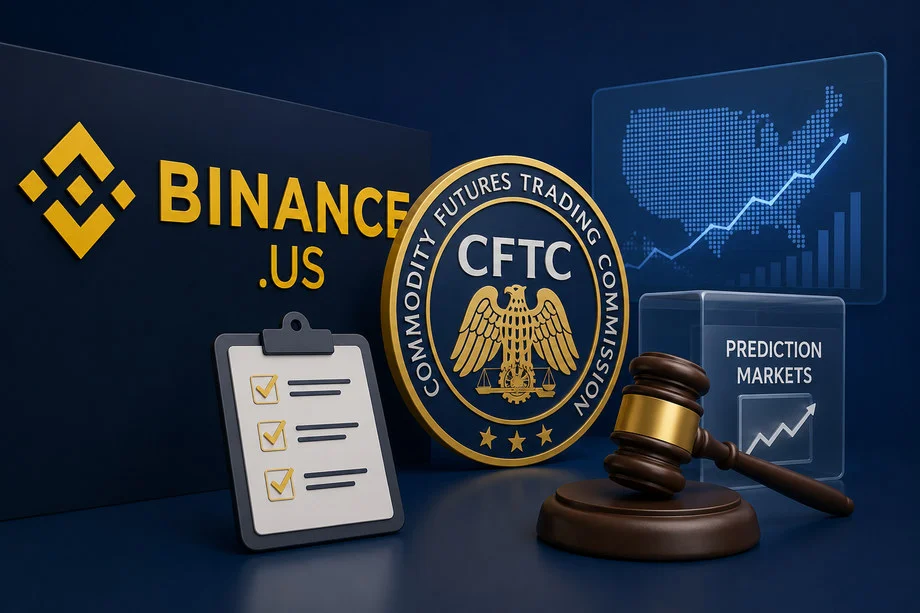
Binance.US intends to seek a designated contract market license from the CFTC next month, aiming to offer regulated event contracts, futures and options as part of its U.S. expansion
Binance.US is preparing to apply for a designated contract market license from the Commodity Futures Trading Commission as early as August. The move would enable the exchange to list futures, options and event contracts under federal oversight, expanding its offerings beyond spot cryptocurrency trading.
Chief Executive Officer Stephen Gregory disclosed the plan during the Rare Evo conference in Las Vegas. A company spokesperson later confirmed the timeline. No application has been submitted to the CFTC yet, according to available records.
License Would Open New Product Categories
A designated contract market designation permits venues to trade futures or option contracts based on commodities, indexes or other instruments. Applicants must satisfy 23 core principles under the Commodity Exchange Act. These cover system safeguards, record-keeping, market surveillance, financial resources and conflicts of interest.
Approval would place Binance.US among a growing group of federally supervised platforms offering event contracts. Users could trade on outcomes tied to elections, economic data, sports results and other events, with prices serving as probability indicators rather than ownership claims.
The initiative forms part of a wider recovery effort. Gregory has previously described goals that include lower trading fees, improved liquidity and additional products such as perpetual futures. The exchange seeks to rebuild its position in the U.S. market after earlier regulatory challenges and a settled anti-money laundering matter.
Crowded Field of Competitors
Kalshi and Polymarket US already operate under CFTC authorization for event contracts. Gemini obtained a related license earlier this year. Coinbase provides access to event contracts through a partnership with Kalshi.
Interest extends beyond crypto-native platforms. Robinhood reported $156 million in revenue from event contracts in its most recent quarter, more than ten times the prior-year figure. Customers traded over 13.6 billion such contracts, making the category its fastest-growing source of transaction-based revenue even as cryptocurrency trading revenue declined. Discussions have also emerged about possible distribution of Crypto.com prediction products within the Robinhood app.
Trading volume across CFTC-designated venues exceeded $25 billion in 2025, with roughly 1,600 event contracts certified that year compared with 131 in 2021.
Ongoing Legal and Regulatory Uncertainty
Federal approval would not resolve all obstacles. Multiple states maintain that sports-linked event contracts fall under state gambling laws rather than federal commodities rules. A federal judge in Wisconsin recently rejected a CFTC request for an injunction against state enforcement targeting platforms that include Kalshi, Polymarket, Crypto.com, Robinhood and Coinbase. The court found insufficient demonstration that the contracts qualify as swaps for preliminary relief purposes and concluded that Wisconsin gambling laws were not preempted.
Other courts have reached mixed outcomes. Some have temporarily blocked state bans while others have supported state enforcement actions. The CFTC has indicated it will appeal the Wisconsin decision.
At the federal level, the agency continues to review proposed amendments to Rule 40.11 concerning event contracts involving gaming, war, terrorism or unlawful activity. Attorneys general from 44 states have urged the commission to withdraw and revise the proposal, arguing it exceeds authority under the Commodity Exchange Act. Sports leagues have expressed differing views, with some seeking stronger integrity measures and others forming commercial partnerships with platforms.
The CFTC’s Division of Market Oversight has also reminded designated contract markets to submit contract-specific legal analysis and settlement details rather than broad template filings.
Path Forward Remains Uncertain
Binance.US has not yet filed its application. CFTC reviews of this type typically require several months, and approval is not assured. Even if granted, product launch timelines and specific listing conditions would depend on the terms of any authorization.
The bid follows the earlier dismissal of a U.S. Securities and Exchange Commission lawsuit against Binance entities. It signals an effort to operate under clearer federal supervision while competing in a product category that has attracted significant retail engagement and revenue growth at other platforms.
Disclaimer
This article was generated by AI using information from multiple industry sources. It has not been reviewed or verified by a human editor and may contain inaccuracies, omissions, or misinformation. Readers are encouraged to independently verify any information before making decisions based on its content.Tired of the noise?
Let the bots trade for you.
Trade 24/7, without emotion, with data-driven strategies.
Associated articles
Blockchain.com Seeks CFTC Approval to Launch U.S. Event Contracts and Crypto Derivatives

Novig Files Preemptive Suit Against Wisconsin Officials Over Sports Prediction Contracts

CFTC Warns Prediction Markets Against American-Style Gambling Odds

CFTC Orders Kalshi to Keep Trading After New York Seeks $36 Billion Shutdown

New York Sues Kalshi Seeking $36 Billion Over Alleged Illegal Gambling
Latest articles

SpaceX and Tesla Set Up Committees to Explore Merger That Would Combine Holdings of Over 30,000 Bitcoins

UK Banks Face Thousands of Complaints Over Crypto Transfer Restrictions

Ripple Backs SEC Proposed Crypto Asset Rules After $150 Million Legal Battle

Blockchain.com Introduces Options Trading on Seven Major Crypto Assets