Newsroom
Binance Requires Purpose and Counterparty Details for Brazilian Cross-Border Crypto Transfers From Nov. 1
5 October, 2026 / News / AI / Tags: brazilian, counterparty, transfers, binance, international
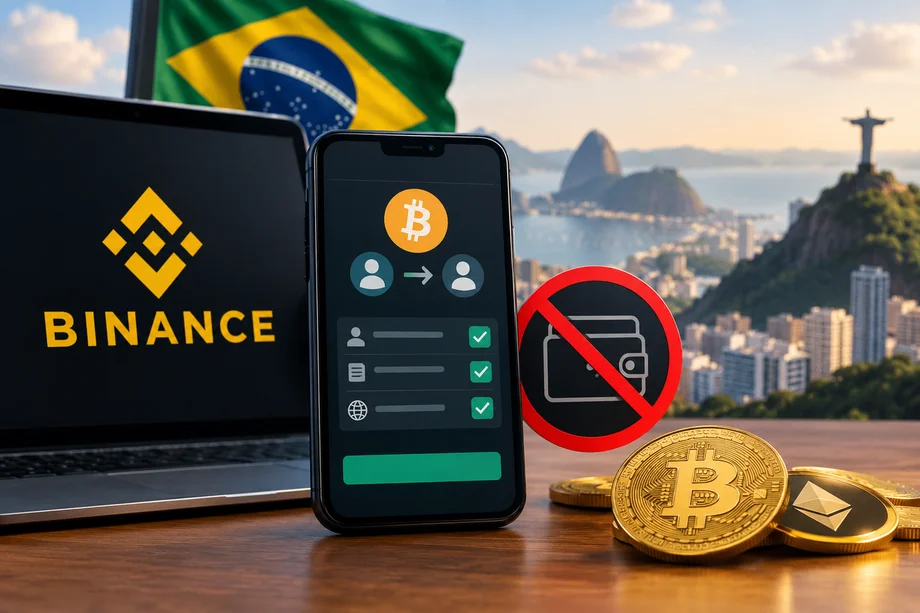
Brazilian users must complete a questionnaire for international crypto moves or face blocked withdrawals and pending deposits under new Central Bank rules
Binance will introduce mandatory disclosure requirements for cross-border cryptocurrency transfers involving Brazilian users beginning November 1. The exchange will require individuals and companies to state the purpose of each international transfer and provide details about the counterparty before processing certain deposits and withdrawals.
The measures stem from Resolution BCB No. 521/2025 issued by the Central Bank of Brazil. The regulation brings international virtual-asset transfers into the country’s foreign-exchange framework and imposes new reporting duties on crypto service providers. Transfers between two Brazilian residents remain unaffected. Moves between a Brazilian resident and a non-resident, including transfers to a user’s own account on an overseas exchange, fall under the new rules.
Questionnaire Requirements and Transaction Thresholds
Users must supply the purpose of the transfer and identify the counterparty type. Categories include individuals, companies, banks, exchanges, investment funds, nonprofits and other classifications. Corporate accounts must also declare whether the counterparty belongs to the same economic group.
Purpose codes follow classifications set by the Central Bank. For transfers of $50,000 or less, users select from a simplified list of 10 purposes, such as transfers between a person’s own accounts, payments for goods, IT or business services, donations and international travel. Transfers above $50,000 require selection from a full list of 96 classifications. No generic “other” option exists for larger amounts, and the chosen category must accurately match the transaction reason because the data is reported to the regulator.
When users transfer assets to an account they own on a foreign exchange, the system typically pre-fills the purpose as a transfer between accounts belonging to the same person, requiring only confirmation. Self-hosted wallets receive different treatment: users must confirm ownership but do not need to provide a purpose. Binance reports those transactions under a separate category.
Consequences of Incomplete Information
International withdrawal requests cannot be submitted until the required questionnaire is completed. Incoming deposits from abroad may remain pending while Binance awaits the information. In some cases, incomplete details can result in the funds being returned to the sender.
The requirements apply to every international deposit and withdrawal, including those initiated through APIs. Institutional and VIP customers will receive separate technical guidance. Binance will submit the collected information to the Central Bank in monthly regulatory reports.
Transfer Caps and Counterparty Authorization
An additional limit applies when the foreign counterparty is not authorized to operate in Brazil’s foreign-exchange market. In such cases, Resolution BCB No. 277, as amended by Resolution 521, restricts the international virtual-asset payment or transfer to the equivalent of $100,000 per transaction. The cap is not universal and depends on the status of the institution or entity on the other side of the transfer.
Foreign exchanges available for transfers appear in a drop-down menu after assessment under Central Bank requirements. Platforms not listed can be submitted to customer support for review, subject to internal analysis. Brazilian providers must also verify that overseas crypto firms are subject to effective prudential and conduct supervision or document their own risk assessment when such supervision is absent.
Distinction From the Travel Rule
Binance has stated that the November questionnaire is separate from Brazil’s crypto Travel Rule. Travel Rule requirements will follow a phased timetable, with domestic transfers scheduled for 2027 and international transfers for 2028. Separate notices will address those obligations.
Resolution 521 classifies a crypto transfer as international when ownership changes between a resident and non-resident, between two non-residents, or when the same person sends or receives assets across Brazil’s border. The new procedure operates within Brazil’s broader regulatory framework for virtual-asset service providers, which continues to expand governance, risk-management and prudential standards.
Binance indicated that further operational details will be provided in the coming days ahead of the November 1 start date. Ordinary trading and domestic transfers between Brazilian residents are not affected by the change.
Disclaimer
This article was generated by AI using information from multiple industry sources. It has not been reviewed or verified by a human editor and may contain inaccuracies, omissions, or misinformation. Readers are encouraged to independently verify any information before making decisions based on its content.Tired of the noise?
Let the bots trade for you.
Trade 24/7, without emotion, with data-driven strategies.
Associated articles

Brazil Central Bank Mandates 24-Hour Hold on Large Crypto Transfers Starting 2027

IMF Calls for Stronger Controls on Brazil’s Surging Stablecoin Activity

South Korea Requires Reporting of Crypto Accounts on Bankrupt Overseas Exchanges

HashKey Exchange Secures JPMorgan Approval for Segregated Client Funds Account

US Slaps 25% Tariffs on Brazil Targeting Pix Payment System
Latest articles

Mysterious Poems Repeatedly Appear on Bitcoin Blockchain Over 12 Days

Arthur Hayes Closes Maelstrom Positions With $22.28 Million Token Sales

Global X Canada Sets Monthly Distributions Across Four ETFs

IRS Plans Lower Penalties and Faster Resolutions for Voluntary Tax Disclosures, Including Crypto