Newsroom
Aptos Activates Encrypted Mempool on Mainnet to Limit MEV Exploitation
13 October, 2026 / News / AI / Tags: aptos, encrypted, mempool, decryption, sandwich
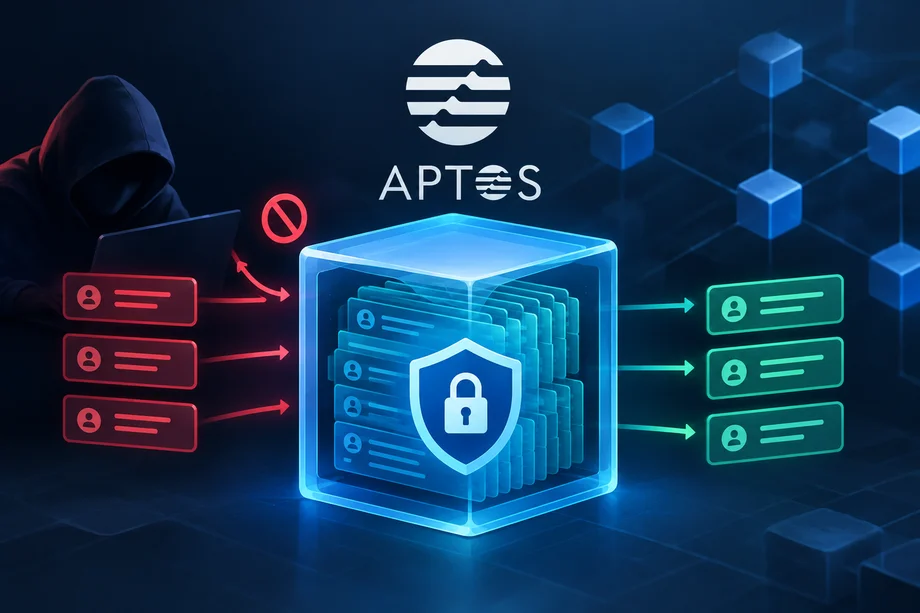
The optional feature encrypts transaction details until block finality, aiming to reduce front-running and sandwich attacks while adding modest costs and latency
Aptos has enabled its Encrypted Mempool feature on mainnet as of October 12, 2026. The protocol-native option lets users encrypt the contents of individual transactions before they enter the network, keeping function calls, parameters, assets and amounts hidden from validators and external parties until ordering is finalized.
The design targets maximal extractable value, or MEV, practices such as front-running and sandwich attacks. In those cases, automated systems monitor pending transactions and insert their own trades to capture value at the original sender’s expense. By withholding transaction payloads during the ordering phase, the system is intended to limit the information available for such strategies.
How the Encrypted Mempool Operates
Users activate the feature on a transaction-by-transaction basis through a compatible wallet or application. Encryption occurs on the user’s device prior to submission. The encrypted payload then enters the mempool, where validators reach consensus on transaction order without access to the hidden details. Sender addresses and gas fees stay visible at every stage.
Once a block achieves finality, validators jointly decrypt the transactions using a stake-weighted threshold identical to the one required for block production. A single validator, or any group controlling less than two-thirds of the network’s staked voting power, cannot perform decryption independently. The revealed transactions are then executed and recorded on-chain.
The mechanism is specified in AIP-144. Aptos describes it as protocol-native, relying on the existing validator set for both ordering and decryption rather than introducing a separate committee or external builders.
Costs, Latency and Technical Parameters
Encrypted transactions carry a minimum gas price of 200 octas per gas unit, twice the network’s base minimum. An additional 375 gas units are charged for decryption, separate from the gas required to execute the transaction instructions. Total fees therefore depend on overall gas consumption.
In a benchmark involving 50 nodes, the system added approximately 20 milliseconds of latency per block relative to the production AptosBFT consensus implementation, which normally finalizes blocks in under one second. Blocks containing no encrypted transactions skip the decryption step.
The encryption system received an independent security review by ZKSecurity prior to mainnet deployment. Support has been added in version 7.0.0 and later of the TypeScript software development kit. Existing Move smart contracts require no changes to work with the feature. Keyless accounts and certain account-abstraction signers are not supported at launch.
Adoption Path and Industry Context
Petra wallet already provides an option to enable encryption during transaction signing. Decibel, an Aptos-based perpetuals exchange, plans to apply the feature to protect pending order details. Aptos has positioned the capability for institutional participants submitting large transactions, individual traders seeking MEV protection, AI agents and application builders.
Other networks have pursued related approaches. Gnosis Chain introduced an encrypted mempool based on Shutter technology in July 2024. Ethereum users can route transactions privately through Flashbots Protect. Aptos notes that its implementation keeps both ordering and decryption within the existing validator set.
Industry data illustrate the scale of the problem the feature addresses. Sandwich attacks on Ethereum cost traders roughly $60 million over the 12 months ending October 2025. On Solana, analysis of an 11-month period identified nearly 6.9 million sandwich attacks that affected about 2.2 million wallets and generated $29.7 million for bots before trading costs.
Alongside the Encrypted Mempool, Aptos maintains other optional privacy tools, including Keyless Accounts for identity and Confidential APT for transfer amounts. Completed transactions remain publicly auditable once decrypted and executed.

Disclaimer
This article was generated by AI using information from multiple industry sources. It has not been reviewed or verified by a human editor and may contain inaccuracies, omissions, or misinformation. Readers are encouraged to independently verify any information before making decisions based on its content.Tired of the noise?
Let the bots trade for you.
Trade 24/7, without emotion, with data-driven strategies.
Associated articles

BNB Chain Activates Pasteur Hard Fork on BSC Mainnet

Solana Alpenglow Consensus Reaches Devnet With 150-Millisecond Finality Target

BNB Chain Prepares Pasteur Hard Fork for August 25 Activation

Solana Begins Testing Alpenglow Upgrade Targeting 150-Millisecond Finality
Solana Prepares Final Slot Time Cut to 200 Milliseconds Under SIMD-0525
Latest articles

Bumble Agrees to $1.3 Billion Take-Private Deal with Ithaca Holdings

Interactive Brokers Launches Ethereum Staking to Boost Client Rewards on Holdings

Sberbank Receives Approval to Trade Bitcoin and Ether

S&P Dow Jones Executes First On-Chain OTC Swap Referencing Tokenized Index on Canton