Newsroom
Solana Alpenglow Consensus Reaches Devnet With 150-Millisecond Finality Target
26 September, 2026 / News / AI / Tags: alpenglow, finality, mainnet, solana, anza
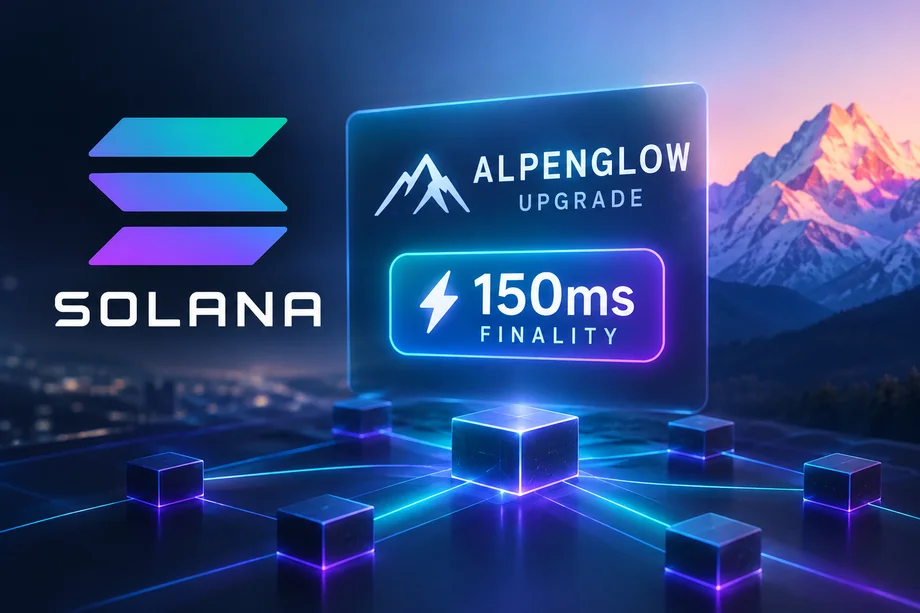
Anza activates the upgrade on the developer network one day after testnet, aiming to slash finality times while mainnet timing remains undecided
Solana’s Alpenglow consensus upgrade is now live on the public developer network, allowing application teams to test a redesigned system intended to reduce transaction finality from roughly 12.8 seconds under the existing TowerBFT mechanism to about 150 milliseconds.
Anza, the firm responsible for Solana’s core validator software, completed the devnet migration on September 25. The move followed the successful transition on testnet the previous day. Mainnet continues to operate under the current consensus rules, and no firm activation date has been announced for the live network.
How Alpenglow Changes Finality
Under TowerBFT, validators submit votes as on-chain transactions that must accumulate across multiple slots before a block is considered final. Alpenglow’s initial phase, known as Votor, replaces those on-chain votes with direct exchanges among validators. Blocks can reach finality after one voting round when validators representing at least 80 percent of stake approve them, or after a second round under a lower stake threshold.
Finality marks the point at which a transaction is treated as irreversible under the network’s consensus rules. The 150-millisecond figure remains a target derived from testing and simulations rather than measured performance under live market conditions. A subsequent phase called Rotor is planned to overhaul block propagation, replacing the current Turbine system, but that component is not part of the current rollout.
Solana co-founder Anatoly Yakovenko commented on the milestone with a brief message on the social platform X. The upgrade preserves the existing application environment, so programs that only send transactions and read account balances require no code changes.
Impact on Data Services and Infrastructure
Services that construct transaction histories face additional work. Alpenglow can surface competing candidate blocks for the same slot before the network selects one. Data providers must keep those candidates distinct and retain only the block that achieves confirmation. Combining transactions across candidates risks producing inaccurate records.
Validator votes will no longer appear inside blocks as transactions. Charts or alerts that previously counted both user activity and vote transactions will show lower totals after activation even if user volume stays constant. Participation data shifts to certificates attached to block information, requiring updates for systems that previously read it from vote transactions. Operators relying on Geyser or gRPC data streams must also handle new identifiers that distinguish candidate blocks within a slot.
Rollout Timeline Remains Open
Earlier roadmaps associated Alpenglow with Agave 4.3 software and an October mainnet window. Anza’s release schedule lists a tentative September 28 milestone for resuming mainnet feature activations, yet that date is not tied specifically to Alpenglow and remains subject to change. The Solana Foundation’s status page continues to list the upgrade as inactive on mainnet.
Devnet gives application developers a controlled environment with tokens that hold no real value, while testnet provides validators and infrastructure operators a more demanding setting. Both stages form part of an observation period before any mainnet decision. The current activation focuses solely on the voting and finality changes introduced by Votor.
The upgrade advances Solana’s multi-year effort to refine consensus while keeping the network’s smart-contract and transaction formats intact. Further testing on the public developer and test networks will determine how the simulated finality targets perform under broader conditions.

Disclaimer
This article was generated by AI using information from multiple industry sources. It has not been reviewed or verified by a human editor and may contain inaccuracies, omissions, or misinformation. Readers are encouraged to independently verify any information before making decisions based on its content.Tired of the noise?
Let the bots trade for you.
Trade 24/7, without emotion, with data-driven strategies.
Associated articles

Solana Begins Testing Alpenglow Upgrade Targeting 150-Millisecond Finality
Solana Targets 150-Millisecond Finality With Alpenglow Consensus Upgrade on October 21
Solana Prepares Final Slot Time Cut to 200 Milliseconds Under SIMD-0525

Solana Activates First Slot Time Reduction to 350 Milliseconds on Mainnet

Cardano Founder Ties Network Completion to Leios Throughput Upgrade as Testnet Hits Peak Capacity
Latest articles

Scammer Loses $4.8 Million in Bitcoin on Tampered Ledger Devices

Visa Moves USDC Prefunding for Cross-Border Payouts into Commercial Production

Schwab Rolls Out Bitcoin and Ether Trading to Millions of Retail Clients

U.S. Fiscal 2026 Deficit Climbs to $1.99 Trillion as Interest Payments Surge