Newsroom
AMD Shares Climb as Nvidia Leadership Change Fuels AI Chip Competition Shift
13 November, 2026 / News / AI / Tags: amd, nvidia, november, accelerators, near
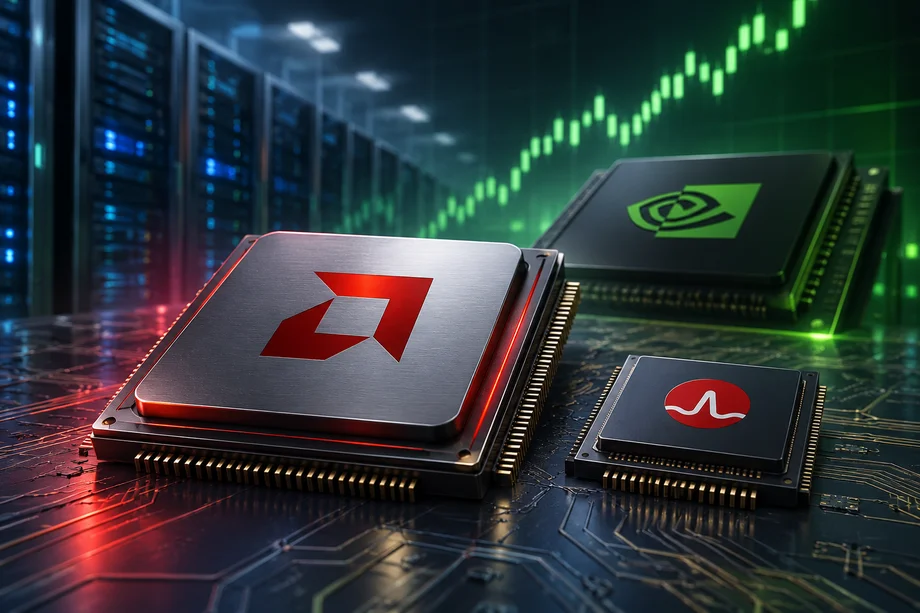
AMD stock advanced sharply on November 12 after Nvidia’s longtime CEO stepped down, drawing investor focus to the company’s data-center growth and expanding AI accelerator lineup
Leadership Transition at Nvidia Sparks Market Rotation
Advanced Micro Devices shares rose between roughly 5% and 7% on November 12, with closing prices reported near $582 to $585, as investors reassessed positions across artificial intelligence chipmakers. The move came after Nvidia confirmed that founder and CEO Jensen Huang had resigned following 33 years at the company. Chief Financial Officer Colette Kress was named interim CEO while the board seeks a permanent successor.
Nvidia shares declined about 4% in the same session, with broader losses reported from recent peaks. Broadcom also advanced more than 5%. Trading volume in AMD was elevated, exceeding its recent average. The divergence occurred against a backdrop of an independent board investigation at Nvidia that had already introduced uncertainty about governance and succession.
AMD entered the session with existing momentum. Shares had closed the prior day near $553 after earlier double-digit gains and had recovered substantially from a November 5 low near $404. One measure placed the recovery at more than 40% from that trough.
AMD Data-Center Results Provide Fundamental Support
The company’s third-quarter results, released earlier in November, showed revenue of $13.38 billion, up 45% from the year-earlier period. Data-center revenue nearly doubled to $8.55 billion, driven by EPYC server processors and Instinct AI accelerators. Non-GAAP earnings per share rose 74% to $2.09.
Management guided fourth-quarter revenue to approximately $17 billion, plus or minus 3%, implying annual growth near 66% at the midpoint. CEO Lisa Su has described plans centered on Helios rack-scale systems and the ROCm software platform. Early customers for Helios systems include Anthropic, Microsoft, Meta, OpenAI and Oracle. AMD’s partnership with Anthropic includes plans for up to two gigawatts of Instinct MI450 GPUs, with larger deployments expected in 2027.
A separate Google Cloud arrangement selected AMD EPYC processors for infrastructure supporting the cloud provider’s proprietary AI accelerators, illustrating how AMD can participate in AI buildouts even when customers use their own specialized chips.
Competitive Dynamics and Analyst Views
Nvidia continues to hold a leading position through its GPU architecture, CUDA software ecosystem and established relationships with major cloud providers. Switching costs for large workloads have historically been high. Recent commentary noted that Anthropic’s restricted-access model required only about three days to bring up prompt processing on AMD MI355X GPUs, compared with traditional engineering timelines of six to twelve months for similar work. That result applies to a single workload rather than a full migration.
Seaport Research’s Jay Goldberg described AMD’s products as more formidable competitors than in prior periods and said both AMD and Broadcom had already begun gaining share before Nvidia’s leadership change. He indicated the uncertainty could accelerate customer efforts to diversify suppliers. Counterpoint Research projected that data-center revenue could exceed 80% of AMD’s total by 2027 and estimated data-center revenue near $77 billion that year, with server business roughly doubling and AI data-center revenue more than doubling. The firm noted AMD has secured manufacturing capacity from Taiwan Semiconductor Manufacturing Company to support planned growth.
William Blair upgraded AMD to Outperform, citing Nvidia leadership uncertainty and supply constraints at another competitor as potential openings. Broadcom, focused on custom accelerators and networking, reported strong fiscal third-quarter results with semiconductor solutions forming the bulk of revenue, offering an alternative path for hyperscalers seeking specialized silicon.
Technical Levels and Near-Term Considerations
AMD traded in a range that placed the stock roughly 15% below its all-time high near $658. Technical measures from the October high to the early-November low showed the 0.618 Fibonacci level near $545 acting as support after being reclaimed. The 0.786 level near $592 sits just below the $600 mark, which aligns with one analyst price target. Resistance zones were also identified between $650 and $680. On the downside, a close below the 0.5 Fibonacci level near $514 would alter the short-term structure.
Premarket trading on November 13 showed AMD lower by more than 2%. Nvidia is scheduled to report earnings on November 17, its first results under interim leadership. No confirmed reports indicate that major Nvidia customers have canceled orders as a direct result of the resignation. Both companies can expand as overall AI computing demand grows, and valuation multiples across the semiconductor sector have compressed amid questions about the sustainability of infrastructure spending returns.
AMD’s expanding product portfolio, rising data-center contribution and secured capacity position it to compete for a larger portion of AI-related demand. The pace at which customers qualify alternative hardware, adapt software stacks and adjust supply arrangements will shape how much share, if any, shifts in the near term.


Disclaimer
This article was generated by AI using information from multiple industry sources. It has not been reviewed or verified by a human editor and may contain inaccuracies, omissions, or misinformation. Readers are encouraged to independently verify any information before making decisions based on its content.Tired of the noise?
Let the bots trade for you.
Trade 24/7, without emotion, with data-driven strategies.
Associated articles
Nvidia’s $92 Billion Earnings Test AI Infrastructure Boom Amid Rising Costs

Riot Platforms Shares Rise After Securing $9.1 Billion AI Compute Agreement
Intel Stock Tumbles Nearly 30% on Weak Q4 Guidance as PC Demand Slumps
Nebius Shares Plunge After Strong Revenue Growth as Capacity Delays Weigh on 2026 Outlook
Palantir Beats Earnings Estimates, Raises Guidance as Shares Surge After Hours
Latest articles

Upbit Suspends OSMO Deposits and Withdrawals After Osmosis Network Halts Block Production

DOJ and CFTC Sue Arkansas to Halt Enforcement Against Kalshi Prediction Markets

Two 2010 Bitcoin Mining Wallets Move 100 BTC Worth $6.9 Million After 16 Years
Nvidia Board Contacts Arm CEO Rene Haas in Search for Permanent Leader